
Research Symposium
26th annual Undergraduate Research Symposium, April 1, 2026
Mia Guerrero Poster Session 2: 10:45 am - 11:45 am / Poster #202
BIO
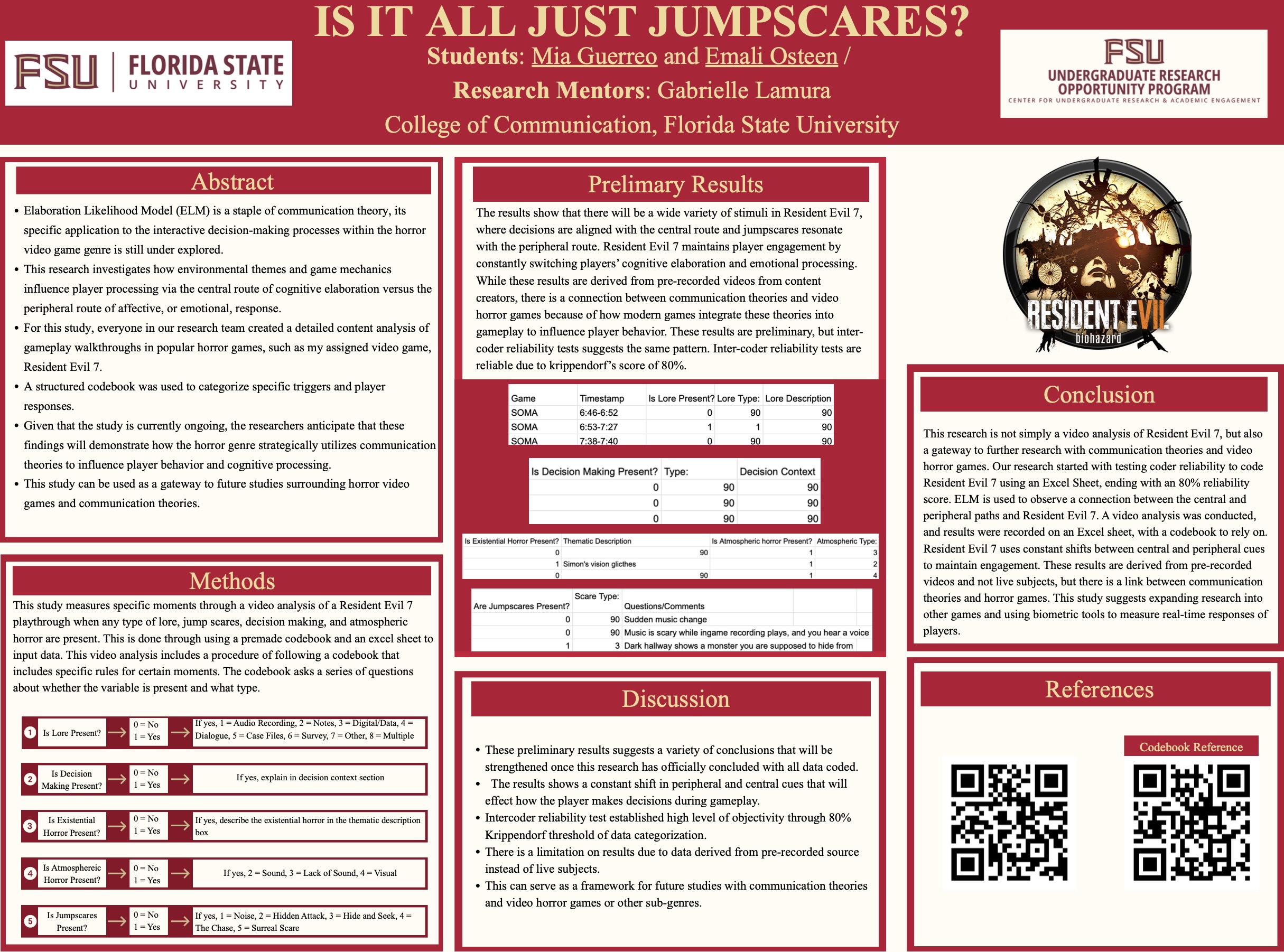
Mia Guerrero is a freshman at Florida State University pursuing a double major in Bachelor of Science in Economics and Bachelor of Science in Neuroscience. Driven by an interest in the intersection of biological processes and behavioral outcomes, they are currently conducting undergraduate research through the Undergraduate Research Opportunity Program (UROP). Their current research focuses on the mechanics of decision-making within high-stress environments, specifically using horror video games like Resident Evil 7 and Soma as controlled environments to analyze cognitive processing and player choices. Under the guidance of their faculty mentor, Gabrielle Lamura, Mia is investigating how environmental stressors and narrative changes in these video games activate central versus peripheral processes. This work will be featured at the 26th Annual Undergraduate Research Symposium in April 2026. Outside of the lab and classroom, Mia is a competitive swimmer on the FSU club team and the creator of The Balance Edit, a health and wellness blog dedicated to holistic student living. They are also active in the FSU community through many clubs, like Champs Chance and the pre-medical society. Following their undergraduate studies, Mia intends to apply to medical school, aiming to bridge their background in economic systems and neuroscience to improve patient care and the healthcare system.
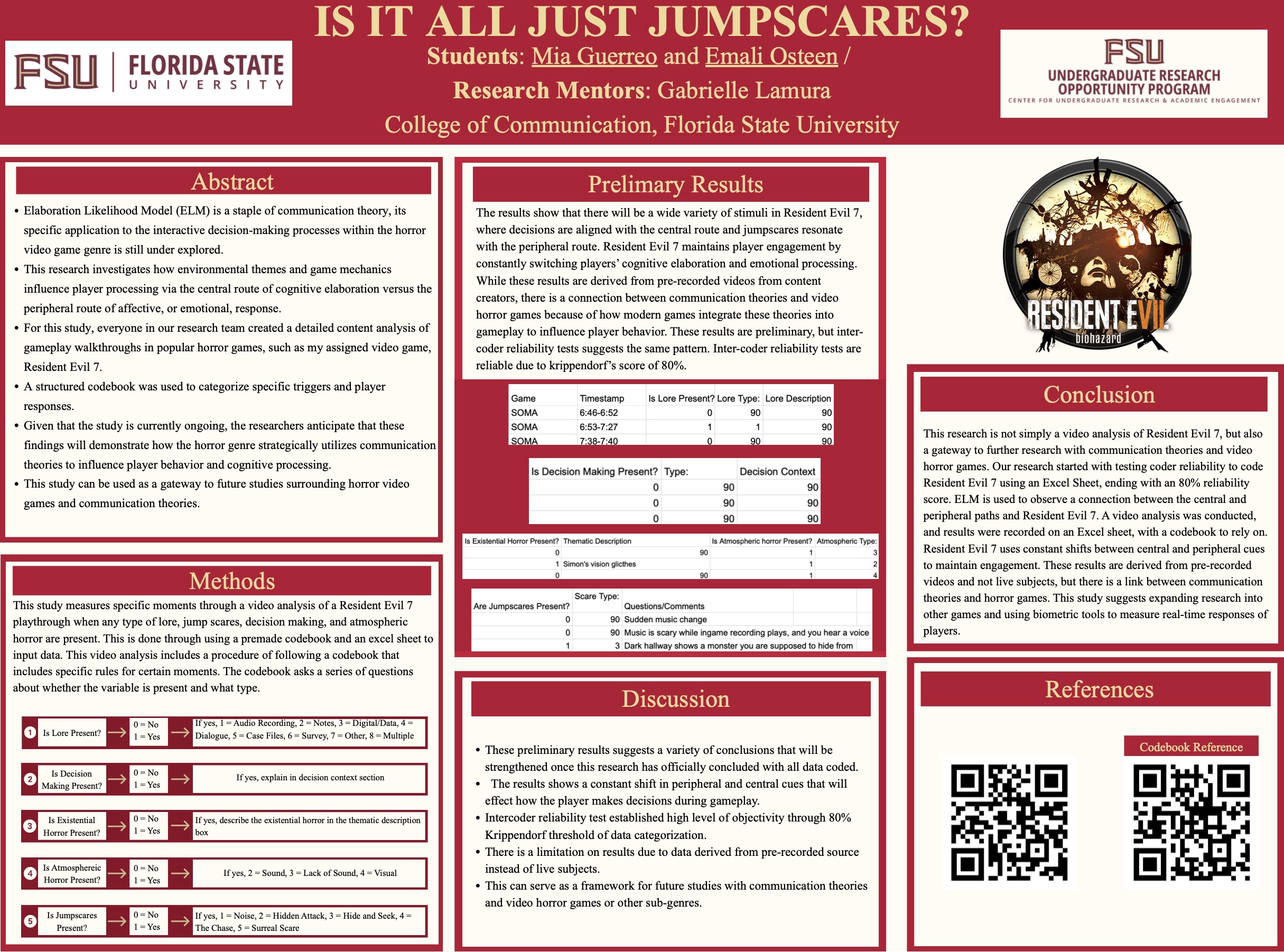
Is it all just Jumpscares?
Authors: Mia Guerrero, Gabrielle LamuraStudent Major: Economics and Neuroscience
Mentor: Gabrielle Lamura
Mentor's Department: Communications Mentor's College: College of Communication Co-Presenters: Emali Osteen
Abstract
While the Elaboration Likelihood Model (ELM) is a staple of communication theory, its specific application to the interactive decision-making processes within the horror video game genre is still underexplored. This research investigates how environmental themes and game mechanics influence player processing via the central route of cognitive elaboration versus the peripheral route of affective, or emotional, response. For this study, everyone in our research team created a detailed content analysis of gameplay walkthroughs in popular horror games, such as my assigned video game, Resident Evil 7. A structured codebook was used to categorize specific triggers and player responses. Objectivity in coding was maintained with an inter-coder reliability threshold of 80% to minimize bias. Building on previous research suggesting that horror environments use dual-processing cues, our study expects to find consistent integration of central and peripheral stimuli throughout gameplay and narrative arcs. Given that the study is currently ongoing, the researchers anticipate that these findings will demonstrate how the horror genre strategically utilizes communication theories to influence player behavior and cognitive processing. This study is expected to prove a connection between communication theories and horror video games because of their reliance on communication tactics. This study can be used as a gateway to future studies surrounding horror video games and communication theories.
Keywords: Horror, ELM Theory, Cognitive Processing, Player Decision-Making