
Research Symposium
26th annual Undergraduate Research Symposium, April 1, 2026
Kayra Serpenguzel Poster Session 1: 9:30 am - 10:30 am / Poster #119
BIO
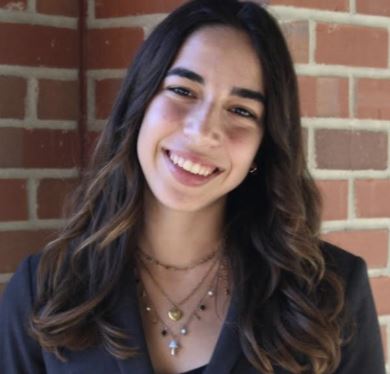
Kayra Serpenguzel is a Presidential and Benacquisto Scholar on the pre-law track pursuing a Bachelors of Science in Political Science and Creative Writing. Her on- and off-campus involvements include being a legislative intern at the Florida House of Representatives for Representative Rosenwald, an incoming class representative on the Presidential Scholars Executive Board, a journalist for the FSView & Florida Flambeau Views Section, a sailor on the FSU Sailing Team, an ambassador for the Student Alumni Association, a Women’s History Month Committee Member for the Women’s Student Union, a selected cohort member for the Freshman Leadership Institute, Seminoles Engaged in Politics, and Legislative Certification Program, an intern for genCLEO FSU, an Eco-Rep for FSU Sustainable Campus and a Senator-elect for the FSU Student Government Association.
When Gains Feel Like Losses: Exploring Zero-Sum Thinking in Immigration Policy and Public Opinion
Authors: Kayra Serpenguzel, Dr. Kai OuStudent Major: Political Science and Creative Writing
Mentor: Dr. Kai Ou
Mentor's Department: Political Science Mentor's College: College of Social Sciences and Public Policy Co-Presenters:
Abstract
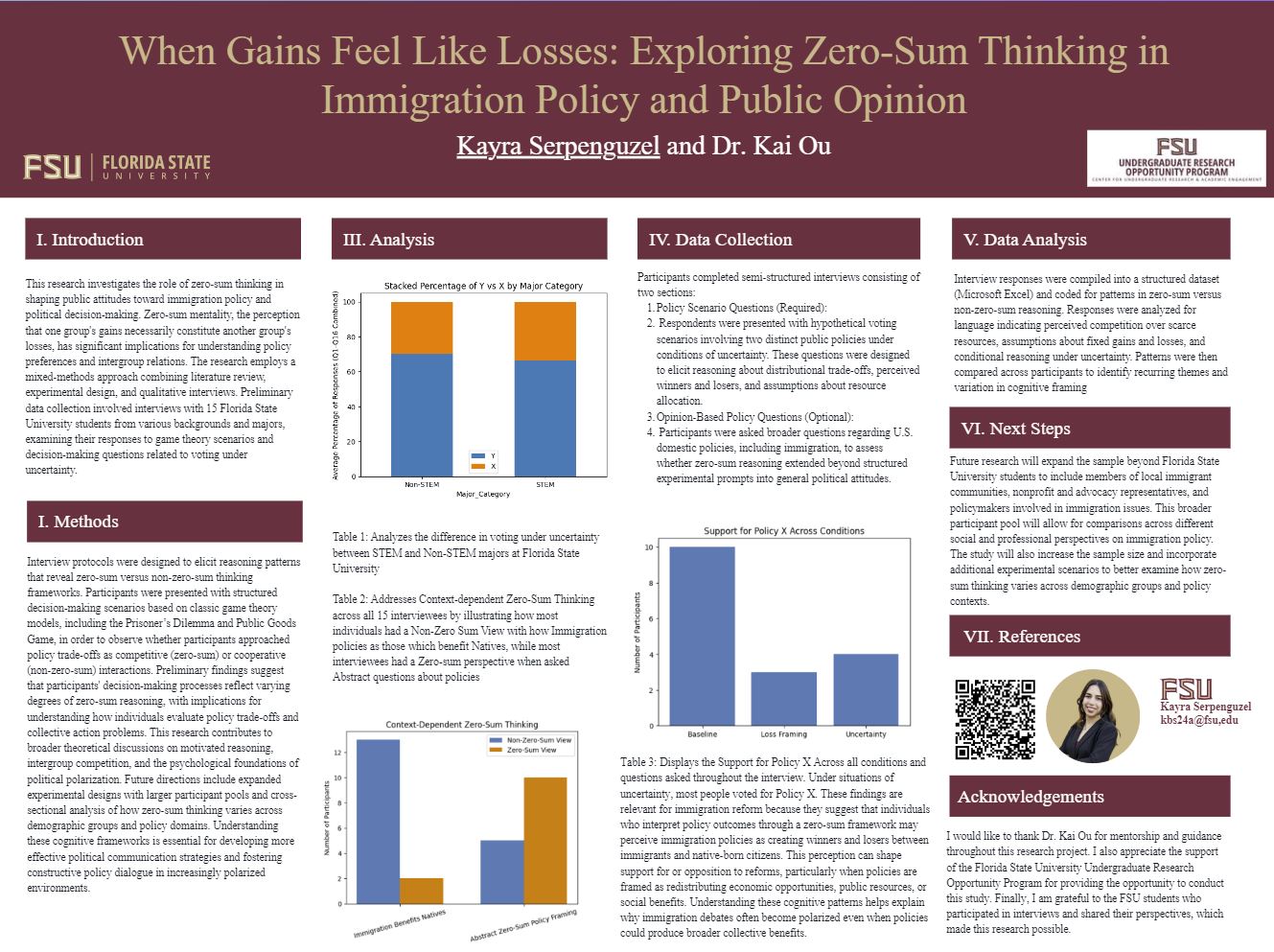
This research investigates the role of zero-sum thinking in shaping public attitudes toward immigration policy and political decision-making. Zero-sum mentality, the perception that one group's gains necessarily constitute another group's losses, has significant implications for understanding policy preferences and intergroup relations. Drawing on first-hand observations of divergent perspectives on immigration in Miami, where some view immigration as enriching diversity while others perceive primarily negative impacts, this study examines how zero-sum framing influences political attitudes across multiple domains. The research employs a mixed-methods approach combining literature review, experimental design, and qualitative interviews. Preliminary data collection involved interviews with 15 Florida State University students from various backgrounds and majors, examining their responses to game theory scenarios and decision-making questions related to voting under uncertainty. Interview protocols were designed to elicit reasoning patterns that reveal zero-sum versus non-zero-sum thinking frameworks. Preliminary findings suggest that participants' decision-making processes reflect varying degrees of zero-sum reasoning, with implications for understanding how individuals evaluate policy trade-offs and collective action problems. This research contributes to broader theoretical discussions on motivated reasoning, intergroup competition, and the psychological foundations of political polarization. Future directions include expanded experimental designs with larger participant pools and cross-sectional analysis of how zero-sum thinking varies across demographic groups and policy domains. Understanding these cognitive frameworks is essential for developing more effective political communication strategies and fostering constructive policy dialogue in increasingly polarized environments.
Keywords: zero-sum thinking, public policy, game theory, politics