
Research Symposium
26th annual Undergraduate Research Symposium, April 1, 2026
Grayson Russell Poster Session 4: 3:00 pm - 4:00 pm / Poster #288

BIO
Grayson Russell is a first-year FSU student in the Honors program, pursuing a double major in linguistics and philosophy. He is involved with the undergraduate linguistics students club, LINGO, at FSU. He plans to go to graduate school for a PhD in linguistics in the future.
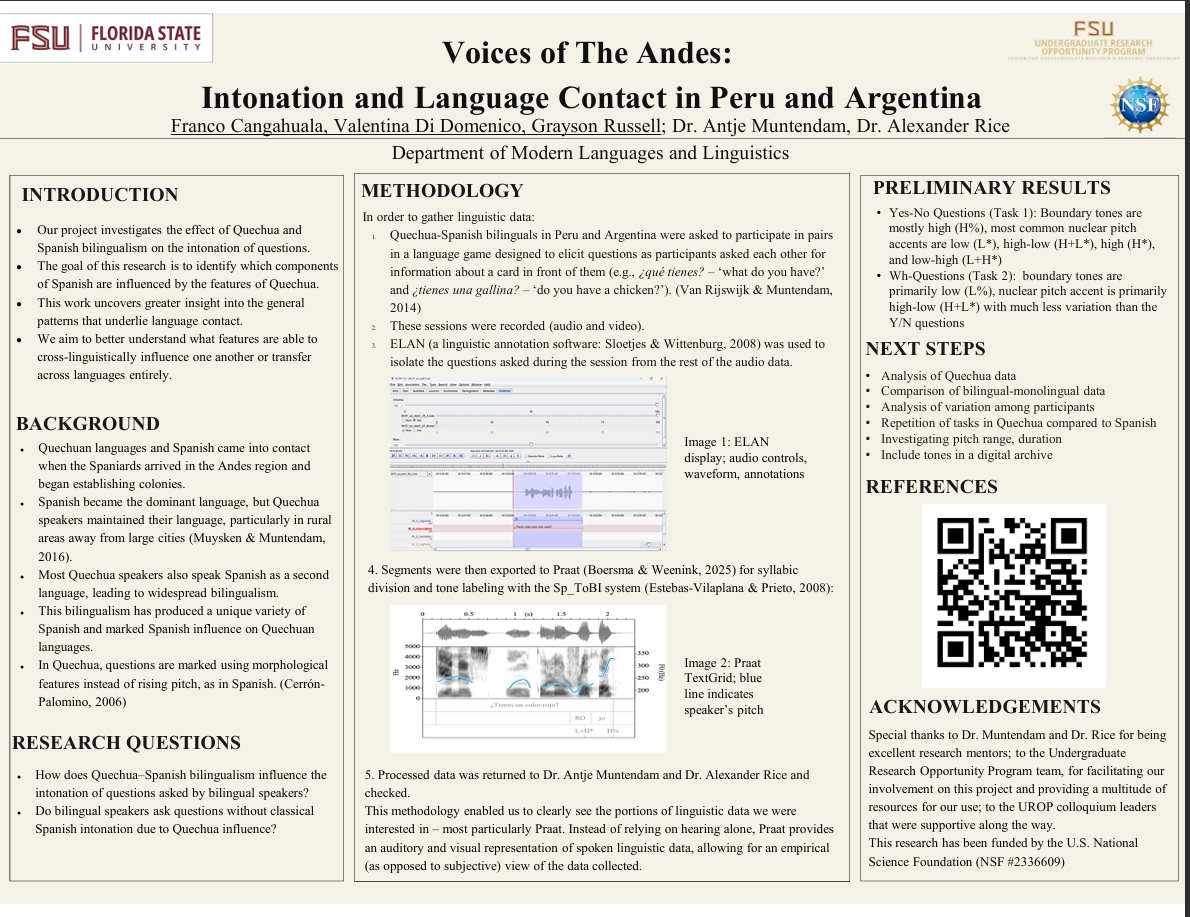
Voices of The Andes: Intonation and Language Contact in Peru and Argentina
Authors: Grayson Russell, Dr. Antje MuntendamStudent Major: Linguistics, Philosophy
Mentor: Dr. Antje Muntendam
Mentor's Department: Department of Modern Languages and Linguistics Mentor's College: College of Arts and Sciences Co-Presenters: Valentina Di Domenico, Franco Cangahuala
Abstract
In our project, we investigated the effect of Quechua-Spanish bilingualism on the intonation of questions elicited from participants fluent in both Quechua and Spanish in Peru and Argentina. The goal of this research is to identify which components of one language, in this case Spanish, are influenced by the features of another language, in this case Quechua, a language which greatly differs in aspects of morphology and phonology. In conducting this research, we uncover greater insight into the general patterns which underlie language contact and better understand what features are able to cross-linguistically influence one another, or even transfer across languages entirely. To investigate this topic we collected audio recordings of Peruvian and Argentinian people who were Spanish monolinguals, Quechua monolinguals, and bilinguals. Participants were paired and played a card game designed to elicit yes-no and information-seeking questions. These recordings were segmented, annotated, and analyzed using the programs Praat (acoustic analysis) and ELAN (annotation software) to study the intonation at the end of the questions asked by participants. It is known that in Quechua, questions are marked using morphological features instead of with a rising pitch, as in Spanish. Therefore, we predict that those who are most influenced by Quechua (bilingual speakers) will ask questions with falling intonation in Spanish. Results of this study may have implications for what we know about culture and language dominance in a post-colonial context, and what effects these deviances in language have on personal or community differentiation.
Keywords: Linguistics, Bilingualism, Intonation, Spanish, Quechua