
Research Symposium
26th annual Undergraduate Research Symposium, April 1, 2026
Charlotte Brown Poster Session 2: 10:45 am - 11:45 am / Poster #68

BIO
Charlotte Brown is a first-year Student and Presidential Scholar at Florida State University, where she is pursuing a degree in Civil Engineering with a minor in Art Entrepreneurship. Deeply committed to environmental advocacy, Charlotte serves as the Sustainability Coordinator for the Student Government Association. In this role, and through various diversity-focused initiatives, she is laying the groundwork for a future career in environmental consulting following her graduation in 2029.
Modeling the Transport of Microplastics Through the Floridan Aquifer System
Authors: Charlotte Brown, Jeffrey FarnerStudent Major: Civil Engineering
Mentor: Jeffrey Farner
Mentor's Department: Civil and Environmental Engineering Mentor's College: College of Engineering Co-Presenters:
Abstract
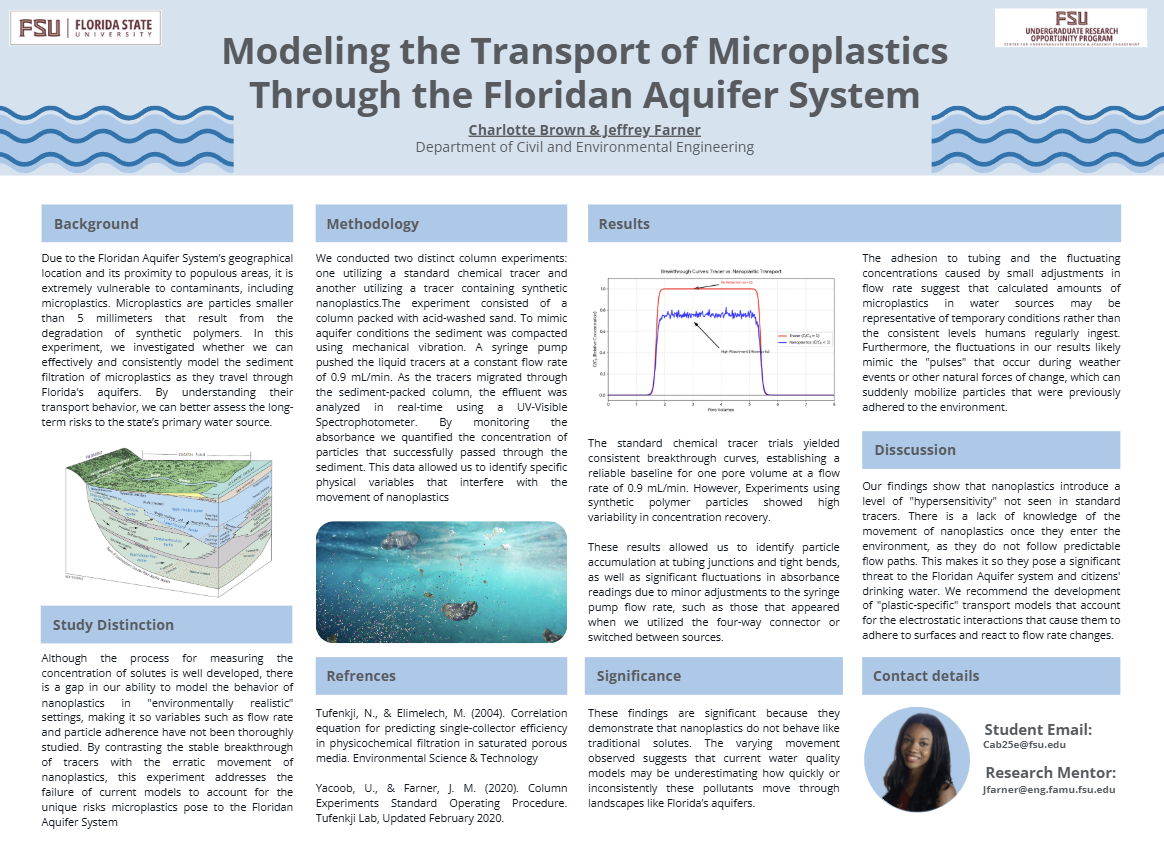
The Floridan Aquifer System provides 90% of Florida’s drinking water. However, due to its geographical location, it is extremely vulnerable to contaminants, including microplastics. Microplastics are particles smaller than 5 millimeters that result from the degradation of synthetic polymers. In this experiment, we investigated whether we can effectively and consistently model the sediment filtration of microplastics as they travel through Florida's aquifers. By understanding their transport behavior, we can better assess the risks to the state’s water source. To achieve this, we conducted column experiments where a liquid tracer containing microplastics was passed through a sediment-packed column. Utilizing a UV-Visible Spectrometer, we analyzed the microplastics that successfully passed through the sediment. This data allowed us to evaluate the efficacy of our experimental design and identify possible variables that interfere with the movement of microplastics. While we researched consistent results with standard chemical tracers, the microplastic trials showed lower consistency. This inconsistency demonstrates the unique physical properties of microplastics, such as their microscopic size, causing them to adhere to tubing, or their hypersensitivity to changes in flow rate. These findings demonstrate that microplastics do not behave like traditional solutes found in drinking water. The difficulty in consistently modeling microplastic movement underscores the lack of control humans have over these particles once they enter the environment, causing them to pose a significant risk to public safety. This research emphasizes the urgent need for research concerning water quality to protect citizens in Florida and across the country from microplastics and their potential hazards.
Keywords: Civil Engineering, Sustainability, Microplastic