
Research Symposium
26th annual Undergraduate Research Symposium, April 1, 2026
Diego Llaverias Poster Session 1: 9:30 am - 10:30 am / Poster #75
BIO
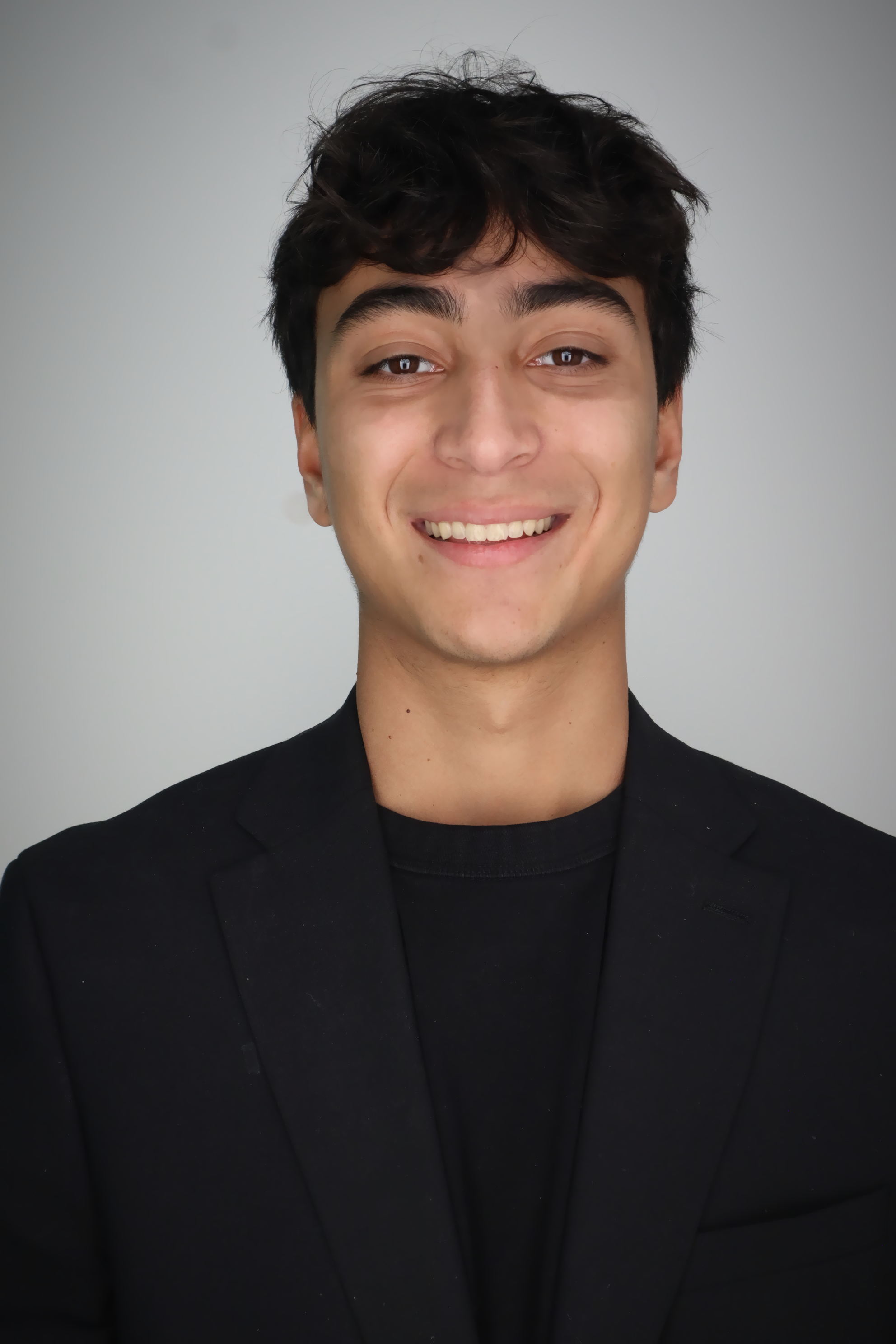
Diego Llaverias is a sophomore at Florida State University pursuing a Bachelor of Science in Biomedical Engineering. His academic interests center on the intersection of engineering, medicine, and technology, with a particular focus on the development of prosthetics, biomedical implants, and biomimetic medical devices that improve patient outcomes and quality of life.
Diego is actively involved in undergraduate research exploring biomimetic robotics and machine learning applications in aquatic locomotion. His work focuses on designing and testing fish-inspired robotic systems using computer-aided simulations and experimental facilities to study efficient and agile movement in water. Through this research, he has gained experience in engineering design, computational modeling, and interdisciplinary collaboration while working alongside faculty mentors and fellow researchers in the biomedical engineering department.
In addition to his academic and research work, Diego gained clinical experience working as a medical assistant at a Hand and Wrist Institute, where he assisted with patient care and clinic operations. Through this role, he developed strong patient interaction and clinical support skills and discovered a passion for helping people through healthcare.
After completing his Bachelor of Science in Biomedical Engineering, Diego plans to pursue a Master of Business Administration (MBA). He hopes to combine engineering expertise with business and leadership skills to contribute to the development and commercialization of innovative medical technologies, particularly in the fields of prosthetics and biomedical implants.
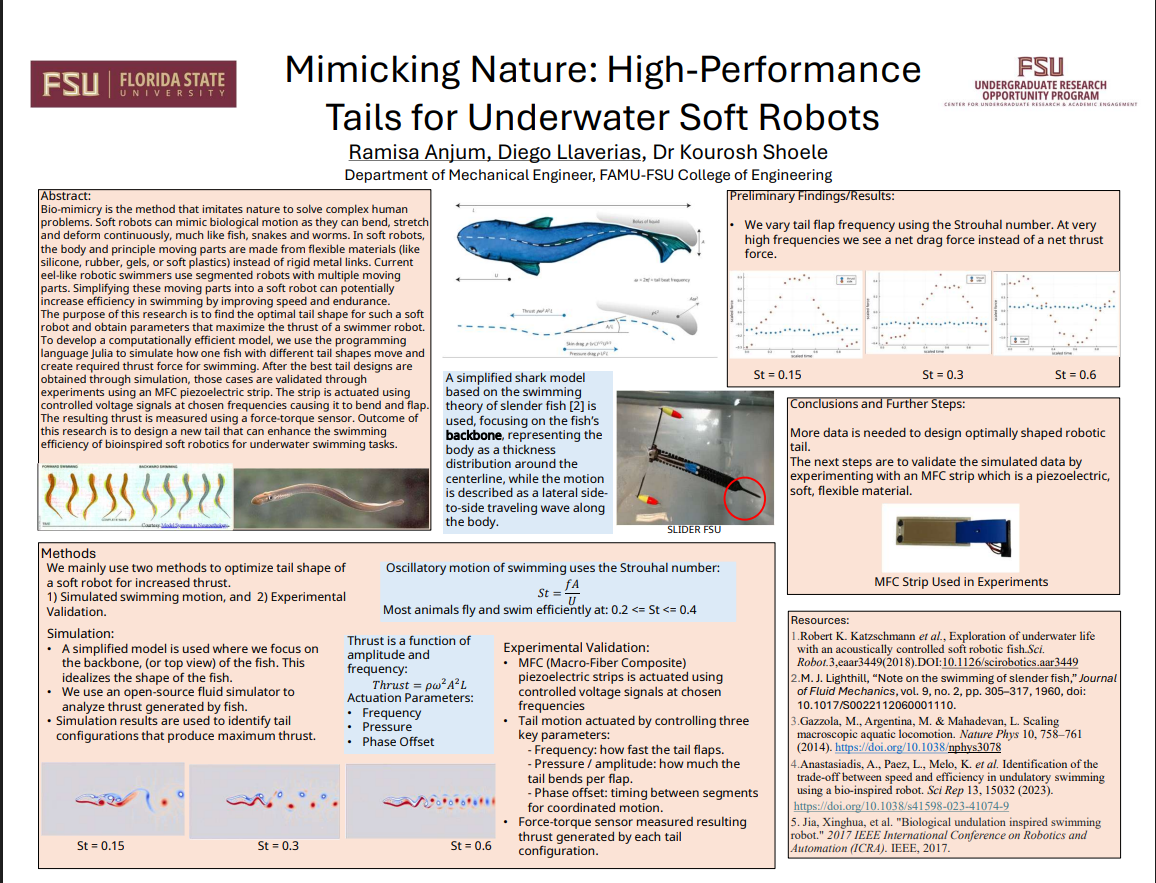
Mimicking Nature: High-Performance Tails for Underwater Soft Robots
Authors: Diego Llaverias, Dr. Kourosh ShoeleStudent Major: Biomedical Engineering
Mentor: Dr. Kourosh Shoele
Mentor's Department: Mechanical Engineering Mentor's College: FAMU-FSU College of Engineering Co-Presenters: Ramisa Anjum
Abstract
Bio-mimicry is the method that imitates nature to solve complex human
problems. Soft robots can mimic biological motion as they can bend, stretch
and deform continuously, much like fish, snakes and worms. In soft robots,
the body and principle moving parts are made from flexible materials (like
silicone, rubber, gels, or soft plastics) instead of rigid metal links. Current
eel-like robotic swimmers use segmented robots with multiple moving
parts. Simplifying these moving parts into a soft robot can potentially
increase efficiency in swimming by improving speed and endurance.
The purpose of this research is to find the optimal tail shape for such a soft
robot and obtain parameters that maximize the thrust of a swimmer robot.
To develop a computationally efficient model, we use the programming
language Julia to simulate how one fish with different tail shapes move and
create required thrust force for swimming. After the best tail designs are
obtained through simulation, those cases are validated through
experiments using an MFC piezoelectric strip. The strip is actuated using
controlled voltage signals at chosen frequencies causing it to bend and flap.
The resulting thrust is measured using a force-torque sensor. Outcome of
this research is to design a new tail that can enhance the swimming
efficiency of bioinspired soft robotics for underwater swimming tasks.
Keywords: Robotics, Swimmers, Fluid Dynamics, Machine Learning