
Research Symposium
26th annual Undergraduate Research Symposium, April 1, 2026
Andrew Robinson Poster Session 1: 9:30 am - 10:30 am / Poster #141

BIO
Andrew Robinson is a pre-law student pursuing a degree in Economics. Outside of class he enjoys working at FSU Rec, hiking, writing and reading.
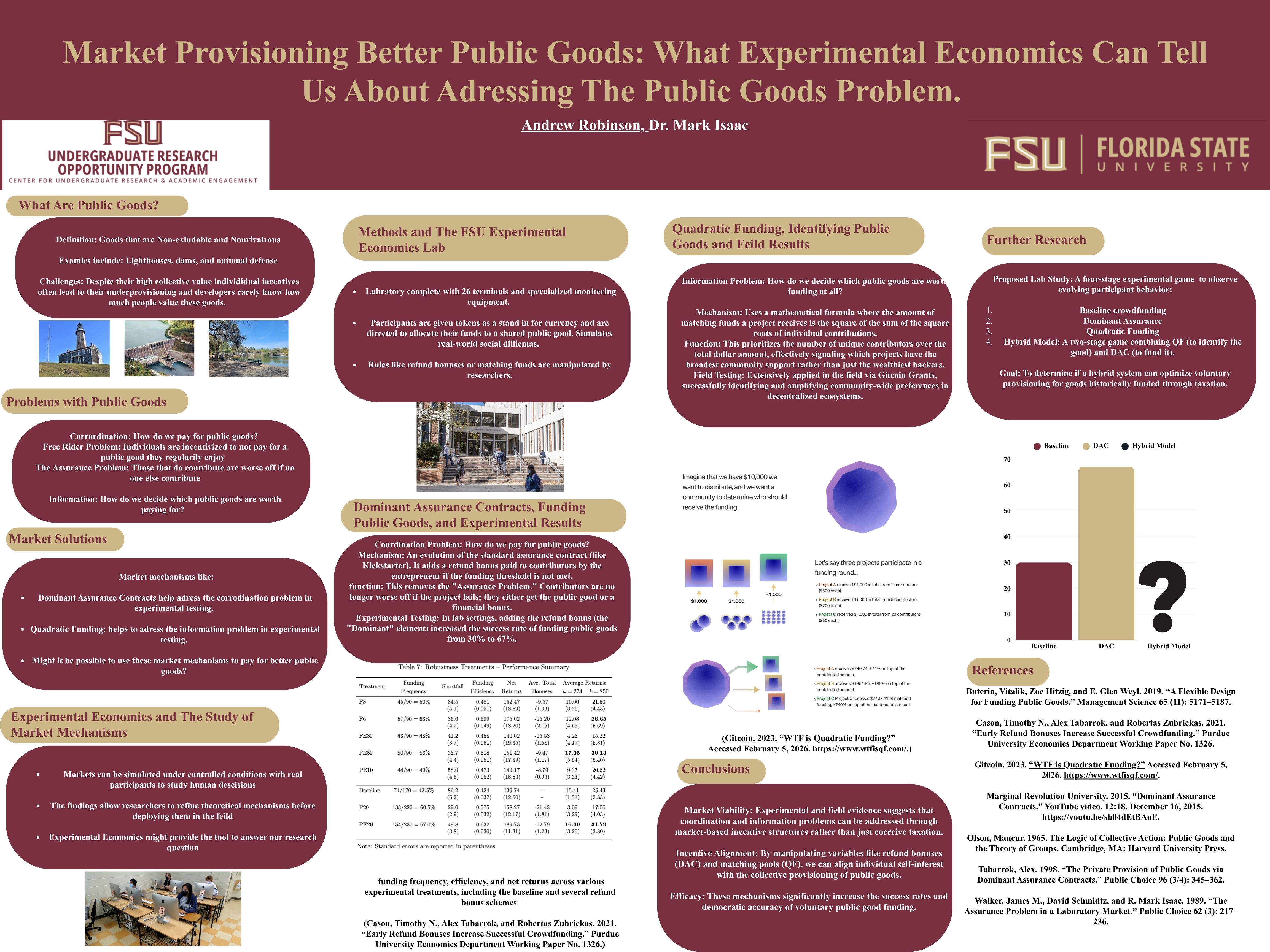
Market Provisioning Better Public Goods: What Experimental Economics Can Tell Us About Addressing The Public Good Problem.
Authors: Andrew Robinson, Mark IsaacStudent Major: Economics
Mentor: Mark Isaac
Mentor's Department: Economics Mentor's College: College Of Social Science and Public Policy Co-Presenters:
Abstract
Public goods like lighthouses, public parks and national defense are notoriously
difficult to fund through private voluntary contributions. Public goods fall prey to problems
of coordination and problems of information. However, theoretical mechanisms like
Dominant assurance contracts and quadratic funding attempt to address these problems
with voluntary public goods (market) provisioning by changing the incentives present in the
market provisioning of these goods. These theoretical considerations reveal the following
questions: Is it possible to solve both the coordination problem and the information
problem by manipulating market incentives and side-stepping coercive measures for
provisioning public goods (taxes)? What can experimental economics tell us about this
question? Experimental evidence shows that Dominant Assurance Contracts increase
successful market provisioning even from basic assurance contract systems. Field
evidence shows that quadratic funding is a viable way to address the information problems
inherent to choosing a public good to fund. It may be possible that a hybrid system
(matching funds and Dominant Assurance Contracts) allows for the optimal voluntary
provisioning of public goods, previously funded through coercion (taxation).
Keywords: Economics, Public Goods, Market Design