
Research Symposium
26th annual Undergraduate Research Symposium, April 1, 2026
Andrew Somerset Poster Session 1: 9:30 am - 10:30 am / Poster #219

BIO
Andrew Somerset is a sophomore Industrial Engineering major at Florida State University. He is interested in AI/ML entrepreneurship and enjoys basketball, weightlifting, and travel.
Machine Learning-Based Defect Detection in Laser Powder Bed Fusion Additive Manufacturing
Authors: Andrew Somerset, Dr. Xinyao ZhangStudent Major: Industrial Engineering
Mentor: Dr. Xinyao Zhang
Mentor's Department: Industrial Engineering Mentor's College: College of Engineering Co-Presenters:
Abstract
Machine Learning-Based Defect Detection in Laser Powder Bed Fusion Additive Manufacturing
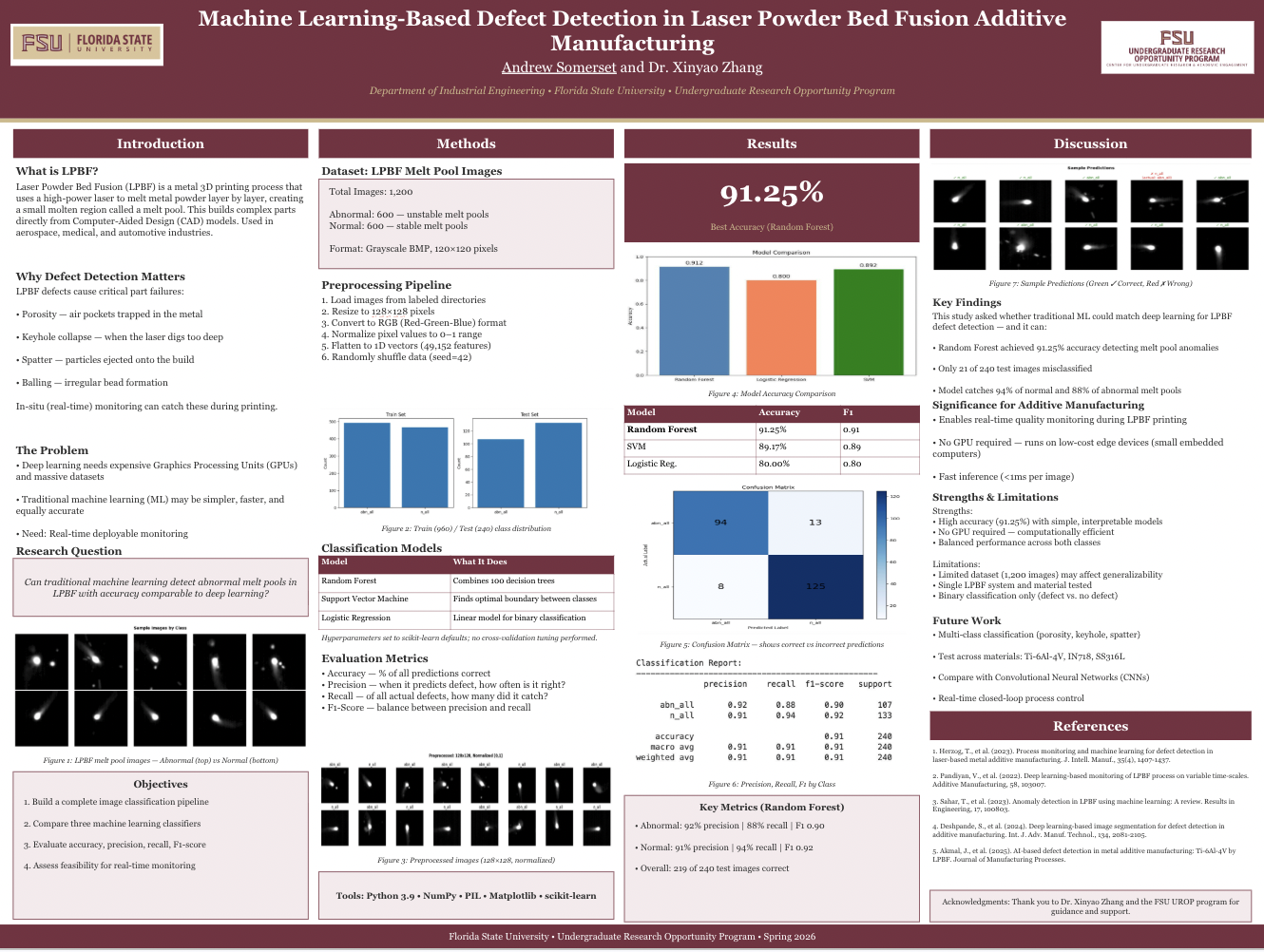
Background: Laser Powder Bed Fusion (LPBF) is a metal 3D printing process used in aerospace, medical, and automotive industries. Defects such as porosity, keyhole collapse, and spatter can compromise part integrity, making quality monitoring essential. While deep learning approaches show promise, they require expensive Graphics Processing Units (GPUs) and large datasets. This research investigates whether traditional machine learning classifiers can effectively detect melt pool anomalies in LPBF images.
Methods: A dataset of 1,200 grayscale melt pool images (600 normal, 600 abnormal) was preprocessed using Python. Images were resized to 128×128 pixels and normalized to a 0–1 range. Data was split 80/20 for training and testing. Three classifiers were compared: Random Forest, Support Vector Machine (SVM), and Logistic Regression. Performance was evaluated using accuracy, precision, recall, and F1-score.
Results: Random Forest achieved the highest accuracy at 91.25%, with 92% precision and 88% recall for anomaly detection. SVM reached 89.17% accuracy, while Logistic Regression achieved 80%. Only 21 of 240 test images were misclassified, with balanced performance across both classes.
Significance: Traditional machine learning can effectively automate LPBF defect detection without complex deep learning or GPU resources. This computationally efficient approach offers a practical solution for real-time, in-situ monitoring. Limitations include the small dataset size and a single material tested. Future work will explore multi-class defect classification, additional materials, and real-time closed-loop process control.
Keywords: Machine Learning, Smart Manufacturing, Artificial Intelligence, Python