
Research Symposium
26th annual Undergraduate Research Symposium, April 1, 2026
Veronika Gardulski Poster Session 3: 1:45 pm - 2:45 pm / Poster #129

BIO
Veronika is a junior studying Finance and plans to pursue graduate school to further her research career. Her academic work focuses on how global trade and labor markets affect real-world issues. Before joining the Undergraduate Research Opportunity Program (UROP), Veronika authored a paper on contemporary garment slavery, where she examined the economic and legal hurdles of keeping slave-made products out of the U.S. market. By looking at how these goods flow across borders, she highlighted the challenges of maintaining ethical standards in global trade. Through UROP, Veronika has turned her attention to the workforce gap in Turkey. Her project explores the mismatch between the jobs available and the people ready to fill them, offering a closer look at the economic factors shaping the country’s current labor landscape.
Veronika would like to give a special thanks to Dr. Amy Kowal for being an incredibly supportive mentor. She is excited to see her research help Dr. Kowal’s students create an exhibit for the Department of Anthropology, which will bring these global labor and trade issues to life for the campus community.
Unpacking the “Turkish Puzzle”: Drivers, Barriers, and the Economic Impact of Female Labor Force Participation
Authors: Veronika Gardulski, Dr. Amy KowalStudent Major: Finance
Mentor: Dr. Amy Kowal
Mentor's Department: Anthropology Mentor's College: College of Arts and Sciences Co-Presenters:
Abstract
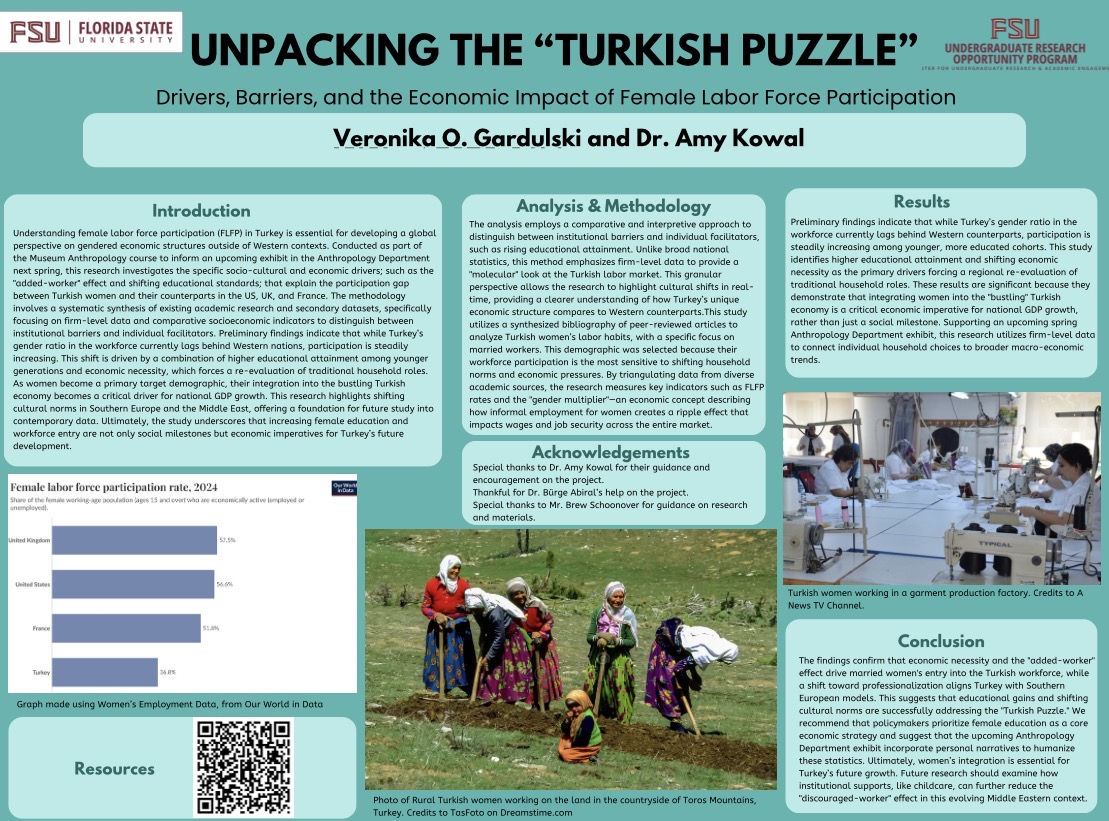
Understanding female labor force participation (FLFP) in Turkey is essential for developing a global perspective on gendered economic structures outside of Western contexts. Conducted as part of the Museum Anthropology course to inform an upcoming exhibit in the Anthropology Department next spring, this research investigates the specific socio-cultural and economic drivers; such as the "added-worker" effect and shifting educational standards; that explain the participation gap between Turkish women and their counterparts in the US, UK, and France. The methodology involves a systematic synthesis of existing academic research and secondary datasets, specifically focusing on firm-level data and comparative socioeconomic indicators to distinguish between institutional barriers and individual facilitators. Preliminary findings indicate that while Turkey’s gender ratio in the workforce currently lags behind Western nations, participation is steadily increasing. This shift is driven by a combination of higher educational attainment among younger generations and economic necessity, which forces a re-evaluation of traditional household roles. As women become a primary target demographic, their integration into the bustling Turkish economy becomes a critical driver for national GDP growth. This research highlights shifting cultural norms in Southern Europe and the Middle East, offering a foundation for future study into contemporary data. Ultimately, the study underscores that increasing female education and workforce entry are not only social milestones but economic imperatives for Turkey’s future development.
Keywords: Turkey, Women in the Workforce, Global Comparisons, Barriers to Employment, Economic Growth