
Research Symposium
26th annual Undergraduate Research Symposium, April 1, 2026
Tirza Savellano Poster Session 4: 3:00 pm - 4:00 pm / Poster #178

BIO
Tirza Savellano is a first-year student at Florida State University pursuing a Bachelor of Science in Public Health with a minor in Chemistry on the pre-medical track. Originally from Hanover, New Hampshire, she is a student in the Florida State University Honors College and is involved with Alpha Epsilon Delta Pre-Medical Honor Society and the Women’s Leadership Network within the College of Social Sciences and Public Policy.
Savellano serves as a research assistant under Casey D. Xavier Hall, Ph.D., M.P.H., at the Center of Population Sciences for Health Empowerment in the Florida State University College of Nursing. In this role, she contributes to a scoping review examining geospatial stigma at the neighborhood level and its influence on health outcomes. Her work includes conducting literature reviews, extracting and organizing data, and synthesizing findings to support peer-reviewed manuscripts. Through this experience, she has developed a growing interest in structural determinants of health, health disparities, and community-level influences on population health.
In July 2026, Savellano will participate in the Oxford Consortium for Human Rights at University of Oxford through the Honors College under the guidance of Honors faculty mentor Ross Moret, Ph.D. She will also conduct an original research project undergoing Institutional Review Board approval examining the reintegration of formerly incarcerated individuals into the workforce in Leon County, Florida, and its relationship to health outcomes.
Following graduation, Savellano plans to attend medical school and pursue a career integrating clinical medicine with public health approaches to advance equitable healthcare delivery.
Mapping Neighborhood-Level Stigma: A Scoping Review of Geospatial Approaches and Influences on Health
Authors: Tirza Savellano, Casey D. Xavier Hall, Ph.D., M.P.H.Student Major: Public Health
Mentor: Casey D. Xavier Hall, Ph.D., M.P.H.
Mentor's Department: Nursing Department Mentor's College: College of Nursing, Center of Population Sciences for Health Empowerment Co-Presenters: Kayla Gonzalez, Anthony Hernandez, Kendall Sampson, Victoria Sierra
Abstract
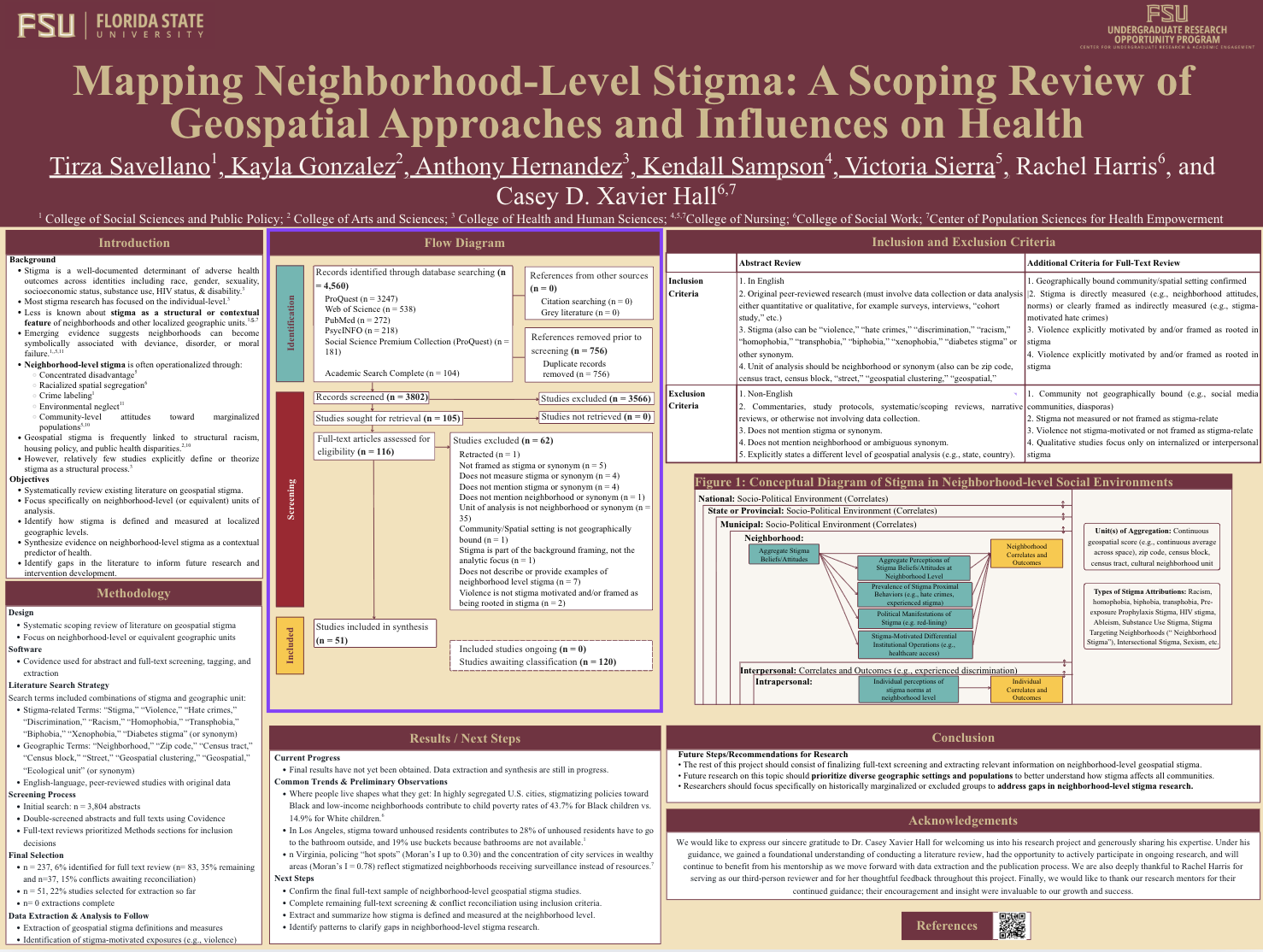
Stigma is a well-documented determinant of adverse health outcomes across diverse identities and lived experiences, including race, gender, sexuality, socioeconomic status, substance use, HIV status, and disability. While most stigma research focuses on individual-level experiences, less is known about stigma as a structural or contextual feature of neighborhoods and other localized geographic units. This project systematically reviews the literature on geospatial stigma, with emphasis on neighborhood-level units of analysis. Using Covidence, a comprehensive search yielded n=3,804 abstracts for screening. Each abstract was independently reviewed by two researchers using predefined inclusion and exclusion criteria, with disagreements resolved by a third reviewer. Eligible studies were published in English, involved original peer-reviewed research with data collection or analysis, explicitly addressed geospatial stigma or a related construct, and used a neighborhood-level (or equivalent) geospatial unit. Studies were excluded if they were non-English, lacked original data, did not address stigma, or focused on broader geographic levels (e.g., state or country). Preliminary screening identified n=237 (6.2%) full texts for review, of which 137 (57.8%) are quantitative; n=44 (18.6%) have been included in the dataset and n=130 (55.9%) remain under review. Early observations indicate that neighborhood-level stigma is commonly operationalized through concentrated disadvantage, racialized spatial segregation, crime labeling, environmental neglect, and community attitudes toward marginalized populations. Neighborhoods are often symbolically associated with deviance or disorder, contributing to disinvestment and reduced healthcare access. Upon completion, this review will synthesize evidence on neighborhood-level stigma and identify gaps, advancing understanding of geospatial stigma as a structural determinant of health.
Keywords: Neighborhood-Level Stigma, Geospatial Approaches, Scoping Review, Health Disparities, Social Determinants of Health