
Research Symposium
26th annual Undergraduate Research Symposium, April 1, 2026
Clarissa Bello Poster Session 3: 1:45 pm - 2:45 pm / Poster #249
BIO
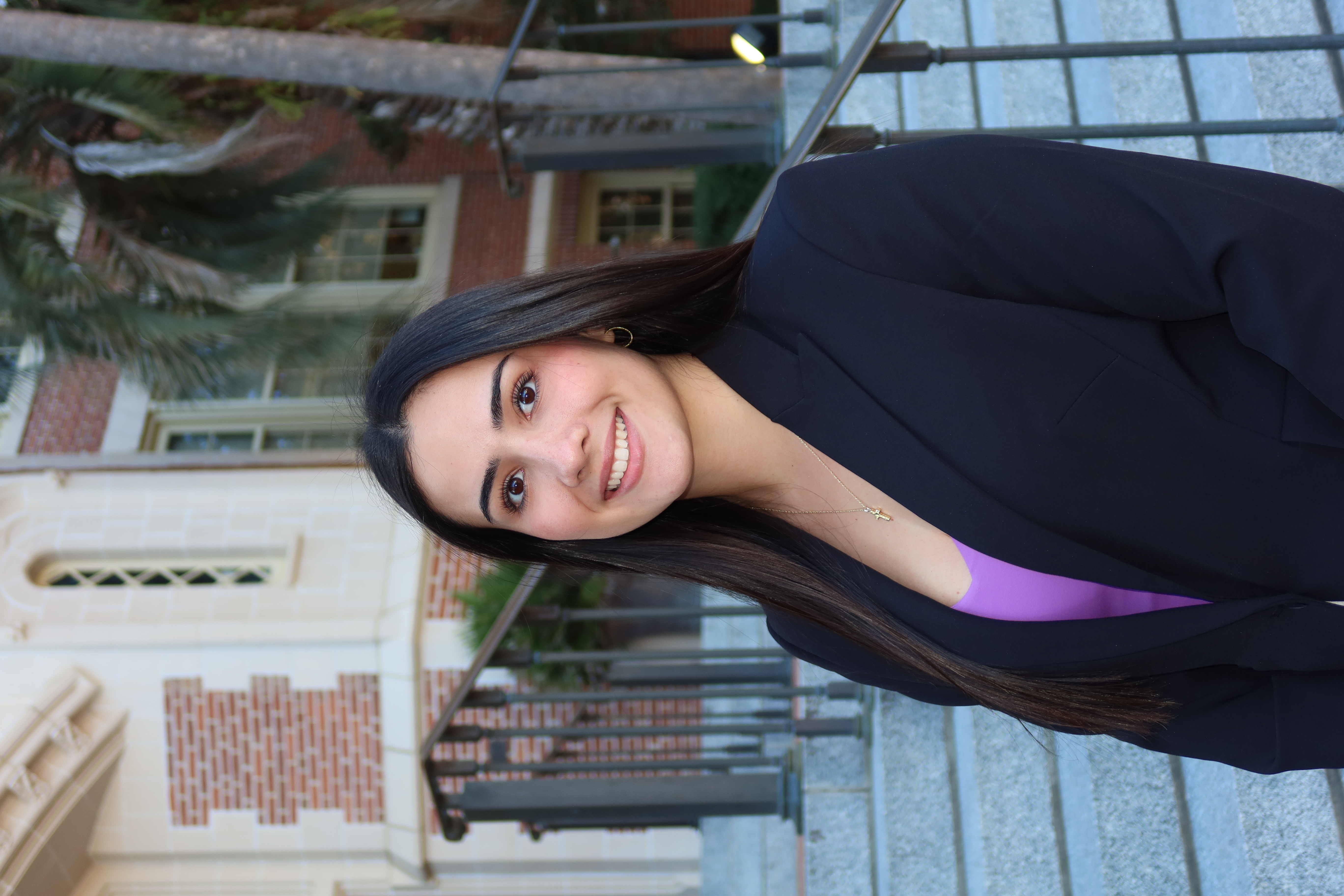
Clarissa Bello is a freshman pursuing a Bachelor of Science in Food and Nutrition Sciences. She is from Orlando, Florida, and is bilingual in Spanish. Clarissa has demonstrated strong academic achievement and has been recognized on the Dean’s List.
She has begun her research experience through the Undergraduate Research Opportunity Program (UROP), working as a research assistant under mentorship of Dr. Michael Lesser and Mrs. Rachel Flemming. This opportunity allowed her to begin exploring her interests and introduced her to the research process.
She is passionate in understanding how human behavior and psychological factors influence decision-making and relationships. These research interests correlate with her academic focus on nutritional health and future goals. Clarissa hopes to explore these interests through future research opportunities and mentorship.
Clarissa plans to attend dental school after completing her undergraduate studies. Her long-term goal is to become an orthodontist, where she can help patients with their oral health and confidence. She is driven to continue building a strong foundation in health sciences and gain hands-on experience that will prepare her for her career dedicated to helping others.
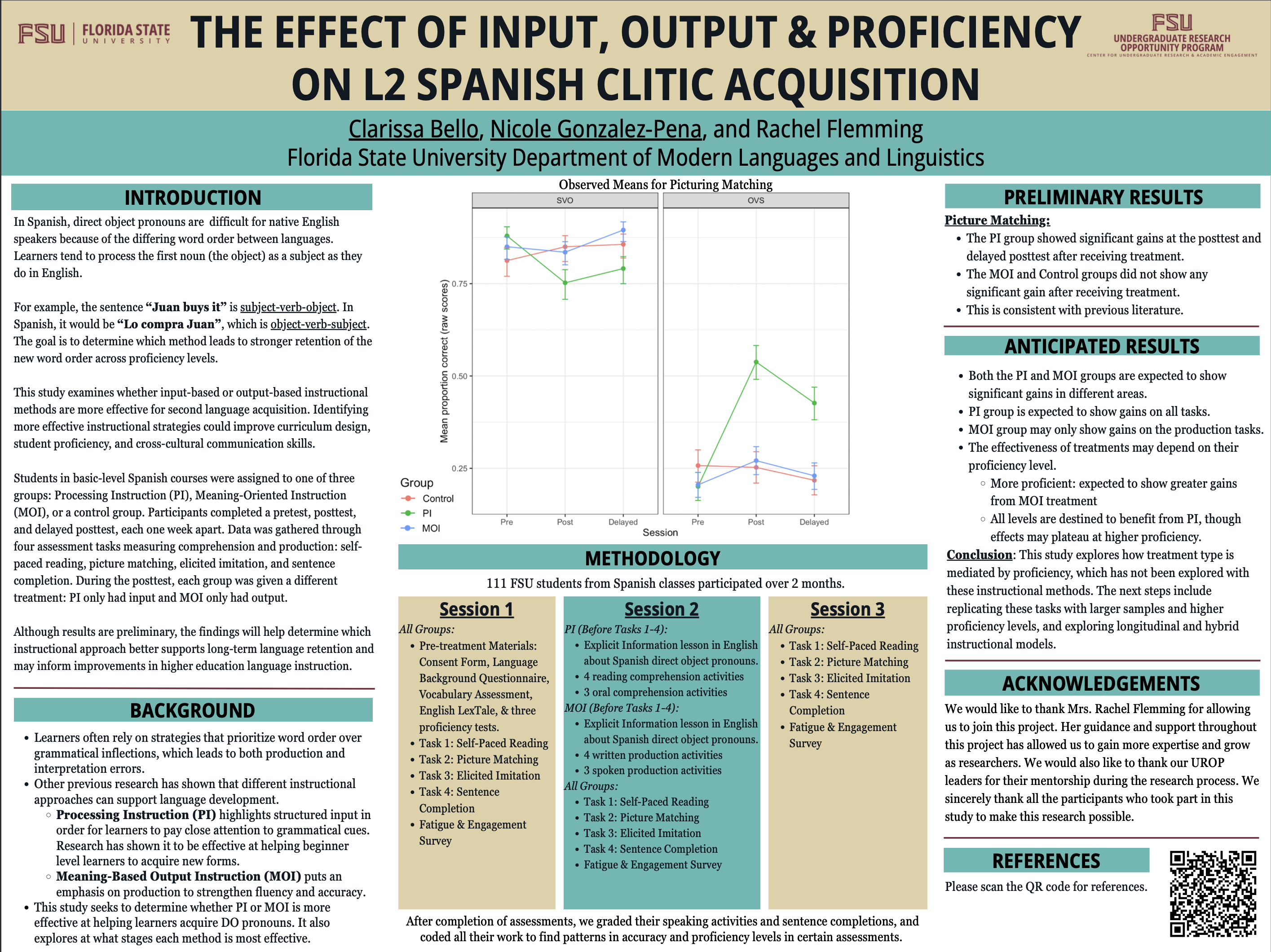
THE EFFECT OF INPUT, OUTPUT & PROFICIENCY ON L2 SPANISH CLITIC ACQUISITION
Authors: Clarissa Bello, Rachel FlemmingStudent Major: Food and Nutrition Sciences
Mentor: Rachel Flemming
Mentor's Department: Department of Modern Languages and Linguistics Mentor's College: College of Arts and Sciences Co-Presenters: Nicole Gonzalez-Pena
Abstract
Second language learners have presented a significant challenge in learning grammatical structures. This is especially present when native English speakers learn Spanish because grammatical orders in sentences differ. Spanish direct object pronouns are also difficult for learners because they must process meaning and grammatical forms at the same time.
Understanding how learners acquire Spanish grammatical forms is crucial for improving instructional methods. Prior research has shown that Processing Instruction (PI) and Meaning-Based Output Instruction (MOI) support the acquisition differently, but their effectiveness is still unclear. College students enrolled in basic-level Spanish courses were
assigned to 1 of 3 groups: PI, MOI, or a control group. Each group completed a pretest, posttest, and delayed posttest, each test being exactly 1 week apart from the previous. Data was collected using 4 assessment tasks which measured comprehension and sentence production: self-paced reading, picture matching, elicited imitation, and sentence completion. Data analysis and final results for this study are still in progress and not available yet. The analyses will compare and score participant’s performances amongst all tasks and proficiency levels. Results will help determine the effectiveness of PI and MOI, and evaluate the teaching methods used in the classroom and instructional effects vary depending on proficiency levels. These findings have the potential to identify strategies that help create methods to further support second language learner comprehension. Further research can examine the long-term retention of instructional effects. Overall, this research emphasizes the importance of aligning proficiency levels with specific instructional methods for second language learners.
Keywords: Processing Instruction, Meaning-Oriented, Spanish