
Research Symposium
26th annual Undergraduate Research Symposium, April 1, 2026
Cole Robinson Poster Session 4: 3:00 pm - 4:00 pm / Poster #306
BIO
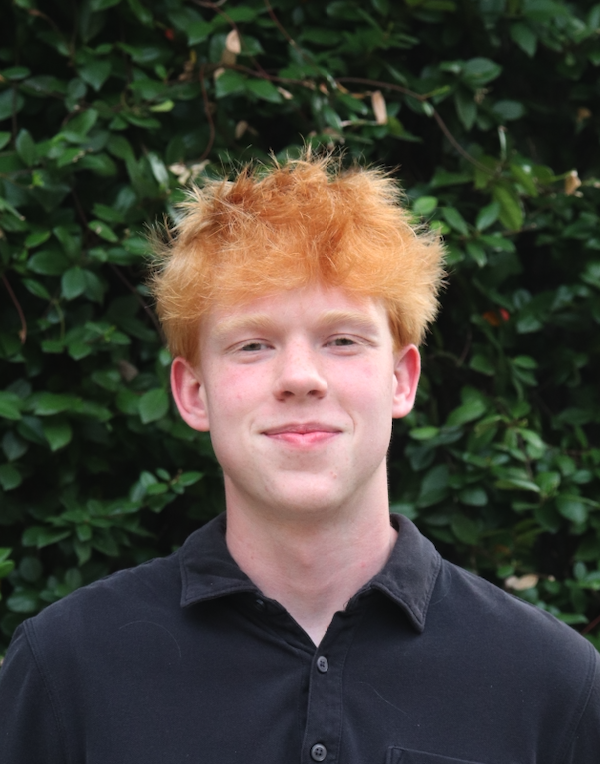
Cole Robinson is a first-year Presidential Scholar pursuing a Bachelor of Science in Environmental Science & Policy and a Bachelor of Science in Economics, along with a minor in English. Throughout his first year, he has worked with Neda Mobasher in the Atwood Lab, conducting coral geochemistry and paleoclimatology research to better understand the behavior of climate systems in the eastern equatorial Pacific. Beyond his research, he serves as a campus tour guide for the Torch Society, a member of the Presidential Scholars Education and Unity Board, and a member of Together Tallahassee's Transportation/Verification team. In the future, he hopes to further his education in a graduate program.
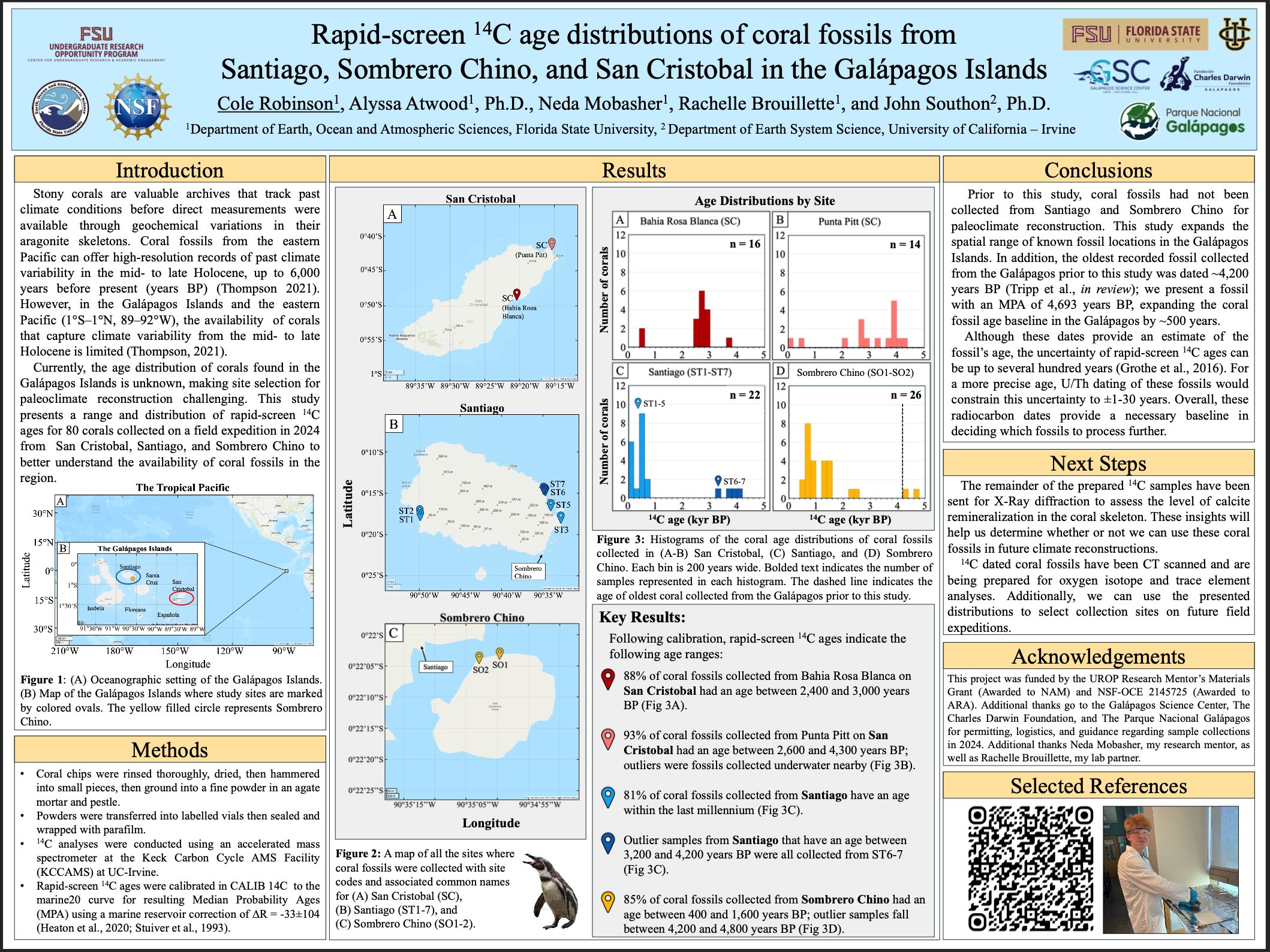
Rapid-screen 14C age distributions of coral fossils from Santiago, Sombrero Chino, and San Cristobal in the Galápagos Islands
Authors: Cole Robinson, Neda MobasherStudent Major: Environmental Science & Policy and Economics
Mentor: Neda Mobasher
Mentor's Department: Earth, Ocean and Atmospheric Sciences Mentor's College: Florida State University Co-Presenters:
Abstract
Scleractinian “stony” corals provide a detailed record of past climate and ocean conditions because of their well-preserved skeletal structure, in which geochemical variations reflect changes in their environmental conditions. Corals from the eastern equatorial Pacific are especially useful for reconstructing past climate and for understanding how climate variability has evolved over the mid-to-late Holocene, 0-5,000 years before present (yr BP). This study presents a range and distribution of rapid-screen 14C ages for corals from San Cristóbal, Sombrero Chino, and Santiago to better understand the availability of coral fossils in the Galápagos Islands.
Approximately 80 corals were analyzed to reconstruct their geologic ages and spatial distribution throughout the Galápagos Islands. Coral chips were drilled, cleaned, and ground into a fine powder using a mortar and pestle on a clean, aluminum-foil-covered surface. Prepared samples were run on an accelerated mass spectrometer at the Keck Carbon Cycle AMS Facility (KCCAMS) at UC-Irvine, then sent for X-ray diffraction to determine the percentage of calcite in the coral skeleton. Raw 14C ages were calibrated in the CALIB 14C Calibration Program to the marine20 calibration curve. San Cristóbal corals were calibrated to a median probability age between 2,500 and 4,200 yr BP, Santiago corals within 1,000 yr BP, and Sombrero Chino corals within 1,500 yr BP or between 4,000 and 4,800 yr BP. Mapping the distributions presented in this research can help accurately pinpoint areas for generating climate reconstructions and increase understanding of the age baseline for available coral fossils in the Galápagos Islands.
Keywords: ocean, corals, fossils, climate, radiocarbon, paleoclimate