
Research Symposium
26th annual Undergraduate Research Symposium, April 1, 2026
Kelsey Gregson Poster Session 4: 3:00 pm - 4:00 pm / Poster #160

BIO
Kelsey Gregson is a first year Honors student at Florida State University double majoring in Environmental Science and Biological Science. She hopes to pursue a career in marine conservation.
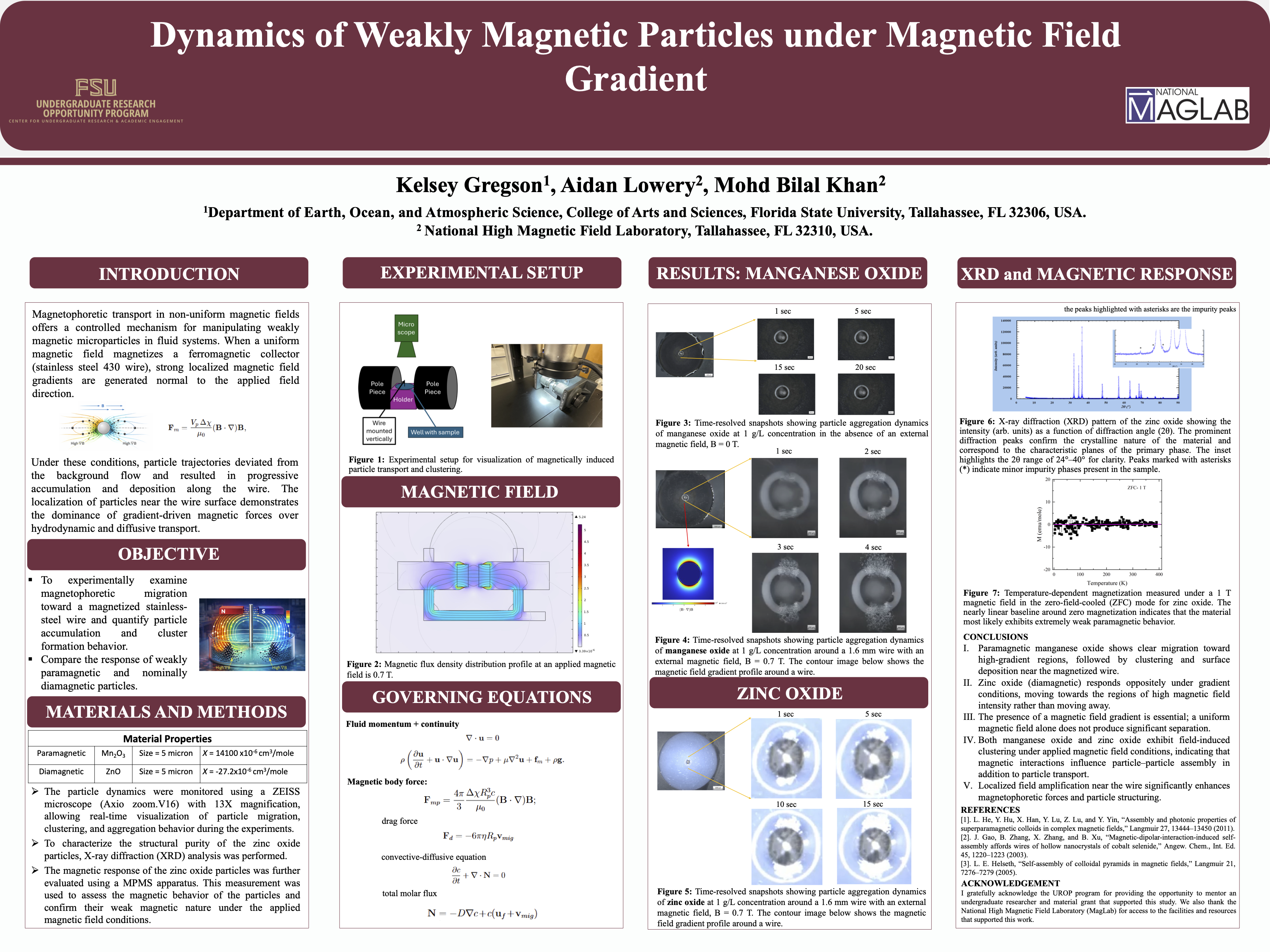
Dynamics of Weakly Magnetic Particles under Magnetic Field Gradient
Authors: Kelsey Gregson, Mohd Bilal KhanStudent Major: Environmental Science, Biological Science
Mentor: Mohd Bilal Khan
Mentor's Department: National High Magnetic Field Laboratory Mentor's College: College of Engineering Co-Presenters:
Abstract
Magnetic separation is widely applied in biotechnology, environmental remediation, and
resource recovery. In magnetophoresis, particles migrate under a magnetic field gradient;
however, interparticle interactions can promote clustering during separation. High-gradient
magnetic separation (HGMS) systems commonly use magnetizable wire matrices to
generate strong localized field gradients for particle capture. Given the central role of wires
in such systems, this study examines the dynamics of weakly magnetic microparticles
around a single magnetized wire, focusing on particle migration, clustering, and deposition
behavior.
Experiments were conducted in 3D-printed cylindrical chambers containing centrally
positioned steel wires of varying diameters, placed between the poles of a permanent
magnet. Suspensions of paramagnetic manganese oxide and diamagnetic zinc oxide
microparticles (0.1–1 g/L) in water–polyethylene glycol mixtures were introduced into the
chambers, and particle behavior was monitored using optical microscopy. Paramagnetic
manganese oxide particles migrated toward regions of high magnetic field gradient, moving
toward the magnetized wire and forming deposits along its surface and near chamber
boundaries. Cluster formation accompanied this gradient-driven accumulation. In contrast,
diamagnetic zinc oxide particles were expected to be repelled from the high-gradient region.
However, they unexpectedly formed deposits along the wire surface where the magnetic
field gradient was strongest.
These results highlight the complex interplay between magnetic forces, particle–particle
interactions, and surface effects in wire-based HGMS systems and provide insight into the
separation behavior of weakly magnetic particles under high-gradient conditions.
Keywords: magnetism, particle dynamics, water filtration