
Research Symposium
26th annual Undergraduate Research Symposium, April 1, 2026
Ashley Ruddick Poster Session 3: 1:45 pm - 2:45 pm / Poster #147

BIO
Ashley Ruddick is a sophomore from West Palm Beach, Florida. She is majoring in psychology and minoring in child development. She is pursuing her Bachelor of Science in Psychology and aims to go to graduate school for clinical mental health counseling. Her career goal is to become a clinical mental health counselor. She is interested in doing research on spatial orientation with different neurodevelopmental disorders. She is a member of the sorority Phi Mu and holds the position of recruitment assistant.
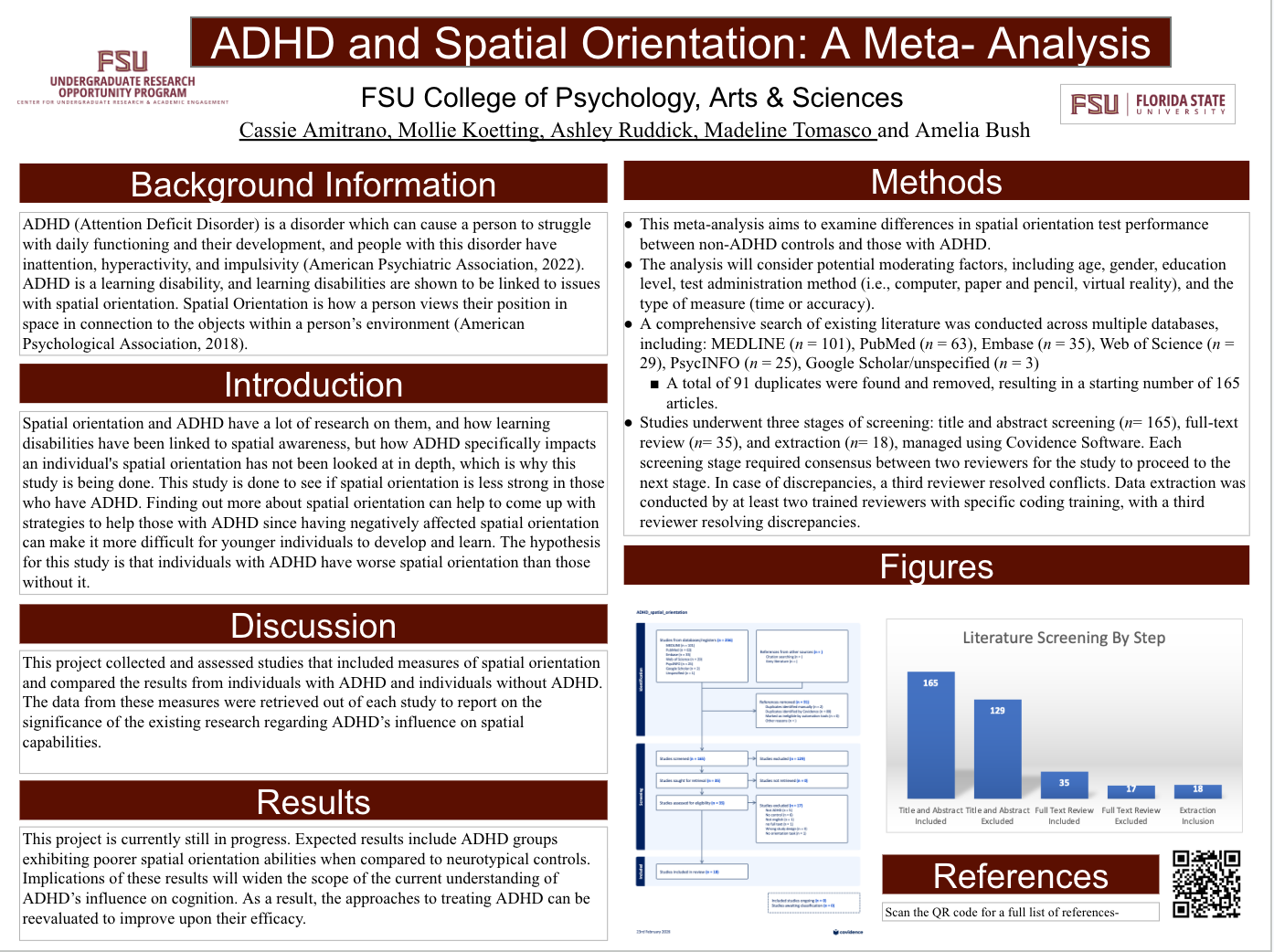
ADHD and Spatial Orientation: A Meta-Analysis
Authors: Ashley Ruddick, Dr. Dorota Kossowska-KuhnStudent Major: Psychology
Mentor: Dr. Dorota Kossowska-Kuhn
Mentor's Department: Department of Psychology Mentor's College: College of Arts and sciences Co-Presenters: Cassie Amitrano, Mollie Koetting, and Madeline Tomasco
Abstract
This study evaluated spatial orientation abilities in individuals diagnosed with Attention Deficit/Hyperactivity Disorder (ADHD) compared to neurotypical controls. ADHD is defined in the DSM-5-TR as a neurodevelopmental disorder characterized by persistent patterns of inattention and/or hyperactivity-impulsivity interfering with functioning or development. Spatial orientation refers to the ability to perceive, interact with, and maintain awareness in a three-dimensional environment through integration of multisensory information. Spatial orientation has been associated with learning disabilities specific to geometric and mathematical reasoning. While prior research has studied spatial orientation and ADHD independently, their relationship has not been examined. Understanding this relationship may expand the scope of understanding of ADHD-related cognition and inform treatment approaches. This study holds importance as it examines under-researched aspects of neurodevelopment, addressing a significant gap in the existing literature. To investigate this relationship, a meta-analysis was conducted to review literature across databases using Covidence. The study began with 165 articles at the title and abstract stage, with 36 advancing to full-text review. Inclusion and exclusion criteria resulted in 18 articles being selected for extraction. Multiple reviewers were involved in the screening process, with consensus between two reviewers required for inclusion. Conflicts were resolved by a third reviewer to ensure reliability. Afterwards, relevant data were extracted and analyzed, providing a comprehensive overview of existing research on spatial orientation in ADHD. Expected results include ADHD groups exhibiting poorer spatial orientation abilities than neurotypical controls. Implications of these results will widen the scope of the current understanding of ADHD’s influence on cognition.
Keywords: Psychology, ADHD, Spatial Orientation, Meta-Analysis