
Research Symposium
26th annual Undergraduate Research Symposium, April 1, 2026
Raine Diaz Poster Session 2: 10:45 am - 11:45 am / Poster #314

BIO
Raine is a second-year undergraduate psychology student whose goal is to continually refine the cognitive infrastructures relevant to being aware of the world through a psychological lens. He plans to pursue graduate-level research and a professional career in clinical psychology, where he can apply these frameworks to help others in real time. Currently, he is conducting research on adolescent sexual decision-making and intends to pursue additional undergraduate research in evolutionary psychology or clinical psychology in the near future.
Influencing Adolescent Sexual Decision-Making: A Theory-Driven Digital Intervention
Authors: Raine Diaz, Yinuo ZhangStudent Major: Psychology
Mentor: Yinuo Zhang
Mentor's Department: Human Development and Family Science Mentor's College: Anne’s College of Education, Health, and Human Sciences Co-Presenters:
Abstract
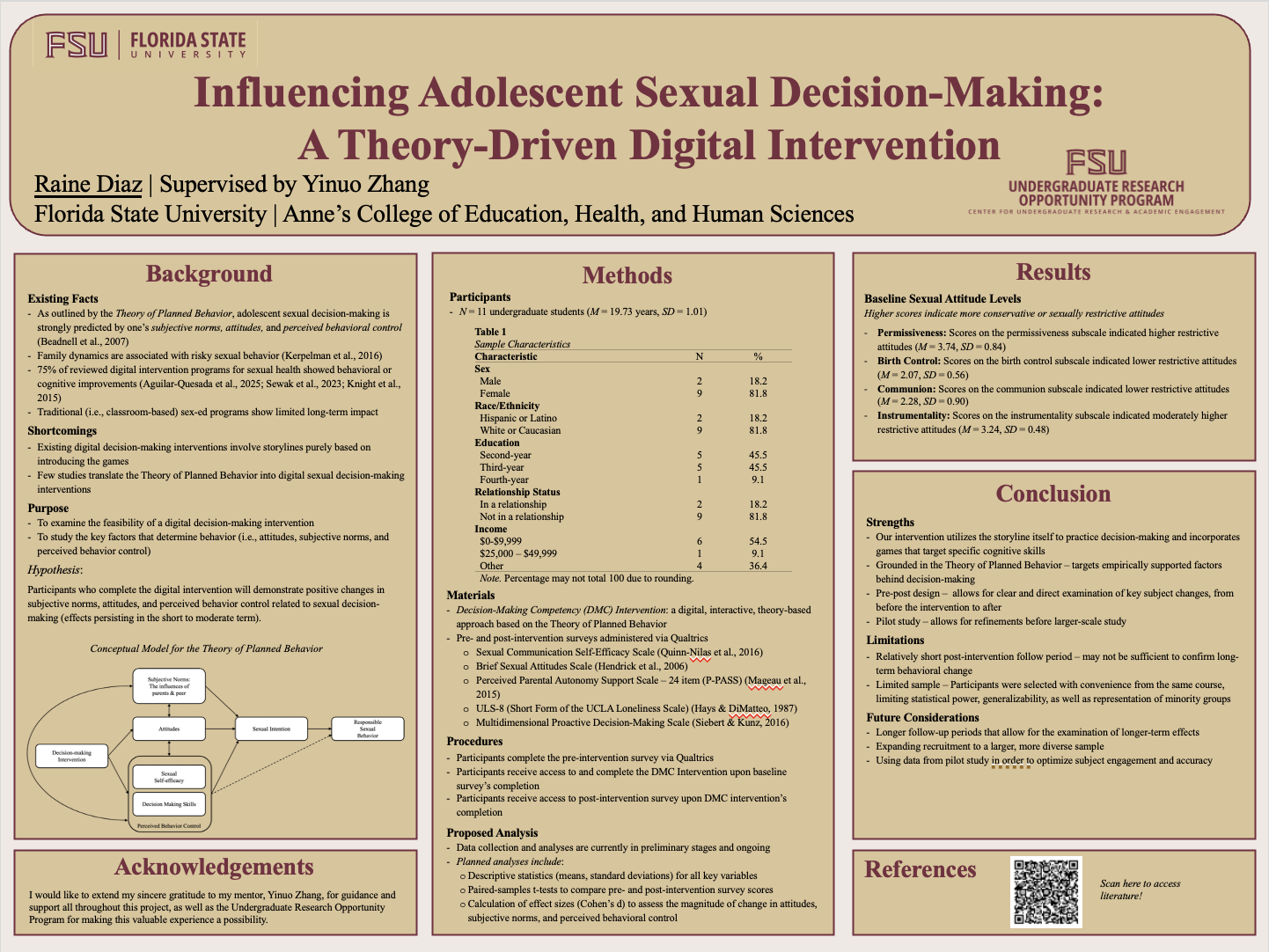
The sexual behavior of adolescents remains a significant public health concern, as sexual decision-making (e.g., unprotected sexual activity) is linked to outcomes such as STI’s, unintended pregnancy, and lasting health consequences. Traditional (e.g., in-person) sex education programs have demonstrated limited long-term influence on adolescents’ sexual attitudes, a key component in guiding sexual decision-making; however, digital interventions show promise through their engaging, personalized, and theory-driven approaches. Building on this growing body of research, this study explores whether a digital decision-making program can meaningfully promote the healthy attitudes that guide adolescents’ sexual choices. To examine feasibility, we began a pilot study with 11 Florida State University students, recruited with participation incentives. Participants completed a pre-intervention baseline survey via Qualtrics, received access to the digital intervention one week later, and were subsequently tasked to complete a post-intervention survey assessing sexual attitude changes. The study design and measures were guided by the Theory of Planned Behavior, emphasizing subjective norms, attitudes, and perceived behavioral control as key drivers of sexual decision-making. Although data collection and analyses are ongoing, preliminary observations suggest that the intervention is feasible and acceptable for participants, alongside adequate responses to the surveys and intervention. Findings are anticipated to contribute to the literature on digital, theory-driven interventions and support their development as tools that compliment traditional sex education approaches, in a more engaging and effective manner. Early evidence from the pilot study is expected to inform refinements for our future, larger-scale study, as well as for future research in this domain.
Keywords: Digital Intervention Influencing Sexual Decision-Making