
Research Symposium
26th annual Undergraduate Research Symposium, April 1, 2026
Emilee Nevaril Poster Session 3: 1:45 pm - 2:45 pm / Poster #283

BIO
Emilee Nevaril is currently a sophomore at Florida State University pursuing a Bachelor of Science in Political Science with a minor in Criminology. She is actively involved in her sorority, Kappa Alpha Theta, and the pre-law fraternity, Kappa Alpha Pi, where she serves as the Director of Recruitment. After completing her undergraduate degree, she plans to continue her education at Florida State University by pursuing a Juris Doctor (J.D.) degree.
Transparency in Florida lobbying
Authors: Emilee Nevaril, James StricklandStudent Major: Political Science
Mentor: James Strickland
Mentor's Department: Political Science Mentor's College: College of Social Sciences and Public Policy Co-Presenters: Isabella Barzaga, Alexandria Schulz, Sofia Arango, Jonathan Espinoza, Sophie Scherer
Abstract
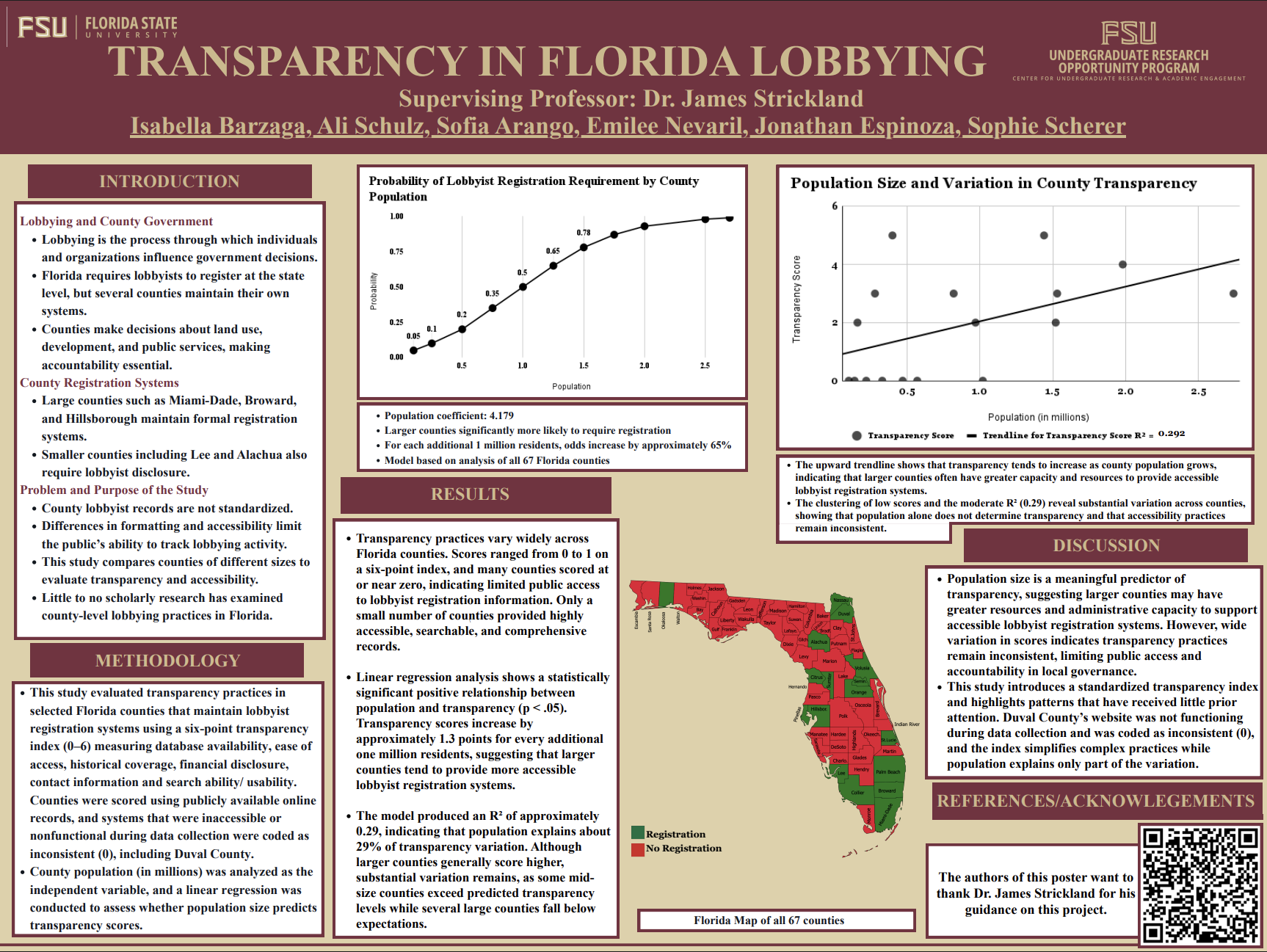
Across the counties of Florida, there is significant variation in how lobbying records are maintained and made available. Lobbying, attempting to influence legislative processes through oral or written communication, is an essential part of the legislative process, and registration of lobbyists is important for transparency and accountability in local governments. This research utilized online county websites to examine the gaps in the current lobbyist database across all 67 counties of Florida. By accessing each website on a 6-factor scale, each county was assigned a transparency score, and then transparency scores were compared across counties. Results found that the overwhelming majority of Florida counties lack a lobbyist database. Out of those that do provide a database, many scored low on the transparency scale due to difficulty of website navigation, lack of contact information, little historical lobbying data, etc. By assessing and comparing these record differences, this research demonstrates how the overall lack of lobbyist data decreases accountability of local governments, can create a sense of distrust among the government and constituents, and prevents constituents from knowing who influences local government decisions. Additionally, this lack of transparency makes it hard for citizens to be informed when voting for politicians and propositions. Based on the research collected, this project helps bring more transparency and accountability to and begins to close gaps in lobbyist data collection.
Keywords: Florida Registration Data