
Research Symposium
26th annual Undergraduate Research Symposium, April 1, 2026
Abbie Sargent Poster Session 2: 10:45 am - 11:45 am / Poster #2

BIO
Abbie Sargent is a first-year undergraduate student at FSU and majoring in Clinical Professions on the pre-medical track. She is in the Honors Program and is completing her first research project on data transparency in professional cycling worldwide. She is conducting research under her mentor, Dr. Patrick Merle. She hopes to go to medical school after she graduates with a Bachelor of Science in Interdisciplinary Medical Sciences and pursue a career in medicine.
Strava, Strategy, and Skepticism
Authors: Abbie Sargent, Patrick MerleStudent Major: Clinical Professions
Mentor: Patrick Merle
Mentor's Department: Communications Mentor's College: College of Communications & Information Co-Presenters: Reagan Panico
Abstract
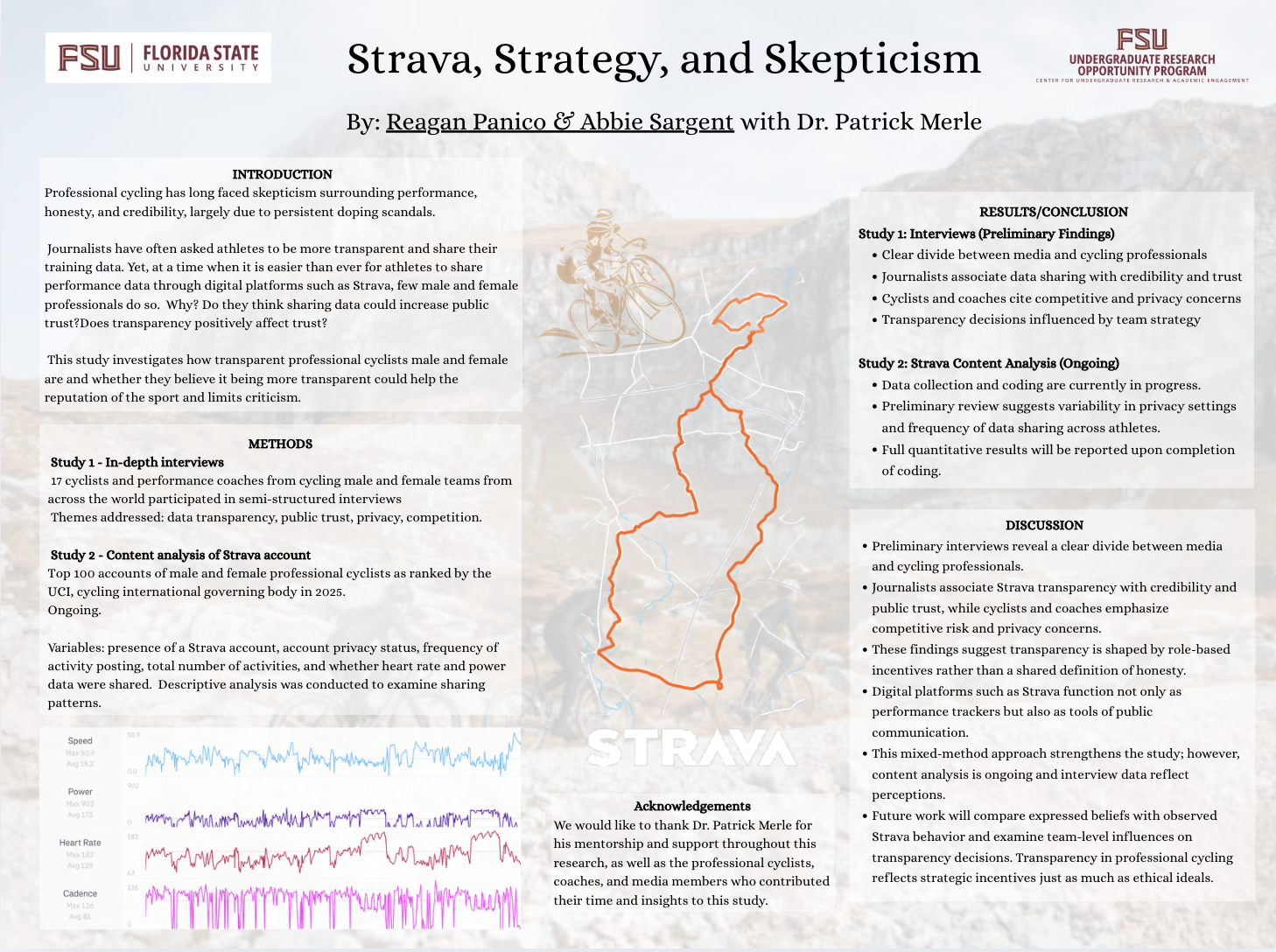
Professional cycling has a long history of skepticism surrounding performance, honesty, and credibility, making transparency an ongoing point of tension within the sport. As digital platforms such as Strava become more visible to fans, media, and sponsors, athletes’ choices about what performance and training data to share function as a form of communication that can influence public trust. This study examines how transparent professional cyclists are with their Strava data and what that transparency reveals about honesty and trust in professional cycling. Using a mixed qualitative approach, the research combines semi structured interviews with professional cyclists, coaches, and media members, alongside an analysis of Strava activity from the top 100 professional cyclists based on UCI rankings as of September 2025. Preliminary findings suggest a clear divide between athlete and media perspectives, with many cyclists and coaches expressing hesitation toward full transparency due to competitive concerns, while journalists generally view increased data sharing as a way to build credibility within the sport. These results indicate that transparency is shaped more by role and incentives than by a shared definition of honesty. The findings further suggest that Strava functions not only as a performance tracking tool, but also as a communication platform that can shape public perception, even when athletes are not intentionally using it for that purpose. Understanding this disconnect has important implications for how trust is built or undermined in modern professional sport and may inform future conversations around athlete privacy, competitive integrity, and data transparency.
Keywords: Strava, cycling, transparency