
Research Symposium
26th annual Undergraduate Research Symposium, April 1, 2026
Jayda Bass Poster Session 2: 10:45 am - 11:45 am / Poster #138

BIO
Jayda Bass is a second-year majoring in Public Health with a minor in Biology, on the Pre-Medical track. She is in the Undergraduate Research Opportunity Program, where she is currently a first-time research assistant in Dr. Julia Sheffler's Integrative Science for Healthy Aging Program. She is also a member of the University Honors Program and the recipient of the Mores and QUEST scholarships. Following obtaining her Bachelor of Science in Public Health, Jayda plans to attend Medical School with career aspirations to become a Neurologist, Cardiologist, or Anesthesiologist.
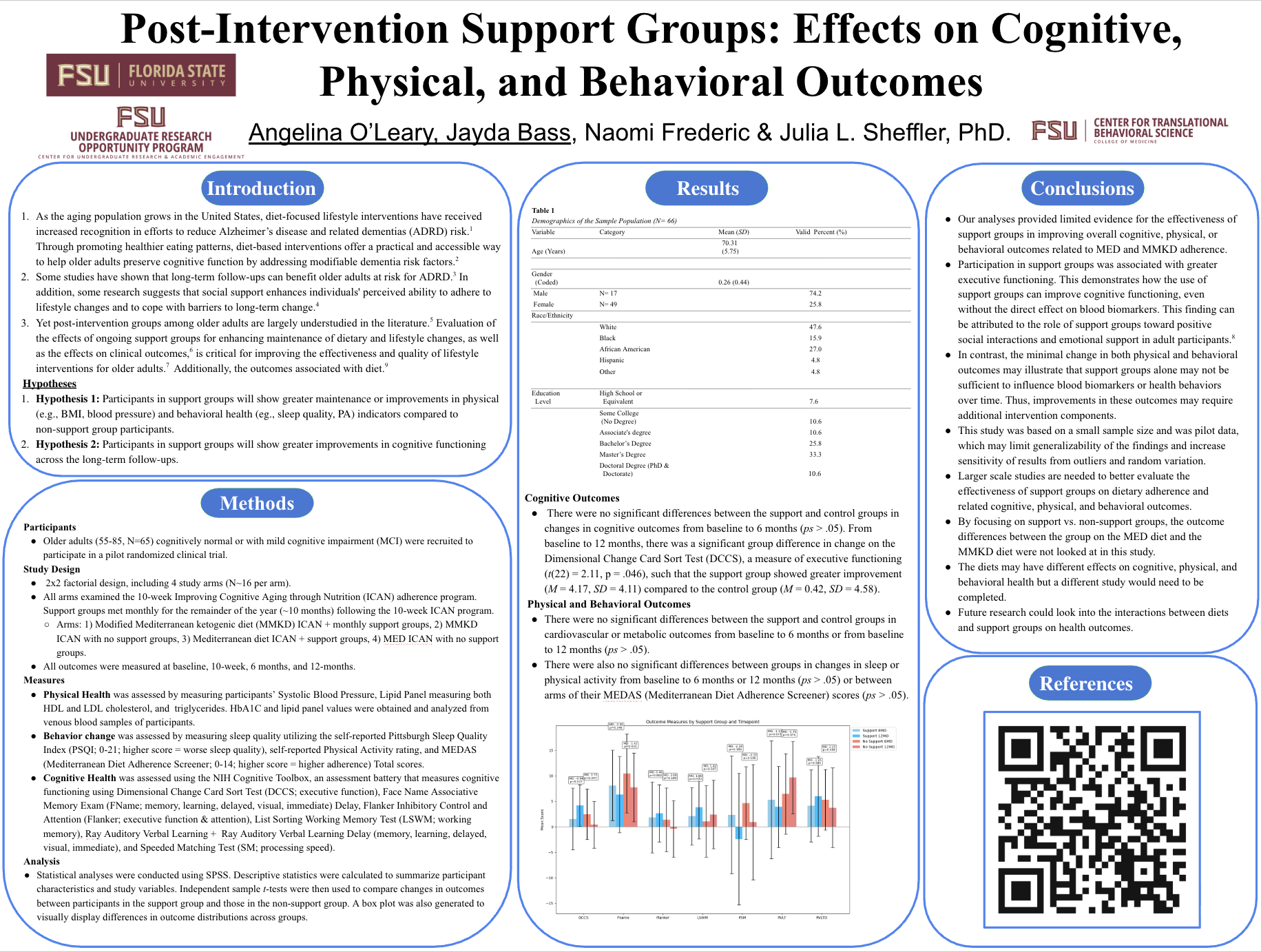
Post-Intervention Support Groups: Effects on Cognitive, Physical, and Behavioral Outcomes
Authors: Jayda Bass, Julia ShefflerStudent Major: Public Health
Mentor: Julia Sheffler
Mentor's Department: Center for Translational Behavioral Science Mentor's College: Medicine Co-Presenters: Angelina O' Leary
Abstract
Background: Dietary interventions such as Mediterranean style diets may reduce dementia risk. However, many individuals have difficulty maintaining these diets after a structured program ends, and few studies examine factors for enhancing long-term adherence. The current study evaluates the effects of post-dietary intervention support groups on long-term cognitive, physical, and behavioral health outcomes.
Methods: A total of 65 participants aged 55+ with dementia risk factors were enrolled in this pilot trial examining a 10-week group nutrition adherence program – the Improving Cognitive Aging through Nutrition program. Using a 2x2 factorial design, participants were randomized to one of four study arms, with two arms receiving ongoing support groups. We hypothesized support group participants would demonstrate greater maintenance or improvements in cardiovascular and cognitive health, as well as behavior change outcomes across follow-ups (6- and 12-month). Outcomes were assessed using NIH Toolbox Cognition Battery, validated self-report measures, and fasting blood draws. Group differences were assessed using independent sample t-tests.
Results: There were no significant differences between support and control groups in cognitive outcomes from baseline to 6 months (ps > .05); however, at 12-months, there was an improvement in executive functioning in the support group compared to the control group (p=0.46). There were no significant differences in physical and behavioral outcomes at 6- or 12-months (ps > .05).
Conclusions: Although a significant improvement in executive function was observed at 12 months, our findings provide limited evidence for the effectiveness of support groups in improving cognitive, physical, or behavioral outcomes.
Keywords: Support group, Older adult