
Research Symposium
26th annual Undergraduate Research Symposium, April 1, 2026
Mikayla Rosenwasser Poster Session 1: 9:30 am - 10:30 am / Poster #267

BIO
Mikayla is second-year dual degree student, studying Political Science & Business Management at Florida State University, aspiring to attend law school and pursue a career as a family lawyer. She is currently a remote legal intern at Walker, Revels, Greninger PLLC, a defense insurance law firm in Orlando, FL. She;s also in involved as a Hope Leader for Relay for Life, Head of Marketing for Hillel at FSU, Small Group Coordinator for CHAARG at FSU, and Marketing Coordinator for Jewish Student Union. She is currently researching with the Human Development and Family Science department, focusing on how parents daily stress levels influence momentary parenting behaviors and children’s self-regulation.
Daily Effects of Parental Stress on Parenting Behaviors and Children’s Self-Regulation in Higher-Risk Families
Authors: Mikayla Rosenwasser, Longfeng LiStudent Major: Political Science and Business Management
Mentor: Longfeng Li
Mentor's Department: Human Development and Family Science Mentor's College: Florida State University Co-Presenters: Kaitlyn Goslinga, Megan Knobloch, Francesca Maresma, Annemarie Wilson
Abstract
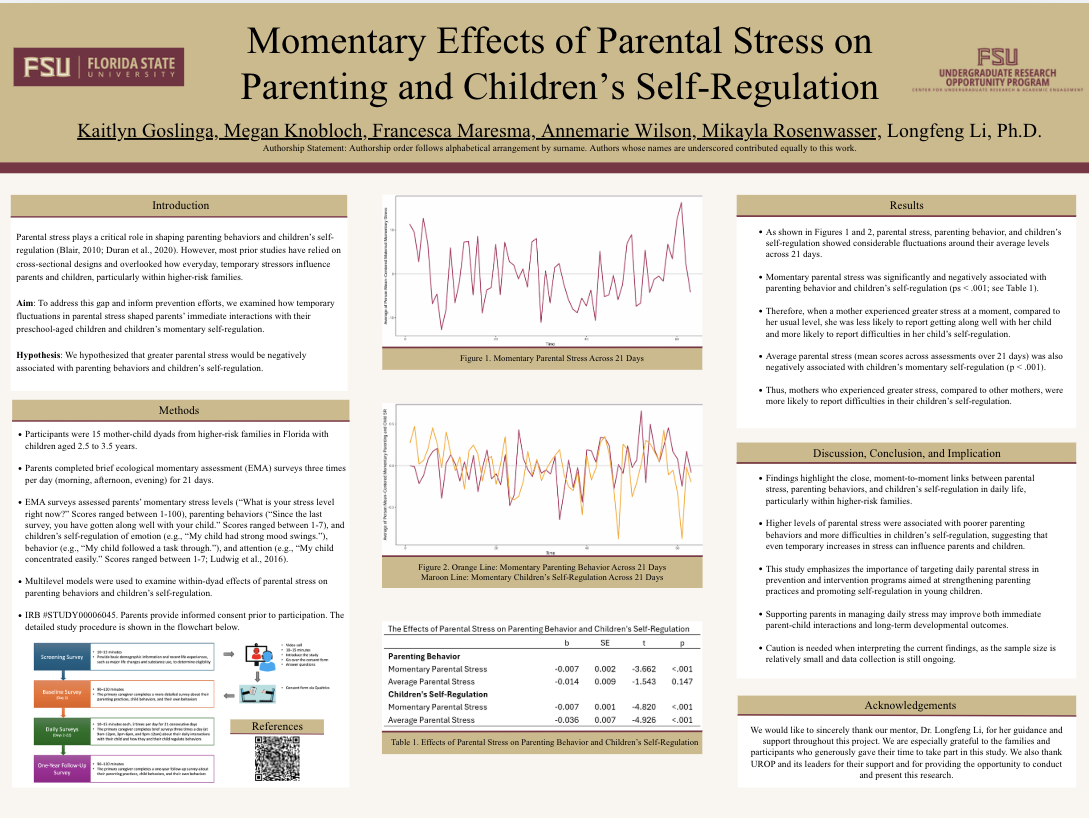
Parental stress plays a critical role in shaping parenting behaviors and children’s self-regulation. However, most prior studies have relied on cross-sectional designs and overlooked how everyday, temporary stressors influence parents and children, particularly within higher-risk families. To address this gap and inform prevention efforts, we examined how temporary fluctuations in parental stress shaped parents’ immediate interactions with their preschool-aged children and children’s momentary self-regulation. This work aims to support the development of targeted, evidence-based interventions to buffer families from the adverse consequences of daily stress. We hypothesized that greater parental stress would be negatively associated with parenting behaviors and children’s self-regulation. Participants were 15 mother-child dyads from higher-risk families in Florida with children aged 2.5 to 3.5 years. Mothers completed an initial survey, followed by brief ecological momentary assessment (EMA) surveys three times daily (morning, afternoon, evening) for 21 days. EMA surveys assessed parental stress, parenting behaviors (i.e., how well they were getting along with their child), and children’s self-regulation of emotion, behavior, and attention. Multilevel models revealed negative within-dyad associations between parental stress and both parenting behaviors and children’s self-regulation (ps < .05). At moments when parents experienced higher-than-usual stress, they were less likely to report getting along well with their child and more likely to report difficulties in their child’s self-regulation. These findings highlight the dynamic, interrelated nature of parental stress, parenting behaviors, and children’s self-regulation in daily life, suggesting that family-system approaches designed to buffer families from everyday stress may be especially beneficial for higher-risk families.
Keywords: Parenting Stress, Self Regulation, Parent-Child Relationships