
Research Symposium
26th annual Undergraduate Research Symposium, April 1, 2026
Brendan McNamara Poster Session 3: 1:45 pm - 2:45 pm / Poster #11

BIO
Brendan is a first year Presidential Scholar at Florida State University, and he is pursuing a degree in cell & molecular neuroscience. He currently serves as a Research Assistant in the Wagner Lab, where he contributes to scientific inquiry through literature review, collaboration, and clear communication of research ideas.
With a 4.0 GPA and a strong academic foundation, Brendan is deeply interested in the intersection of neuroscience research and clinical medicine. His long-term goal is to pursue a career as a physician, driven by a commitment to evidence-based practice and patient-centered care.
Meta-Analysis of Risk-Factors for Dyslexia
Authors: Brendan McNamara, Dr. Richard WagnerStudent Major: Cell & Molecular Neuroscience
Mentor: Dr. Richard Wagner
Mentor's Department: Psychology Mentor's College: Arts & Sciences Co-Presenters: Brendan Hanbury, Alyssa Montanez, Madison Taylor
Abstract
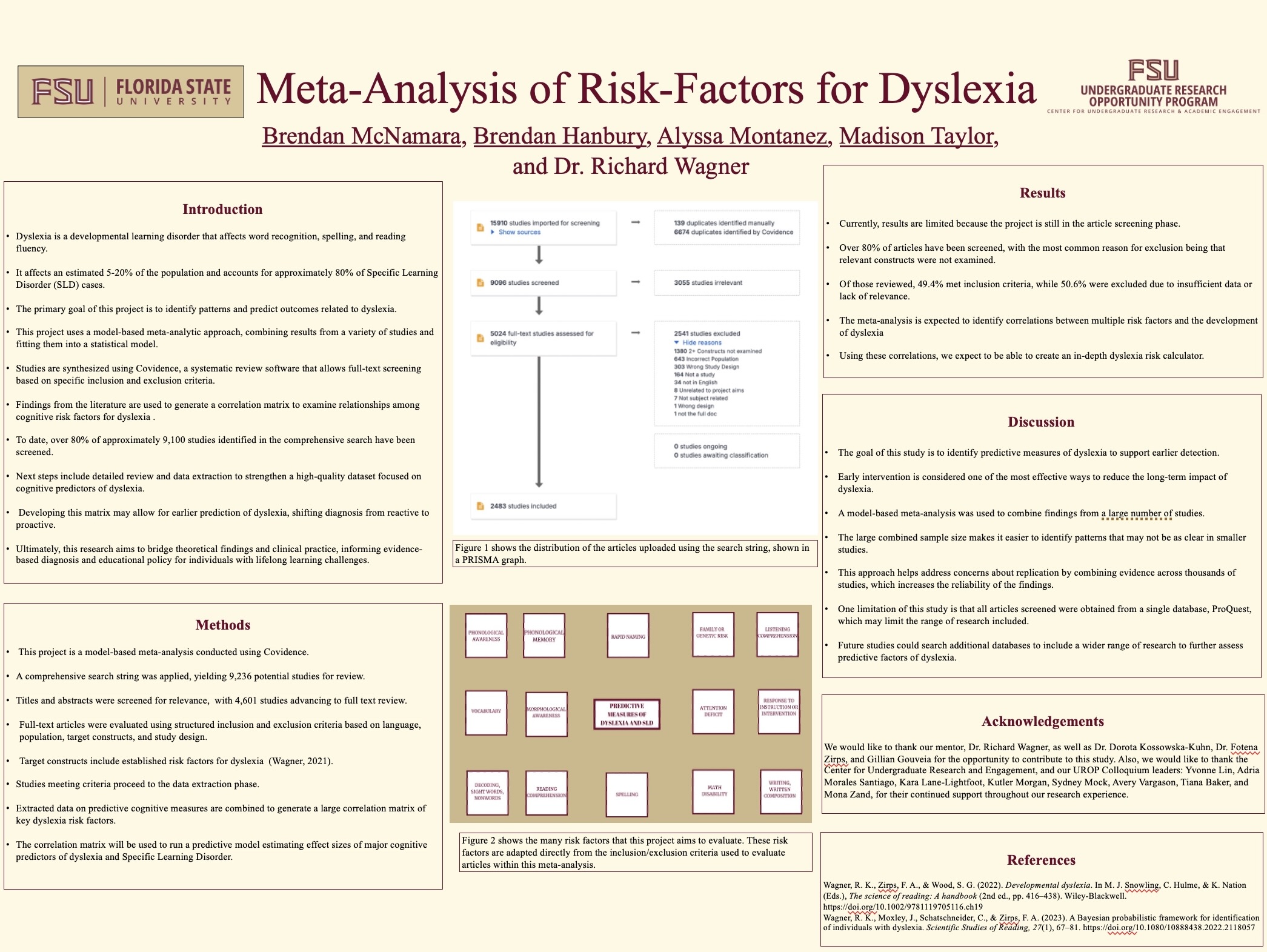
Dyslexia is a distinct, complex neurodevelopmental condition that significantly impacts lifelong educational outcomes and affects up to 20% of the population. Dyslexia is primarily characterized by impaired word recognition and decoding difficulties. While there has been much research on dyslexia, individual small-scale studies often lack the necessary statistical power to generalize these findings across a multitude of diverse groups. This research, conducted through Florida State University’s NIH Multidisciplinary Learning Disabilities Research Center, utilizes a large-scale meta-analysis to establish an evidence-based understanding of the prevalence and underlying mechanisms of dyslexia. The methodology follows a rigorous systematic framework to screen and synthesize decades of global research. Following an extensive literature review of over 3,800 identified studies, researchers applied a standardized codebook and strict inclusionary criteria to exclude methodologically unsound data and refine the sample. Preliminary results have yielded a group of high-quality studies that provide precise effect sizes regarding the cognitive and behavioral markers of this disorder. By aggregating these data, the project is developing a large-scale correlation matrix to identify and weight predictive neurobiological signs. These findings underscore the importance of treating dyslexia as a specific challenge requiring specialized, evidence-based approaches for diagnosis and intervention. Ultimately, this research aims to bridge the gap between laboratory findings and real-world application by creating a robust scientific foundation for earlier prediction, more accurate clinical diagnosis, and more effective instructional policies. This comprehensive synthesis provides the clarity necessary to improve long-term academic trajectories for all individuals who are currently struggling with these learning disabilities.
Keywords: dyslexia, meta-analysis, learning disorder