
Research Symposium
26th annual Undergraduate Research Symposium, April 1, 2026
Sarah Awwad Poster Session 2: 10:45 am - 11:45 am / Poster #306

BIO
Sarah Awwad is a third-year student at Florida State University, majoring in Psychology and minoring in Biological Science and Child Development. Her academic interests center on mental health research, particularly suicide prevention and the ways language and social environments influence help-seeking behaviors. Sarah is actively involved in research as a Research Assistant in the Joiner Lab, where she contributes to projects examining suicide risk and prevention. In addition to her research involvement, she is engaged in campus mental health initiatives and serves as a Peer Educator with RENEW to promote emotional wellness and support among students. After graduation, she plans to pursue graduate studies in Clinical Psychology and continue conducting research in the field of Psychology.
Exploring Psychological Safety and Salient Experience in Suicide-Related Virtual Reality: A Qualitative Analysis
Authors: Sarah Awwad, Sara ProstkoStudent Major: Psychology
Mentor: Sara Prostko
Mentor's Department: Psychology Mentor's College: College of Arts and Sciences Co-Presenters:
Abstract
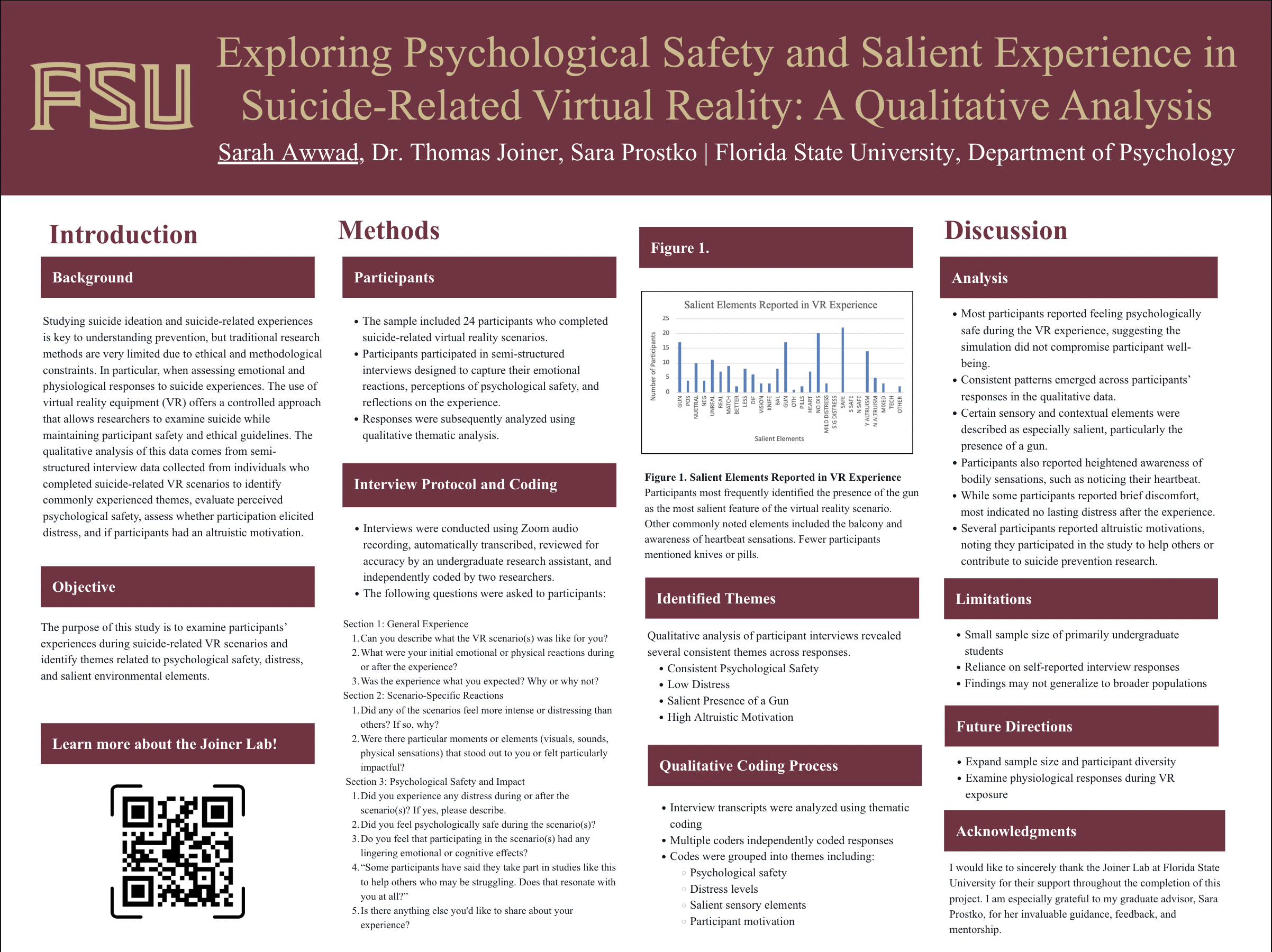
Understanding decision-making behind suicidal behaviors is key to improving prevention. However, traditional research methods are very limited due to ethical and methodological constraints. The use of virtual reality equipment (VR) offers a controlled approach that allows researchers to examine suicide while maintaining participant safety and ethical guidelines. The current study is from a semi-structured interview portion of a larger suicide-related VR study. The qualitative interview administered to all participants aims to identify commonly experienced themes, evaluate perceived psychological safety, assess whether participation elicited distress, and if participants had an altruistic motivation.
A thematic analysis of the data indicated various consistent patterns across the data. One pattern showcased is that most participants reported feeling psychologically safe throughout the VR experience, suggesting that the VR is a safe and ethical approach to examining suicidal behaviors and decision-making. Similarly, patterns highlighted that specific sensory and contextual elements were described as especially salient. Particularly, the presence of a gun and of bodily sensations such as heartbeat in the VR scenarios. These features show an increase in realism and emotional engagement. Although some participants described brief discomfort, most reported no lasting distress. Additionally, several participants noted that they had altruistic intentions when completing the study.
Overall, the findings of this data suggest that Virtual Reality may be used as a feasible and ethically acceptable method for studying suicide-related behaviors, and identifying which specific elements most strongly shape participant responses can inform future study design to improve both safety and validity of study results.
Keywords: Qualitative Interview, Suicide, Suicide Prevention