
Research Symposium
26th annual Undergraduate Research Symposium, April 1, 2026
Charlie Lu Poster Session 3: 1:45 pm - 2:45 pm / Poster #75

BIO
Charlie Lu is a sophomore at Florida State University pursuing a Bachelor of Science in Actuarial Science and a Bachelor of Science in Computer Science. He has been recognized on the President's List for three consecutive semesters, as well as receiving the Florida State University Vires Scholarship, IB Scholarship, and the Evelyn R. & John W. Baugh Memorial Scholarship.
His research explores how patients' preconceived perceptions of insurance coverage influence their healthcare choices, including which treatments they consider and whether they seek or delay care. This work sits at the intersection of behavioral decision-making (marketing), insurance design, and actuarial practice, and reflects his deep commitment to improving health outcomes for patients navigating complex insurance systems.
Beyond the classroom, Charlie holds a passing score on SOA Exam P and is currently preparing to sit for Exam FM, demonstrating his dedication to the actuarial profession. He is an active member of Lambda Phi Epsilon, Gamma Iota Sigma and Future Seminole Actuaries. Looking ahead, Charlie hopes to build a career focused on the Medicare/CAS space, where he can apply his actuarial training to advocate for more equitable and patient-centered coverage policies.
Doctors, Patients, and Insurance Relations
Authors: Charlie Lu, Matilda VeveraStudent Major: Actuarial Science/Computer Science
Mentor: Matilda Vevera
Mentor's Department: Marketing Mentor's College: College of Business Co-Presenters: Charlie Rust
Abstract
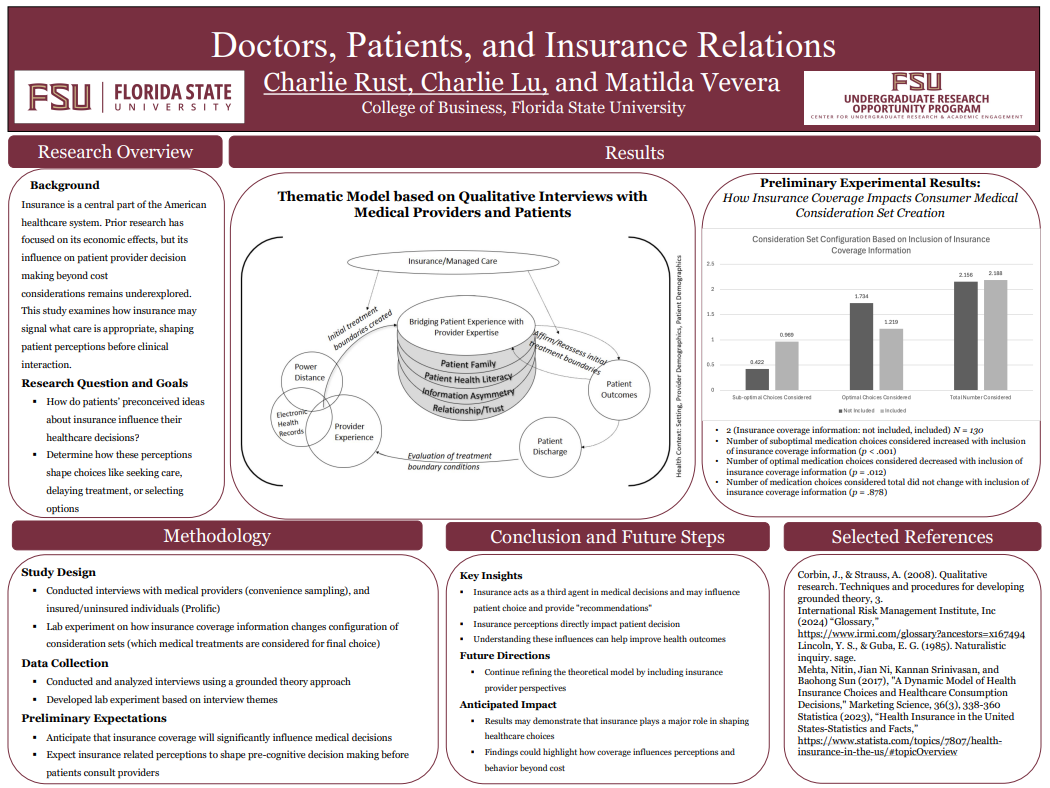
This research examines how insurance coverage influences patients’ perceptions and choices during healthcare decision making. While insurance is a central part of the American healthcare system, previous studies have focused mostly on economic effects, leaving its role in shaping patient and provider decisions less understood. Using a multi-method approach, the project began with qualitative coding of interviews to capture perspectives from both patients and doctors. These insights informed the design of a formal lab experiment, which examined how insurance information affects the set of medical treatments considered for final choice. Preliminary results show that access to coverage information leads participants to consider more suboptimal medications and fewer optimal ones, while the total number of options considered stays the same. These findings suggest that insurance perceptions can strongly influence patient decisions beyond cost and highlight the importance of evaluating its role in healthcare choices.
Keywords: Insurance, Healthcare, Patient, Cost, Choice