
Research Symposium
26th annual Undergraduate Research Symposium, April 1, 2026
Parini Mehta Poster Session 4: 3:00 pm - 4:00 pm / Poster #52
BIO
Parini Mehta is a first-year humanities student at FSU from Tallahassee, FL. Post-graduation, she plans on attending law school to then become a practicing attorney with the personal goal of helping others. Throughout her academic career, she is determined to increase her understanding of people and gain perspective through studying history and philosophy, as well as learning from a diverse range of people. Currently in her academic career, she anticipates her summer research, where she will go to India to study the legal system.
Parini began research in FSU’s Undergraduate Research Opportunity Program, where she joined Alicia Batailles’ research project ‘Understanding the Range of Mentorship within the Undergraduate Research Opportunity Program’ to deepen her understanding of people. She felt as though the project would teach her to be a better leader and further understand professional relationships in a manner that stresses the importance of people's affects on one another. Along with an in-depth understanding of relationships, Parini has gained experience in presentation and increased her skills in teamwork, communication, and coding through her time on the project.
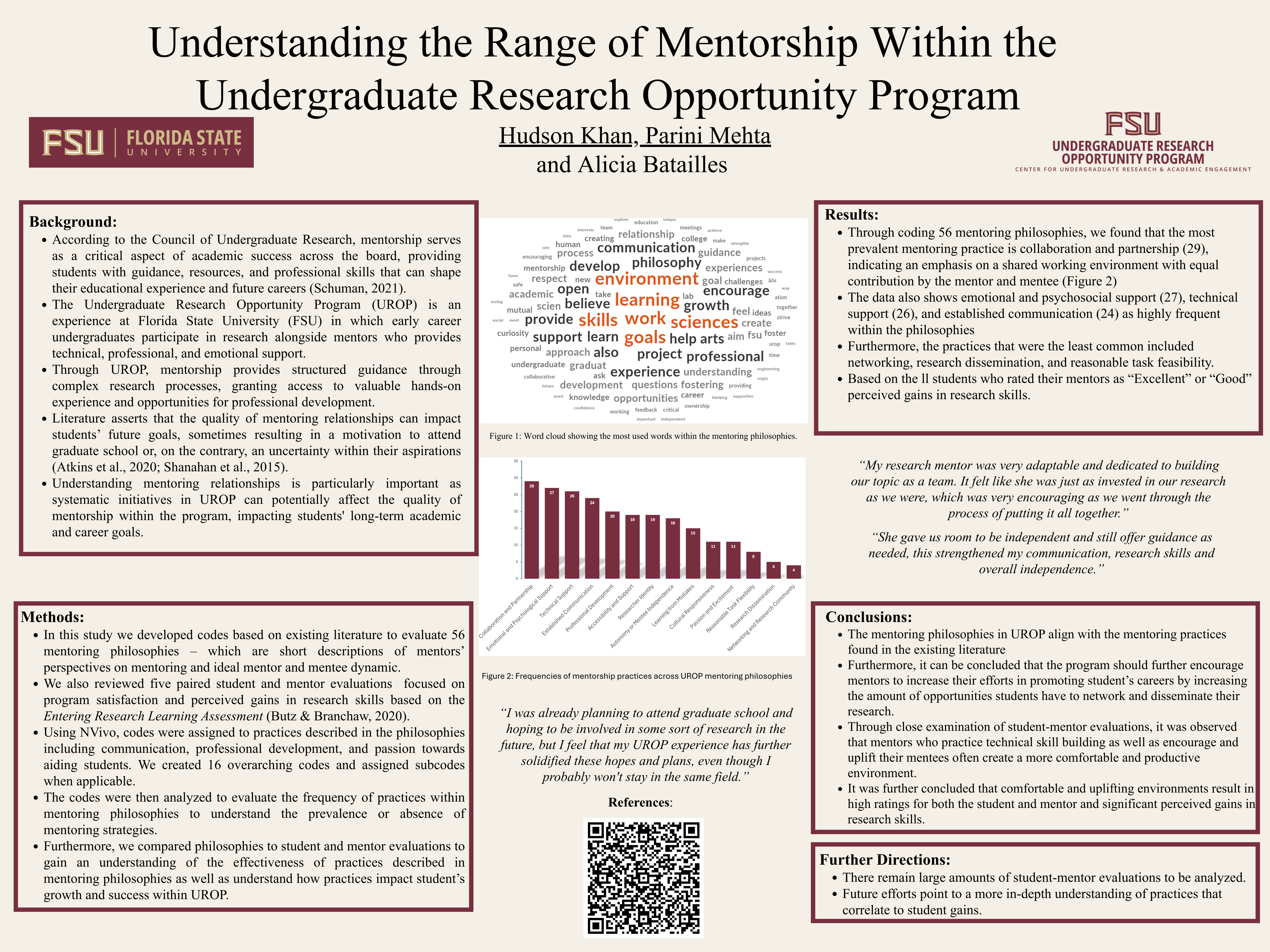
Understanding the Range of Mentorship Within the Undergraduate Research Opportunity Program
Authors: Parini Mehta, Alicia BataillesStudent Major: Humanities
Mentor: Alicia Batailles
Mentor's Department: Division of Undergraduate Studies Mentor's College: Center for Undergraduate Research and Academic Engagement Co-Presenters: Hudson Khan
Abstract
Mentorship is an integral piece of the undergraduate research experience (URE). The quality of mentorship can impact the outcomes of a URE. At Florida State University (FSU), hundreds of undergraduate students enter the Undergraduate Research Opportunity Program (UROP) every year and conduct research by partnering with a mentor. Mentoring is a complex practice that not only impacts students' academics, but drives their careers. However, poor quality mentorship has the capacity to undermine students' performance and motivation. To mitigate this, the Center for Undergraduate Research and Academic Excellence (CRE) hosts mentor training for graduate students to raise awareness about effective strategies to foster positive mentoring relationships. This research examines both sides of mentoring relationships and their impact on students' outcomes, with an aim to understand and improve mentoring relationships throughout FSU. The literature shows that high quality mentorship stresses open communication and flexibility with mentees. On the contrary, absenteeism and unreasonable expectations can be characteristics of poor-quality mentorship. In our research, we used a qualitative approach, using data from UROP mentoring philosophies, and coded them to observe the trends of positive and negative mentoring practices. We also analyzed paired student and mentor evaluations to understand how submitted philosophies are related to student satisfaction and growth in research outcomes. Our analysis includes documenting the frequency of different mentoring strategies and identifying patterns. Our findings will be used to enhance the current research mentor training curriculum and develop workshops for all research mentors.
Keywords: Research, Mentor, Mentorship, Mentee