
Research Symposium
26th annual Undergraduate Research Symposium, April 1, 2026
Valeria Hernandez Poster Session 4: 3:00 pm - 4:00 pm / Poster #240

BIO
Valeria Hernandez is a sophomore at Florida State University majoring in Clinical Professions while pursuing the pre-dental track. She is involved in the Undergraduate Research Opportunity Program (UROP), where she is gaining research experience and participating in UROP Leader Training to develop mentorship and leadership skills. Valeria is also a member of the Pre-Dental Society and has gained exposure to the dental field by shadowing at a dental office and participating in Global Dental Brigades. She plans to pursue a career in dentistry and is passionate about improving oral health. In her free time, Valeria enjoys playing tennis and working out to stay active and balanced.
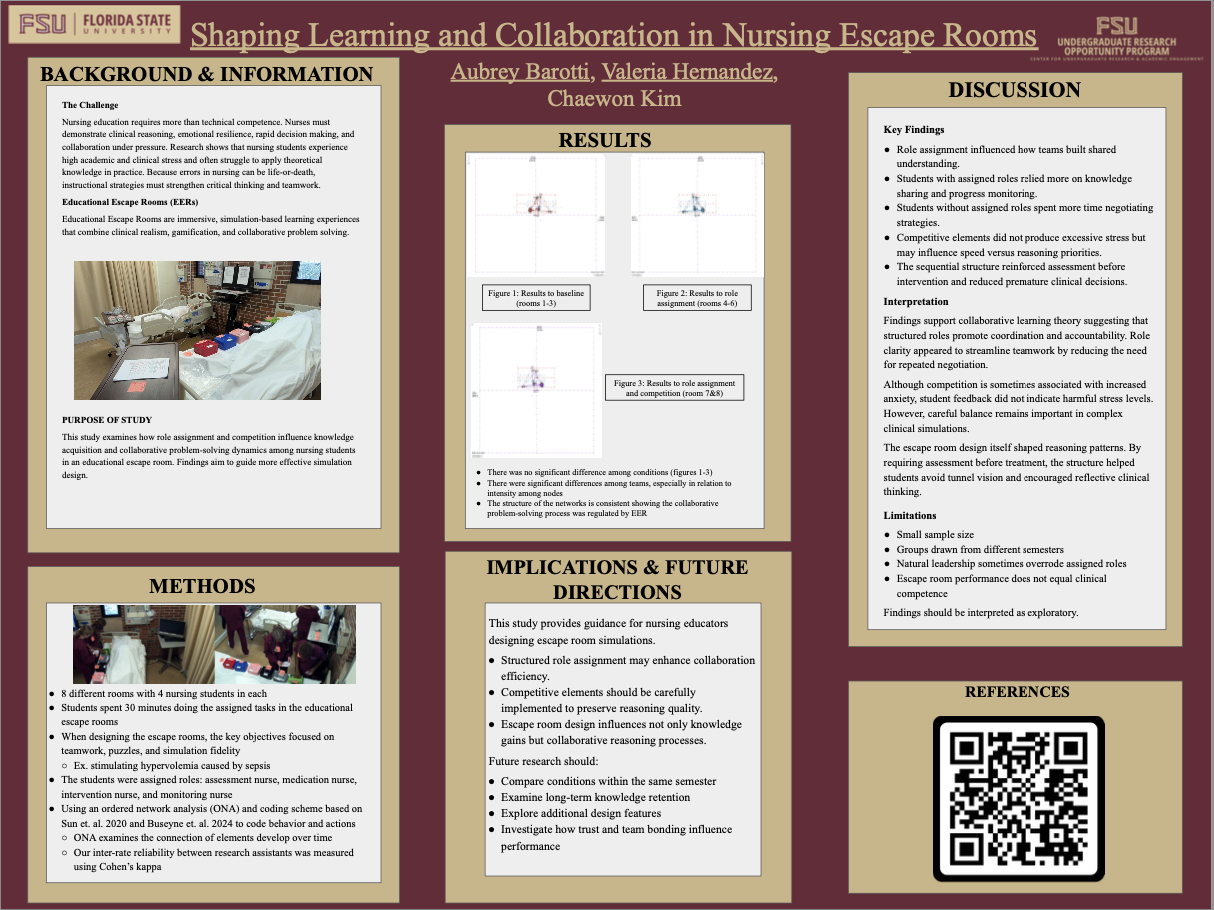
Shaping Learning and Collaboration in Nursing Escape Rooms
Authors: Valeria Hernandez, Chaewon KimStudent Major: Clinical Professions
Mentor: Chaewon Kim
Mentor's Department: Instructional Systems and Learning Technologies (ISLT) Ph.D. Mentor's College: Education Co-Presenters: Aubrey Barotti
Abstract
The goal for any nursing student is to be able to make quick decisions and perform under pressure. However, according to the study, many students fail to apply what they are learning in the classroom to actual patient care. Interactive learning has increased over the years as a tool to help support students’ learning, and specifically, education escape rooms (EER) have been studied to see what skills can be enhanced. An EER is a game-based environment where the aim is to boost collaboration and critical thinking. In the study, a baseline escape room on the recognition and management of hypovolemia was designed. Here, students participated in a group of 4, each taking a pre-test and a post-test. The 30-minute escape room was designed to have a clear sequence, as in the nursing process. The findings revealed significant knowledge gains, as well as patterns that favored a common ground approach where strategies were negotiated. In the absence of a designated role, there was a tendency to loop back to strategy talks before advancing. Overall, the results suggest that EERs with meaningful, defined roles yield beneficial outcomes for collaborative reasoning, and at the same time, it retains the potential for robust cognitive learning in nursing.
Keywords: nursing, education, escape rooms