
Research Symposium
26th annual Undergraduate Research Symposium, April 1, 2026
Kathryn Fjelland Poster Session 4: 3:00 pm - 4:00 pm / Poster #114

BIO
Kathryn Fjelland is a biology student in the FSU Presidential Scholars Program. Her research interests center around anatomy, physiology, and emergency medicine. After graduating from FSU, she plans to attend medical school and become a physician. Outside of research she is involved in club sports, volunteering, and various academic organizations. Originally from Spearfish, SD, she enjoys being active and outdoors.
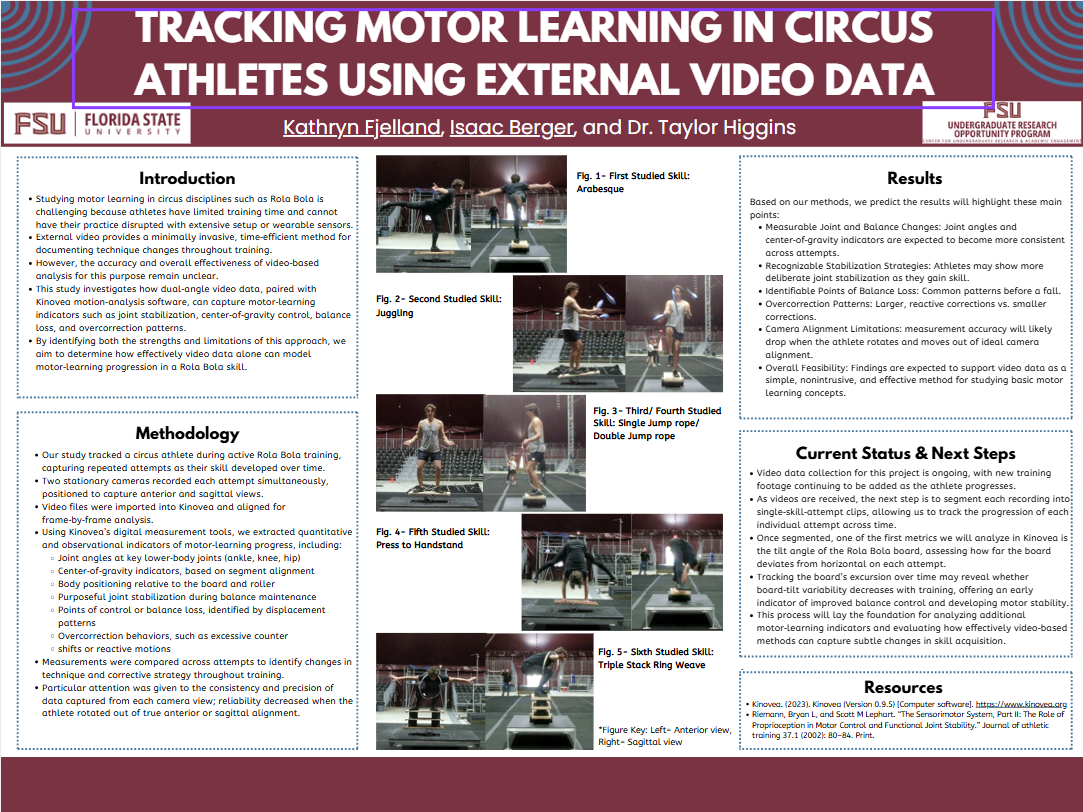
Tracking Motor Learning in Circus Athletes Using External Video Data
Authors: Kathryn Fjelland, Dr. Taylor HigginsStudent Major: Biology, Criminology
Mentor: Dr. Taylor Higgins
Mentor's Department: Mechanical Engineering Mentor's College: College of Engineering Co-Presenters: Isaac Berger
Abstract
Understanding the progression of motor learning in circus talents such as Rola Bola presents a unique challenge when working solely with external video data. Our study investigates how this type of video data can be effectively acquired and used to analyze motor learning. We used two motion cameras to capture both anterior and sagittal views of the subject and aimed to use the video analysis software Kinovea to derive measurable data points to track progress. This data would include joint angles, center of gravity, and body positioning. A few concepts we were particularly hoping to track are the impact of purposeful joint stabilization, the point of control or balance loss, and what aspects lead to overcorrection. We predict that our results will indicate that video data is an effective and nonintrusive study method, and that Kinovea could be used effectively if the athlete remains in alignment with the cameras. Overall, our study aims to determine that video data is an effective method for studying basic motor concepts such as balance, corrections, and failure patterns at a small scale, and a simple and affordable way to conduct our research. The use of video data has broader implications for athletes, coaches, medicine, and the study of motor learning, as it can support more informed coaching decisions, enhance injury‑prevention strategies, and make biomechanical feedback accessible in settings that lack advanced motion‑capture technology.
Keywords: Engineering, Biology, Video