
Research Symposium
26th annual Undergraduate Research Symposium, April 1, 2026
Evan Safi Poster Session 1: 9:30 am - 10:30 am / Poster #241

BIO
Evan Thomas Safi is a first year student at Florida State University pursuing a Bachelor of Science in Neuroscience on the pre medical track. He maintains a 4.0 GPA and is actively involved in undergraduate research through the Florida State University Undergraduate Research Opportunity Program. Under the mentorship of Dr. Jaesung Hur in the Department of Educational Psychology and Learning Systems, Evan contributes to a systematic literature review examining the role of webcams in synchronous online learning environments. His work focuses on identifying instructional strategies, benefits, and challenges associated with webcam use in virtual classrooms.
Beyond research, Evan is involved in several service and campus organizations. He volunteers with Big Bend Hospice, where he works with patients in palliative care settings and gains experience supporting individuals and families during difficult stages of illness. Outside of academics, he is also involved in campus life through student organizations and Greek life, which allow him to stay connected to the university community while balancing his academic and research commitments.
Evan is particularly interested in neuroscience, human behavior, and the intersection of technology and learning. His long term goal is to attend medical school and pursue a career as a physician while continuing to engage with research that explores how biological and social factors shape human health and performance.
Systematic Literature Review on Webcams
Authors: Evan Safi, Jaesung HurStudent Major: Cell/Molecular Neuroscience
Mentor: Jaesung Hur
Mentor's Department: Educational Psychology and Learning Systems Mentor's College: Florida State University Co-Presenters: Xavier Garcia, Julian Raton
Abstract
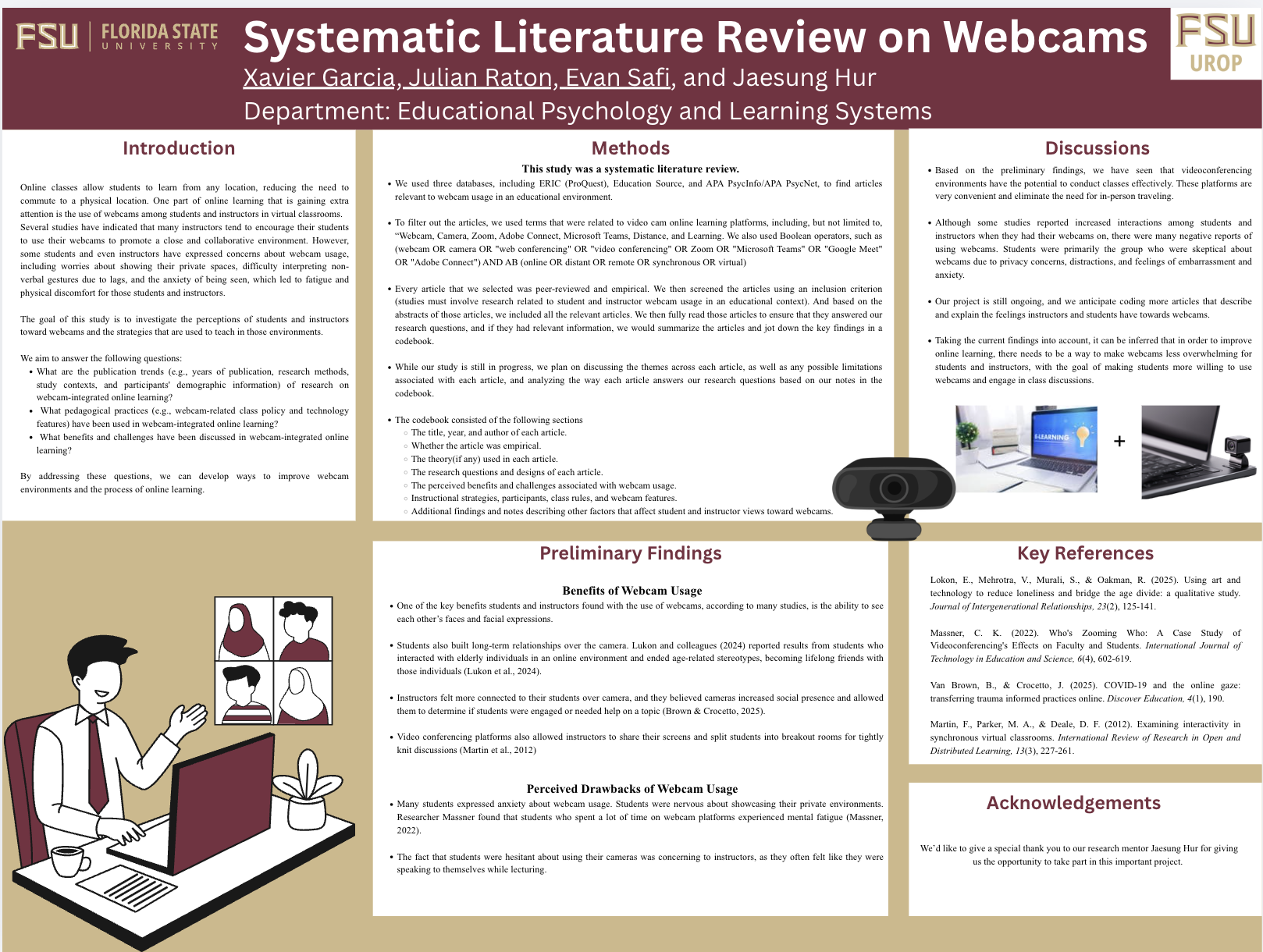
This study aims to examine the perceptions and experiences of students and educators regarding webcam usage in virtual learning contexts. Over the years, online learning has become increasingly popular, and the COVID-19 pandemic has further accelerated its growth. Prior research has found mixed opinions regarding webcam usage. Some studies highlight that videoconferencing allows students and instructors to engage in real-time discussions, eliminating the need for in-person contact. Other studies indicate that many students and educators have also felt overwhelmed and hesitant about using their webcams. Based on these findings, it is important to review additional literature to gain further insight into the role webcams play from both a learner’s and instructor’s perspective to provide data for future research designed to improve webcam usage in teaching and learning environments. To conduct this study, our team located articles from three different education-focused databases that discussed the different teaching approaches taken in virtual environments. We then screened articles and only included articles that specified the use of video-conferencing tools or webcams in teaching and learning environments and summarized key themes. Based on our current articles, there was a common trend: many students and instructors believed webcams promoted engagement and social presence, while others reported exhaustion and expressed privacy concerns related to revealing personal spaces, background environments, and noise. These results suggest that webcams may be useful in online learning, but additional data is needed to help future researchers develop instructional strategies that instructors can use to improve webcam experiences in online classes.
Keywords: Online Learning, Webcam Use in Education, Student Engagement, Video Conferencing in Education, Systematic Literature Review