
Research Symposium
26th annual Undergraduate Research Symposium, April 1, 2026
aenon tsahakis Poster Session 1: 9:30 am - 10:30 am / Poster #43

BIO
Aenon Tsahakis is a junior at Florida State University majoring in the Criminology and Criminal Justice with a minor in International Affairs. He is actively involved in the university’s Mock Trial program, where he has developed a strong interest in the legal process and courtroom advocacy. Through this experience, he has gained a deeper understanding of litigation strategy, evidence presentation, and the role of legal institutions within the justice system.
Aenon’s academic and research interests focus on issues surrounding Juvenile Justice, particularly juvenile incarceration and the broader corrections process. He is also interested in how Public Policy and legislative research influence the development and reform of criminal justice systems. Through his studies, he aims to explore how policy decisions and institutional practices impact youth within the justice system and shape long-term outcomes.
Motivated by a passion for justice and legal analysis, Aenon seeks to further examine the intersection of law, policy, and corrections in order to contribute to informed reform and effective criminal justice policy.
Understanding Bias's
Authors: aenon tsahakis, Dr. Sylwia PiatkowskaStudent Major: Criminology and Criminal Justice + International Affairs
Mentor: Dr. Sylwia Piatkowska
Mentor's Department: Criminology and Criminal Justice Mentor's College: College of Criminology and Criminal Justice Co-Presenters: Khalise Richard-Williams, Malak Ghandour, Beatrice L’Ecuyer, and Aenon Tsahakis
Abstract
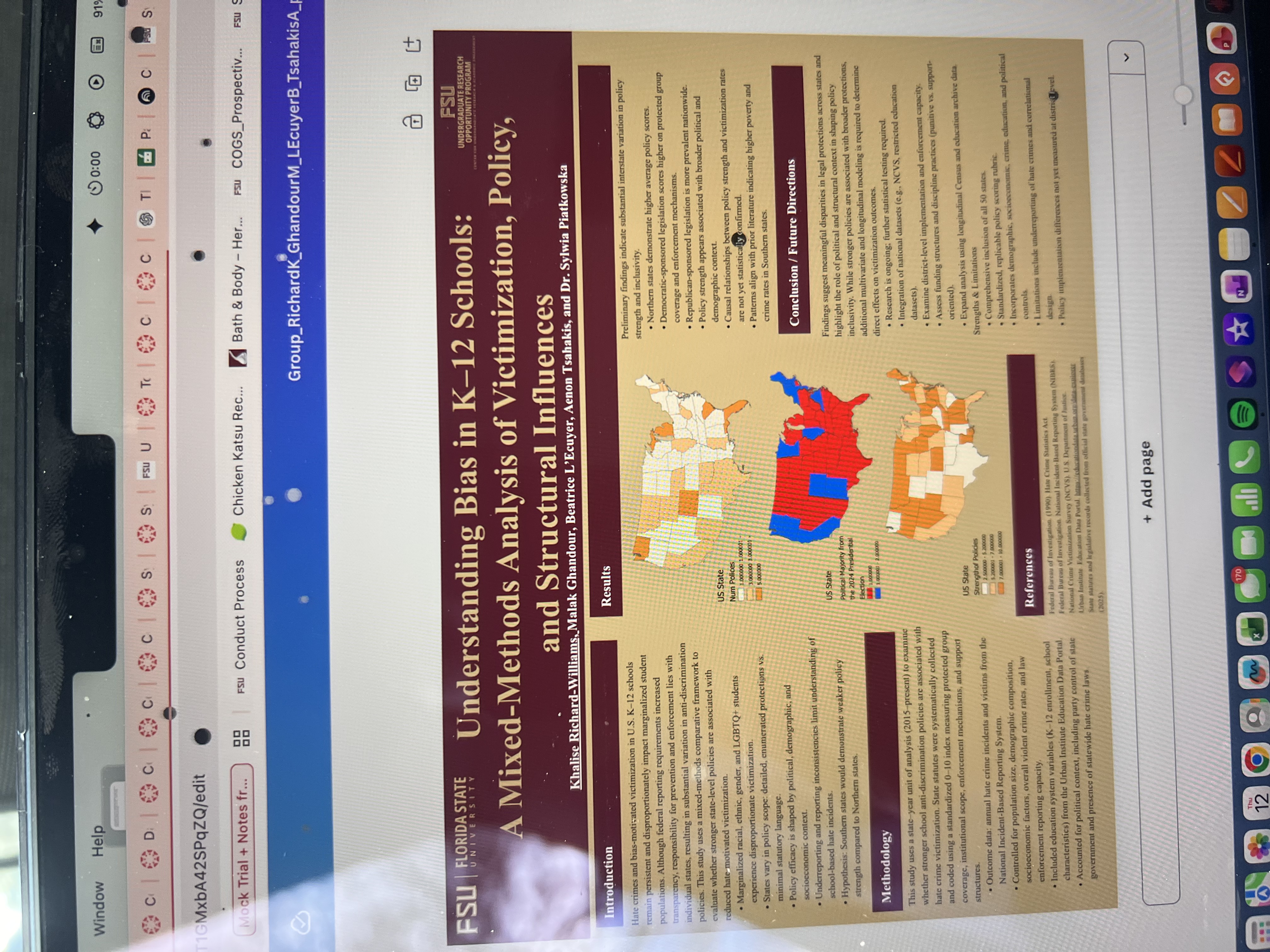
Hate crimes and bias-motivated victimization in U.S. K–12 schools remain persistent and disproportionately impact marginalized student populations. Although federal reporting requirements increased transparency, responsibility for prevention and enforcement lies with individual states, resulting in substantial variation in anti-discrimination policies. This study uses a mixed-methods comparative framework to evaluate whether stronger state-level policies are associated with reduced hate-motivated victimization.
- Marginalized racial, ethnic, gender, and LGBTQ+ students experience disproportionate victimization.
- States vary in policy scope: detailed, enumerated protections vs. minimal statutory language.
- Policy efficacy is shaped by political, demographic, and socioeconomic context.
- Underreporting and reporting inconsistencies limit understanding of school-based hate incidents.
- Hypothesis: Southern states would demonstrate weaker policy strength compared to Northern states.
Keywords: Legislation, Public Policy, Hate Crime