
Research Symposium
26th annual Undergraduate Research Symposium, April 1, 2026
Sabri Hanley Poster Session 3: 1:45 pm - 2:45 pm / Poster #81

BIO
Sabri Hanley is a first-year Presidential Scholar majoring in Modern Languages and Linguistics. He has worked with Dr. Matthew Patience throughout this project and, through this mentorship, has been able to learn a great deal about research within the field of linguistics. He is hoping to pursue graduate school and eventually a Ph.D. with future career plans involving academia.
Speech Motor Skill in Indigenous Language Acquisition
Authors: Sabri Hanley, Dr. Matthew PatienceStudent Major: Modern Languages and Linguistics
Mentor: Dr. Matthew Patience
Mentor's Department: Modern Languages and Linguistics Mentor's College: Arts and Sciences Co-Presenters:
Abstract
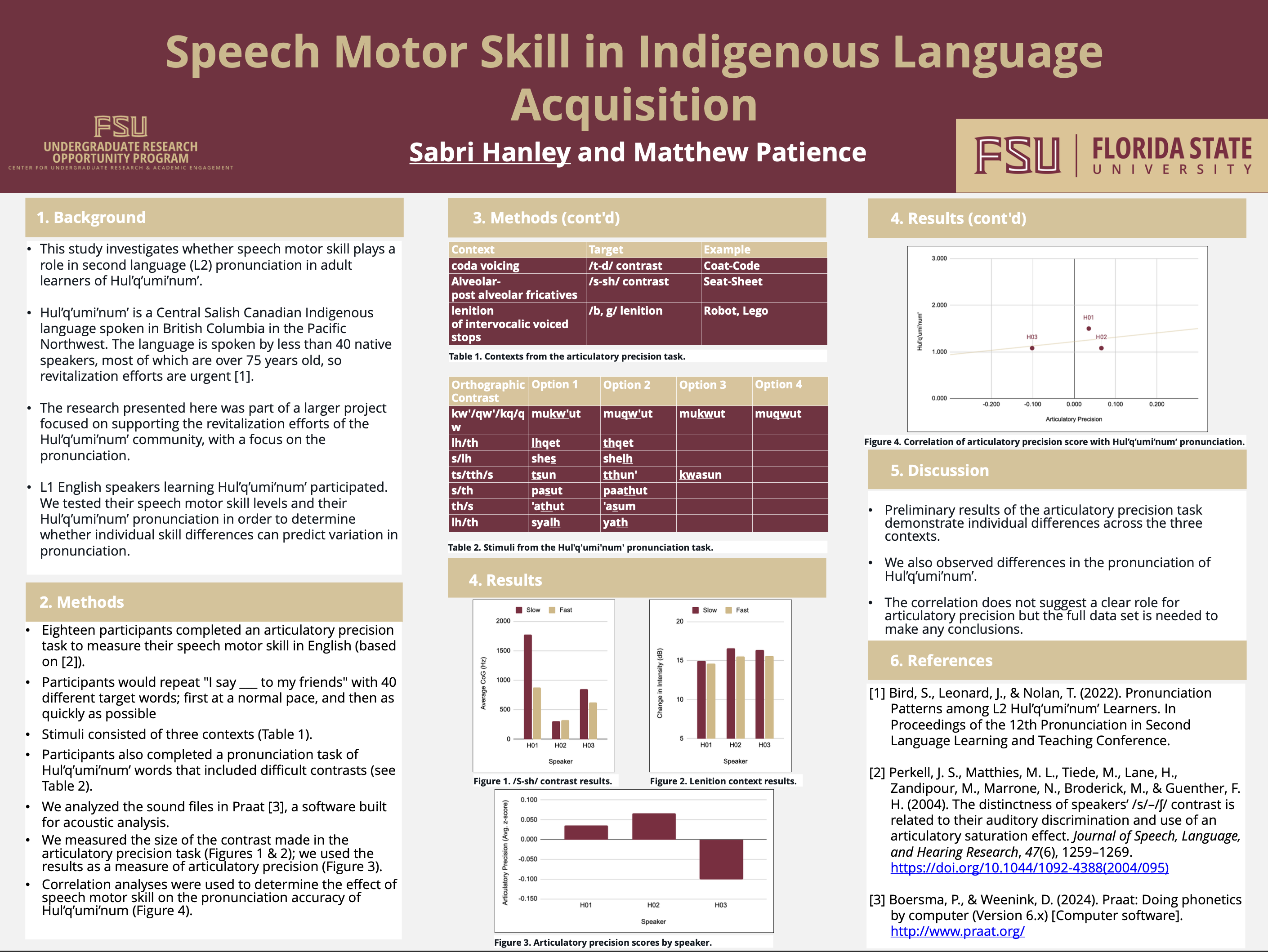
A primary focus in L2 pronunciation research is the significant variation in how successfully adults acquire non-native phonology. While existing studies, such as Saito et al. (2020), suggest that perceptual acuity is a key driver of this variance, the influence of general speech motor skills remains unexplored. This study investigates how these underlying skill differences affect L2 pronunciation, specifically within the context of adult learners of Hul’q’umi’num’, a Canadian Indigenous language characterized by its intricate phonological structure. The study was part of a larger project focused on contributing to the revitalization of Hul’q’umi’num’.
Eighteen participants were given an articulatory precision task (used as a measure of speech motor skill) in English, their first language, and a pronunciation task in Hul’q’umi’num’. The English task consisted of saying 40 target words in a carrier sentence (I say _____ to my friends), first at a normal pace and then as fast as possible. Stimuli consisted of three contexts: coda voicing (e.g., coat-code), s-sh (e.g., seat-sheet), and intervocalic voiced stops, which are often lenited in rapid speech (e.g., bubble). We acoustically analyzed the sound files in Praat. Participants who maintained the largest contrast in the fast condition were considered to have the strongest articulatory precision. The participants also produced 17 Hul’q’umi’num’ words that included difficult contrasts such as /k-q/. Correlation analyses were then used to determine the effect of speech motor skill on the pronunciation accuracy of Hul’q’umi’num’. Data analysis and results are in progress.
Keywords: language, linguistics, Canada, indigenous, speech