
Research Symposium
26th annual Undergraduate Research Symposium, April 1, 2026
Khaled Bouaziz Poster Session 4: 3:00 pm - 4:00 pm / Poster #307
BIO
Khaled is a second-year student at Florida State University double majoring in Geology and Environmental Science. He has been working under the guidance of research mentors Neda Mobasher and Dr. Alyssa Atwood to develop coral δ18O paleoclimate reconstructions from Kiritimati, Kiribati to reconstruct changes in ENSO over the last millennium. Khaled hopes to pursue higher education after his bachelors, specifically in geochemistry and adjacent fields.
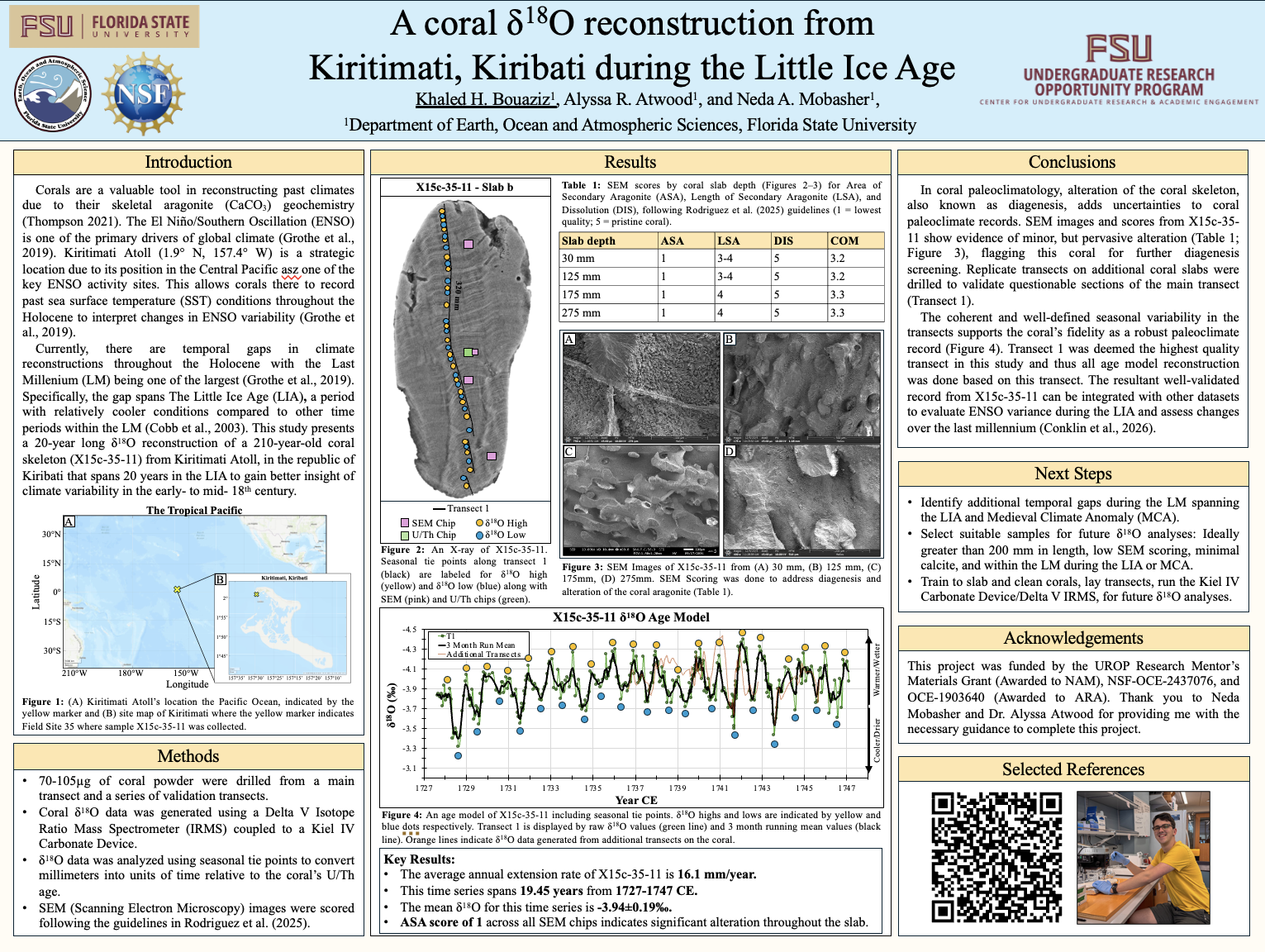
A coral δ18O reconstruction from Kiritimati, Kiribati during the Little Ice Age
Authors: Khaled Bouaziz, Neda MobasherStudent Major: Geology, Environmental Science
Mentor: Neda Mobasher
Mentor's Department: Department of Earth, Oceanic, and Atmospheric Sciences Mentor's College: College of Arts & Sciences Co-Presenters:
Abstract
El Niño/Southern Oscillation (ENSO) is the dominant mode of interannual variability and drives global climate patterns. Paleoclimate proxies from scleractinian “stony” corals can be used to reconstruct past changes in sea surface temperatures and interpret changes in climate variability. Currently, there are many temporal gaps in available coral geochemical data from the Central Pacific, with the last millennium being one of the largest data gaps in the coral record. This study focuses on the Little Ice Age, a period with relatively cooler conditions compared to other time periods within the last millennium. We hope to better understand the extent of ENSO variability throughout this time period.
We present a coral fossil (X15c-35-11) from Kiritimati, Kiribati (1.9° N, 157.4° W) that spans from 1728-1748 CE. 70-105µg sub-samples of coral powder were drilled following a transect on the primary growth axis of the coral and analyzed for δ18O and δ13C using a using a Kiel IV Carbonate Device coupled to a Delta V Isotope Ratio Mass Spectrometer. Using this method, coral δ18O values were generated during the period of coral growth. Seasonal tie points were assigned to the coral to convert the coral depth into units of time which allowed for the calculation of the coral growth rate and the interpretation of climate variability during the early- to mid- 18th century. We discuss the potential for future studies to expand on this work.
Keywords: Paleoclimate, Climate, Coral, Geochemistry, ENSO