
Research Symposium
26th annual Undergraduate Research Symposium, April 1, 2026
Beatrice L'Ecuyer Poster Session 3: 1:45 pm - 2:45 pm / Poster #43

BIO
A second-year student in the Honors Program, Beatrice L'Ecuyer is working towards completing a Bachelor of Science in Criminology with a double major in Psychology and a minor in Social Work at Florida State University. She is currently a member of the Honors Student Association, the Assistant Executive Director of a nonprofit organization, the Fundraising Chair for Lambda Alpha Epsilon, and is training to be an Honors Colloquium Leader for the fall. Beatrice has a deep interest in how psychology and the criminal justice system interact, with a particular focus on justice-involved youth. After graduating, she hopes to attend graduate school to learn more about how to help those impacted by the criminal justice system.
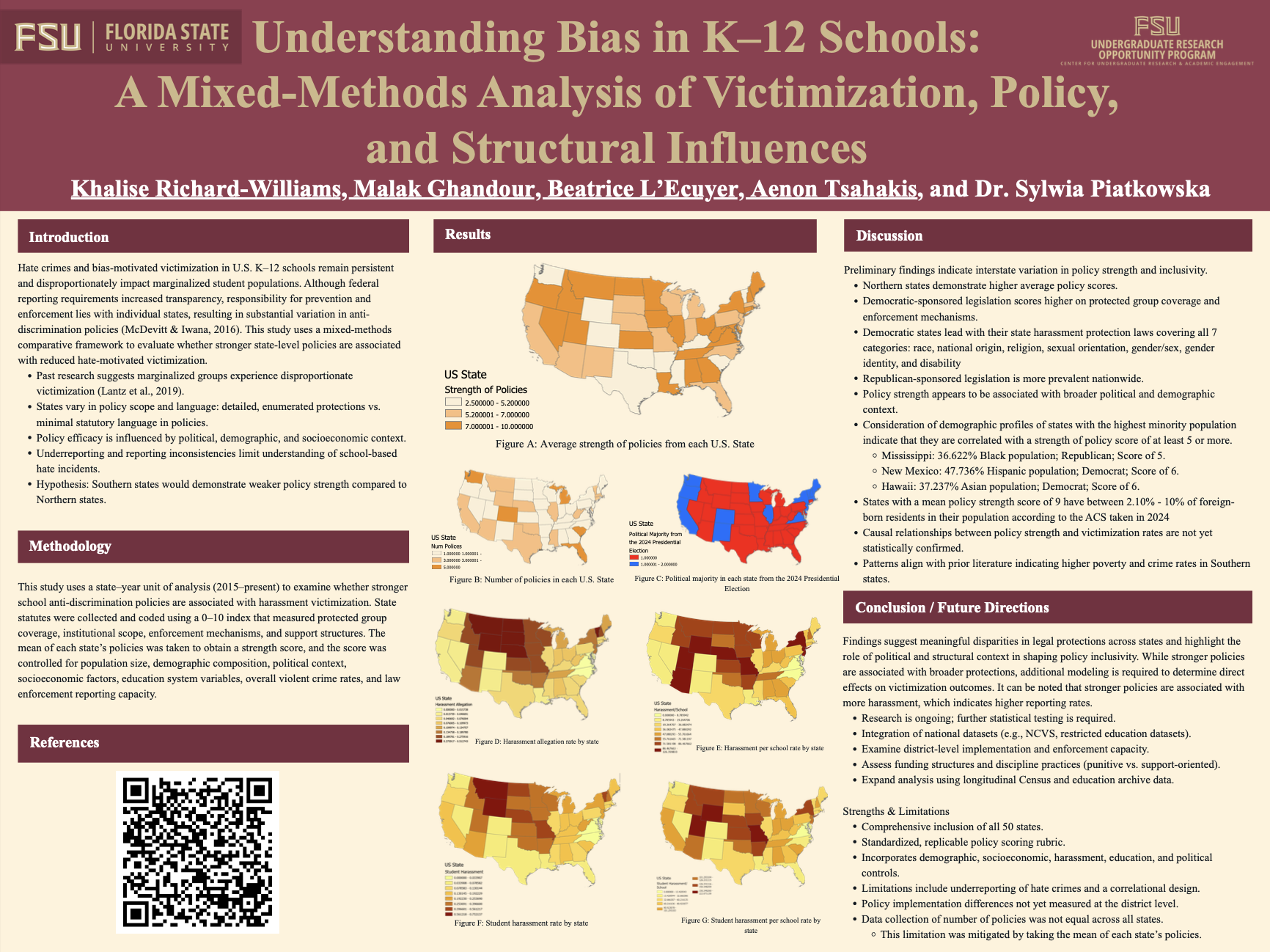
Understanding Bias in K-12 Schools: A Mixed-Methods Analysis of Victimization, Policy, and Structural Influences
Authors: Beatrice L'Ecuyer, Dr. Sylwia J. PiatkowskaStudent Major: Criminology and Psychology
Mentor: Dr. Sylwia J. Piatkowska
Mentor's Department: International and Comparative Criminology Mentor's College: College of Criminology and Criminal Justice Co-Presenters: Malak Ghandour, Aenon Tsahakis, and Khalise Richard-Williams
Abstract
Hate crimes and bias-motivated harassment in U.S. K–12 schools have drawn sustained attention from policymakers, scholars, and the public as incidents in educational settings have become more visible in national reporting. Federal intervention through the Hate Crime Statistics Act mandated the systematic collection of hate crime data by the FBI, increasing transparency around bias-related incidents occurring in schools. Despite this federal data infrastructure, responsibility for prevention and response largely remains at the state level, where legislative approaches vary considerably. By examining the variations and effectiveness of state-level school policies, the research seeks to determine whether stronger legislative policies are associated with improved outcomes and safer educational environments. Through a review of statutes, legislative records, and state constitutional provisions across all 50 states, policies are coded and scored on the basis of protected groups, enforcement mechanisms, institutional scope, and representational inclusivity. Comparative quantitative analysis incorporates controls for political affiliation, regional crime rates, demographic composition, and socioeconomic conditions to isolate policy effects. Preliminary findings reveal substantial interstate variation in policy strength, with more comprehensive protections often concentrated in northern states. Democratic-sponsored policies generally receive higher inclusivity scores than Republican-sponsored legislation, though further statistical testing is required to establish causal relationships. The current findings provide a foundation for future research using national databases to assess long-term policy outcomes and their impact on reducing hate-related incidents in schools. These insights will empower policymakers to implement effective, evidence-based strategies that safeguard marginalized students and ensure equitable, high-quality educational experiences for all communities.
Keywords: Victimization, Harassment, and Policy