
Research Symposium
26th annual Undergraduate Research Symposium, April 1, 2026
Shaelyn Taylor Poster Session 4: 3:00 pm - 4:00 pm / Poster #10

BIO
Shaelyn Taylor is a current freshman at Florida State University studying Environmental Science and Policy and pursuing a Bachelor of Science degree. She is passionate about conserving Florida's unique ecosystems and combatting excessive urbanization via sustainability. Shaelyn graduated high school with an AP Capstone degree for her senior year research project on native plant advertising.
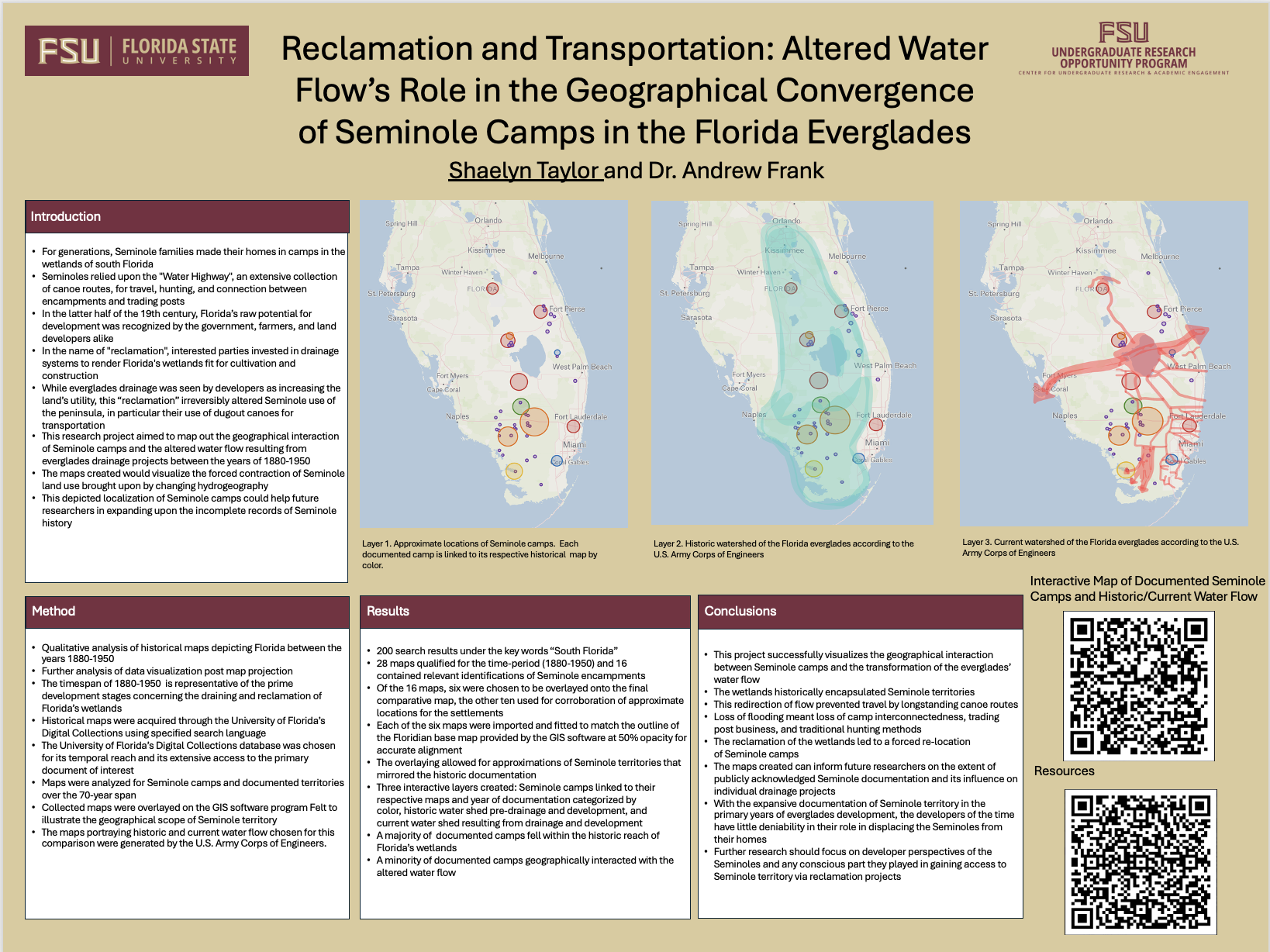
Reclamation and Transportation: Altered Water Flow’s Role in the Geographical Convergence of Seminole Camps in the Florida Everglades
Authors: Shaelyn Taylor, Dr. Andrew FrankStudent Major: Environmental Science and Policy
Mentor: Dr. Andrew Frank
Mentor's Department: Department of History Mentor's College: College of Arts and Sciences Co-Presenters:
Abstract
In the latter half of the 19th century, Florida’s raw potential for development was recognized by the government, farmers, and land developers alike. Theoretically, the composition of the uninhabitable wetlands could be changed through the engineering of drainage systems to yield dry land for cultivation and construction. While Everglades drainage was seen as increasing the land’s utility, Seminole families had made their homes in the wetlands of south Florida for generations. The “reclamation” of the Everglade's irreversibly altered Seminole use of the peninsula, in particular their use of dugout canoes for transportation. This research project aims to map out the geographical interaction of Seminole camps and the altered water flow resulting from Everglades drainage projects between the years of 1880-1950 to better visualize the forced contraction of Seminole land use brought upon by increased development. This information could help future researchers in expanding upon the incomplete records of Seminole History. Historical maps acquired through the University of Florida’s Digital Collections using specified search language were analyzed for Seminole camps and documented territories over the 70 year span. This data was then overlayed with maps portraying the historical and post-reclamation water shed using the GIS and mapping platform Felt.com. The analysis revealed that many Seminole camps populating south Florida were deserted where altered water flow led to a loss of wetlands, and therefore transportation. The changing geography deprived Seminoles of long-standing canoe routes and imposed an indirect relocation of extended encampments.
Keywords: History, Seminoles, Everglades, Maps