
Research Symposium
26th annual Undergraduate Research Symposium, April 1, 2026
Kiyan Atighechi Poster Session 2: 10:45 am - 11:45 am / Poster #264

BIO
Hi, my name is Kiyan Atighechi, I am an Applied Math and CS major in my second year here at FSU. I've enjoyed working on our deep learning project so much over the year and am proud of the progress we have made.
AI-DRIVEN VULNERABILITY AND MALWARE DETECTION IN WINDOWS BINARIES
Authors: Kiyan Atighechi, Sharanya JayaramanStudent Major: Economics (in the process of changing to Applied Math and CS so that is what I will put in my bio)
Mentor: Sharanya Jayaraman
Mentor's Department: Computer Science Mentor's College: Arts & Sciences Co-Presenters: Aakanksha Pathak
Abstract
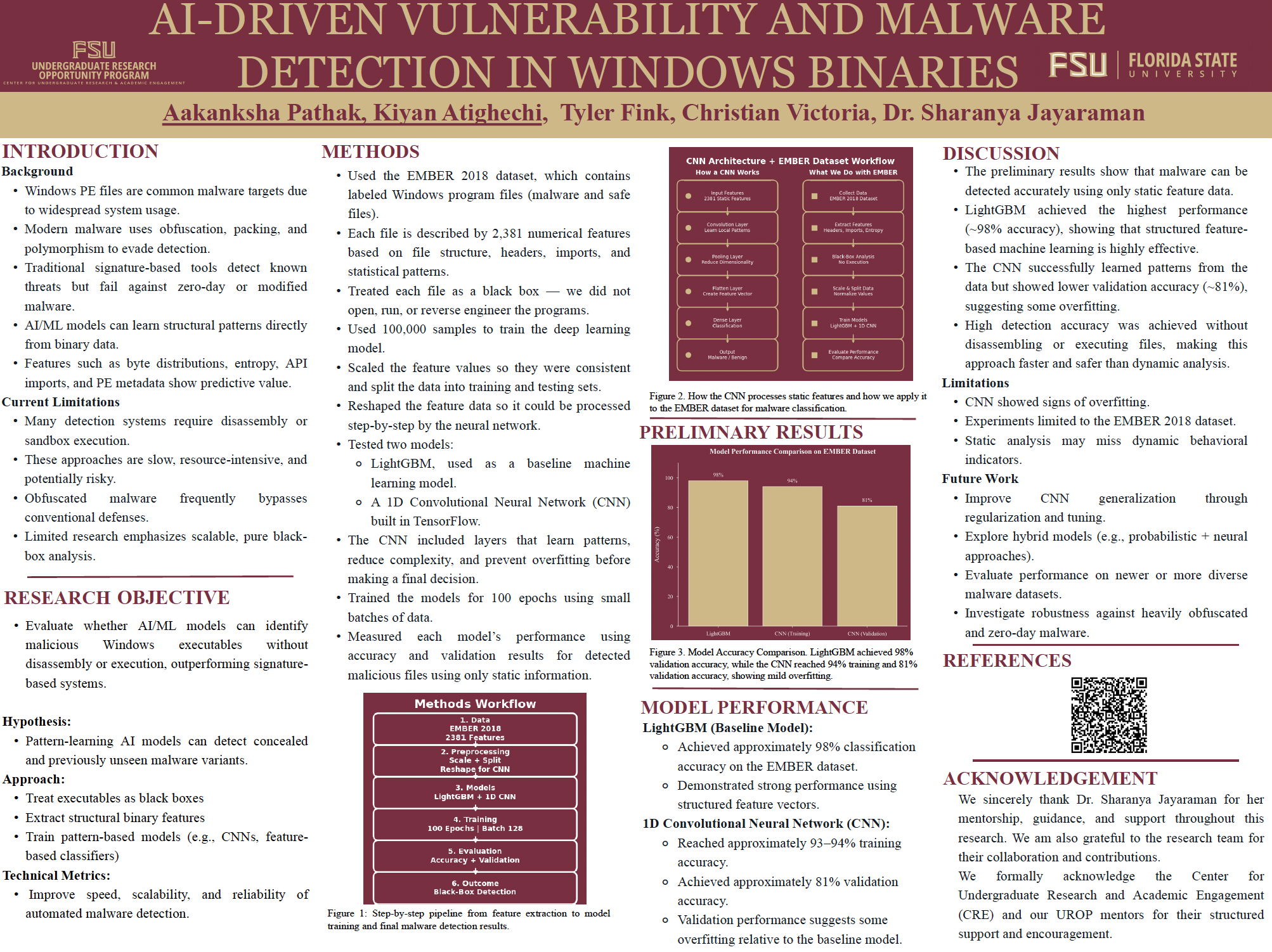
Malware and software defects in Windows applications continue to pose serious security risks, especially since hackers are using techniques to hide or disguise malicious activity. This study uses machine learning (ML) and artificial intelligence (AI) techniques to analyze Windows executable files without disassembly in an effort to improve malware and vulnerability detection.The project examines whether structural and behavioral patterns alone can identify serious security risks by viewing each program as a "black box." The study utilizes datasets of both known benign and malicious Windows binaries. Characteristics such as byte-level patterns, entropy values, API calls, and PE-header details are extracted and then refined through normalization and feature selection. These characteristics are subsequently employed to train and assess machine learning and deep-learning models, including Convolutional Neural Networks (CNNs), Markov Chain-based models, and other types of classifiers, to differentiate malicious files from those deemed safe. Initial findings suggest that artificial intelligence models can effectively identify harmful activities, including hidden or disguised malware, with greater accuracy than traditional methods that rely on signatures. The results suggest that analyzing patterns is a useful way to find threats that traditional methods might miss,so it can be applied to larger or more complex datasets. In summary, this research contributes to the development of faster, more scalable, and more reliable methods for detecting malware. The results advocate for the implementation of AI-based strategies to enhance cybersecurity measures and improve the automated evaluation of Windows software.
see less
Keywords: Machine Learning, Artificial Intelligence, Cyber Security