
Research Symposium
26th annual Undergraduate Research Symposium, April 1, 2026
Natalie Johnstone Poster Session 4: 3:00 pm - 4:00 pm / Poster #14

BIO
My name is Natalie Johnstone, and I am a sophomore majoring in Biological Sciences. I am planning on pursuing medical school to become a pathologist. My interests include immunology, virology, pathology, and microbiology.
Innate Immune Response to the Bacterial Quorum Sensing Molecule N-(3-oxododecanoyl) Homoserine Lactone
Authors: Natalie Johnstone, Kislay ParvatiyarStudent Major: Biological Sciences
Mentor: Kislay Parvatiyar
Mentor's Department: Health, Nutrition, and Food Sciences Mentor's College: Anne Spencer Daves College of Education, Health, and Human Sciences Co-Presenters: Cameron Goodwin
Abstract
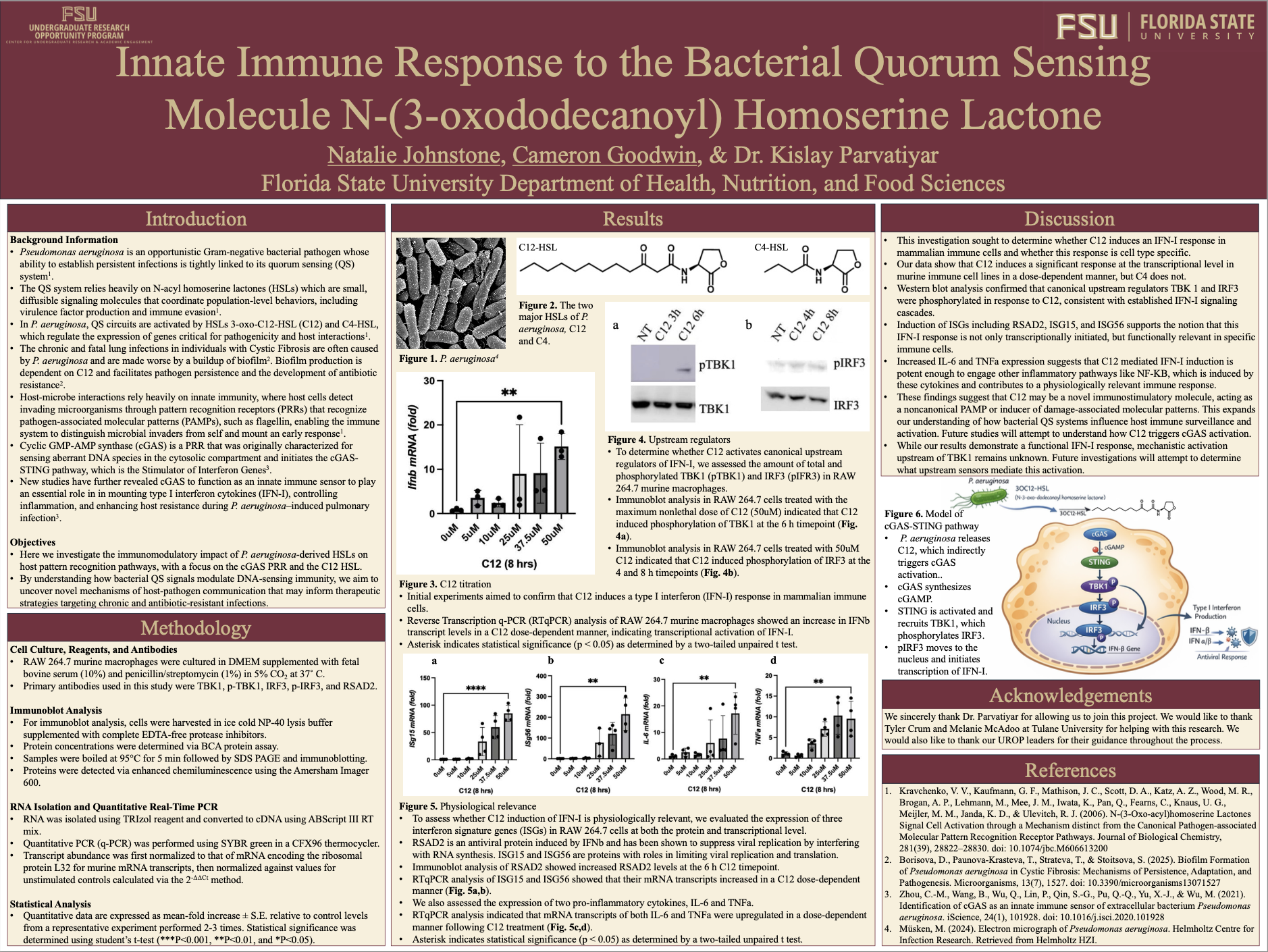
The chronic and fatal lung infections in individuals with Cystic Fibrosis are often caused by the bacterium Pseudomonas aeruginosa and are made worse by the buildup of biofilm. The production of this biofilm is dependent on the bacterial quorum sensing (QS) molecule N-(3-oxo-dodecanoyl)-L-homoserine lactone, known as C12. QS molecules are increasingly recognized as critical mediators of host-pathogen interactions, yet their direct impact on innate immune signaling remains incompletely defined. Utilizing the murine macrophage cell line RAW 264.7, we tested whether C12 and N-butyryl homoserine lactone (C4) induce type 1 interferon (IFN-I) cytokine expression. We demonstrated that C12 robustly induces IFN-I expression, while C4 does not, revealing a previously underappreciated facet of QS-mediated host signaling. To determine whether C12 activates upstream regulators of IFN-I, we assessed the effect of C12 on interferon regulatory factor 3 (IRF3), a transcription factor necessary to IFN-I gene induction. Immunoblot analyses revealed that C12 promotes the phosphorylation and activation of IRF3. We also found that the C12-induced production of IFN-I mediates the JAK-STAT signaling pathway, allowing for production of interferon signature genes (ISGs). We then evaluated the expression of three ISGs and found that their mRNA transcripts increased in a C12 dose-dependent manner. These findings indicate that C12 may act as or cause a pathogen associated molecular pattern detected by pattern recognition receptors. These results provide new insight into the molecular mechanisms by which P. aeruginosa manipulates host innate immune responses and highlight QS molecules as potential modulators of Stimulator of Interferon Genes (STING)-driven inflammatory pathways.
Keywords: Innate immune system, Pseudomonas aeruginosa, quorum sensing, homoserine lactone, type I interferons