
Research Symposium
26th annual Undergraduate Research Symposium, April 1, 2026
Princeton Pun Poster Session 3: 1:45 pm - 2:45 pm / Poster #184

BIO
Princeton is a freshman at Florida State University majoring in Applied and Computational Mathematics who is also planning to take a minor in Computer Science and Statistics. His primary interest is in leveraging statistical analysis of real-world data and rigorous hypothesis testing of economic models to refine quantitative trading strategies. Beyond that, he likes playing soccer and tennis whenever he happens to be free.
Risk vs Ambiguity: Reducing Hedging by Changing Payment Structure
Authors: Princeton Pun, Jose LopezStudent Major: Applied and Computational Mathematics
Mentor: Jose Lopez
Mentor's Department: Department of Economics Mentor's College: College of Social Sciences and Public Policy Co-Presenters: Emmanuela Avlonitis, Victoria Blackwell
Abstract
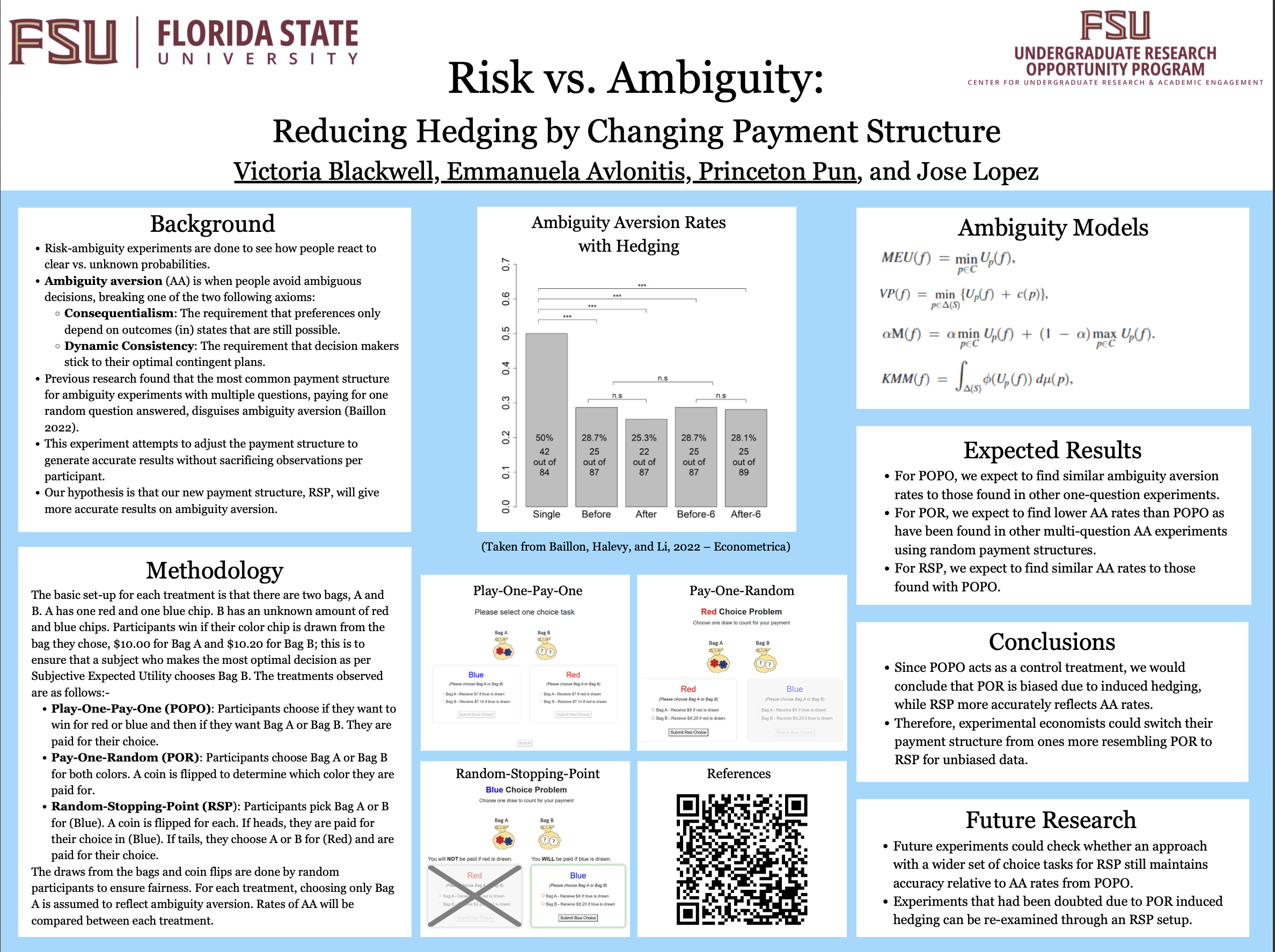
It is well established that pay-one-random and play-one-pay-one schemes in experiments comparing risk and ambiguity yield narrow data breadth or suffer from incentive incompatibility due to hedging opportunities. Consequently, the Random Stopping Procedure (RSP) has been proposed as a mechanism to extract data efficiently while maintaining incentive compatibility.
Our research examines this theory by testing participants using the RSP in an ambiguity experiment. In this setup, participants first choose between Bag A (risky) and Bag B (ambiguous) for the color Blue. A coin is then flipped. If it lands on heads, the experiment stops, and participants are paid based on their choice for Blue. If it lands on tails, they proceed to choose between Bag A and Bag B for the color Red, and are paid based on this second choice.
The payout for the risky bag is $10.00, while the payout for the ambiguous bag is $10.20. Participants receive this payout if their chosen color is randomly drawn from their selected bag. This premium ensures that a subject optimizing their Subjective Expected Utility (SEU) will strictly prefer the ambiguous bag for at least one of the colors.
The results of this experiment are crucial for understanding innate ambiguity aversion within populations. Financial institutions can leverage these insights to assess market volatility during uncertain periods, which is highly relevant for quantitative trading strategies.
Keywords: Hedging, Ambiguity, Quantitative Trading, Economics