
Research Symposium
26th annual Undergraduate Research Symposium, April 1, 2026
Ty Biser Poster Session 3: 1:45 pm - 2:45 pm / Poster #303
BIO
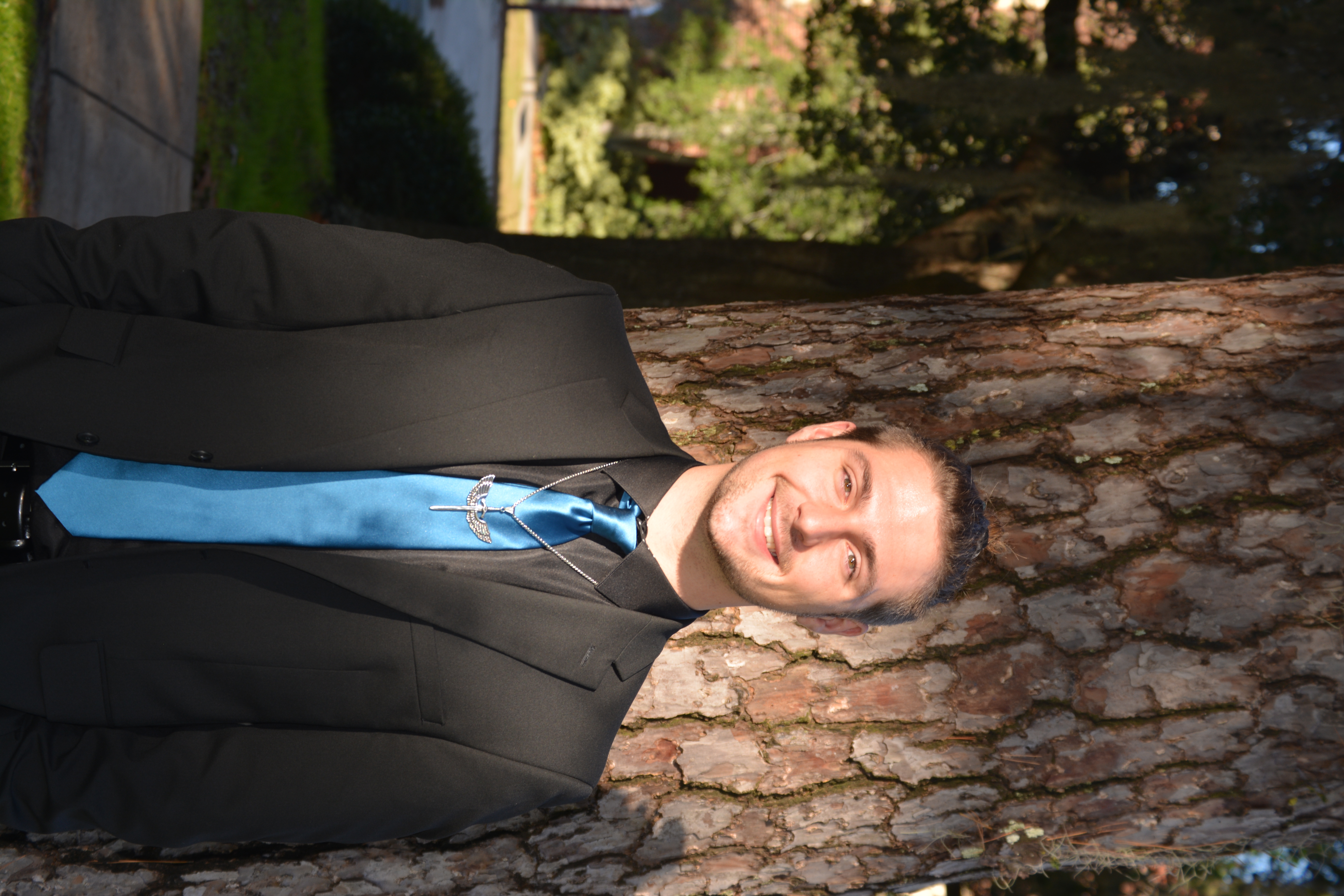
Ty Biser (he/they) is a second-year majoring in geography and minoring in women and gender studies. They are the Founding President of the Geographical Society at FSU, and the 2027 Student Representative of the Florida Society of Geographers. He has been working with Dr. Rachael Cofield (they/them) for over a year, and seeks to become a professor of geography.
Queer Labor in Southern Suburbia
Authors: Ty Biser, Dr. Rachael CofieldStudent Major: Geography
Mentor: Dr. Rachael Cofield
Mentor's Department: Geography Mentor's College: College of Social Sciences and Public Policy Co-Presenters:
Abstract
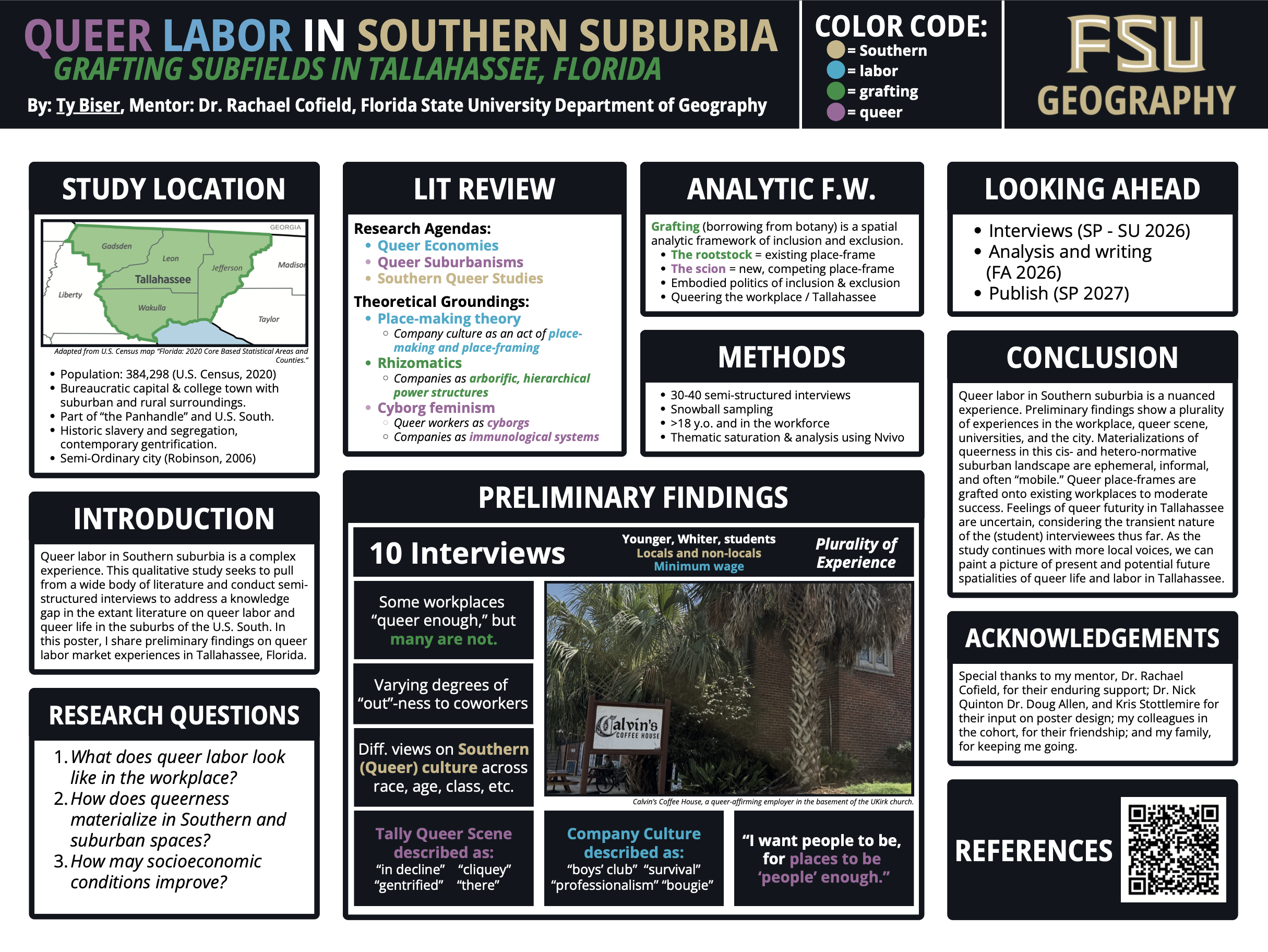
A paper on queer labor in Southern suburbia makes a botanist out of a geographer. From the old-growth forests of economic, urban, and queer geographic thought, two subfields, saplings, have been nurtured to address these complexities. First, the queer economies research agenda, stemming from Rowan Rush-Morgan (2023) and Daniel Cockayne (2024), holds that there is more to understand about how queer people navigate within and shape the economies they are a part of. The second, seeded by Gavin Brown (2008), Amy Stone (August 2018) and Alison Bain and Julia Podmore (2021; 2025), motions for an agenda on suburban/ordinary queerisms, one capable of articulating the differences in queer lifestyles across suburban environments and highly urbanized ones. Betwixt these nascent subfields lies the potential for collaboration and symbiosis. A good analogy would be that of botanical grafting, whereby a plant’s appendage is severed and affixed to another. Vulgar and violent, botanists perform grafting for the promise of new value. Grafting these subfields may create a hardy perspective capable of answering both agendas, while also recontextualizing queer labor within a new dialogue. Examining queer labor in the Tallahassee Metropolitan Area, a suburban centre in the U.S. South, this study reveals new insights into the collaboration of economic, queer, and urban geographies, and how grafting may recontextualize both post-disciplinary thinking and the similarly grafted circumstances and violent symbiosis of queer laborers in the cis- and hetero-normative spaces of suburbia, the South, and the American workplace.
Keywords: queer, urban, suburban, economic