
Research Symposium
26th annual Undergraduate Research Symposium, April 1, 2026
Nathan Sanborn Poster Session 3: 1:45 pm - 2:45 pm / Poster #119

BIO
Nathan Sanborn is a junior majoring in History with a minor in Education at Florida State University. His research focuses on nineteenth-century European diplomacy and political violence. He works with archival diplomatic correspondence from the early nineteenth century, transcribing and analyzing previously unstudied letters to examine how European envoys described repression, alliance tensions, and political instability. His research uses rhetorical analysis and positioning theory to better understand how diplomatic language framed political actors and crises during moments of uncertainty.
Nathan plans to continue developing his research through conference presentations and further archival work. After completing his Bachelor of Arts in History, Nathan hopes to pursue graduate study and eventually teach and conduct research in the field of history.
Diplomatic Language and Repression in Post-Napoleonic Germany
Authors: Nathan Sanborn, George S. WilliamsonStudent Major: History
Mentor: George S. Williamson
Mentor's Department: Department of History Mentor's College: College of Arts and Sciences Co-Presenters:
Abstract
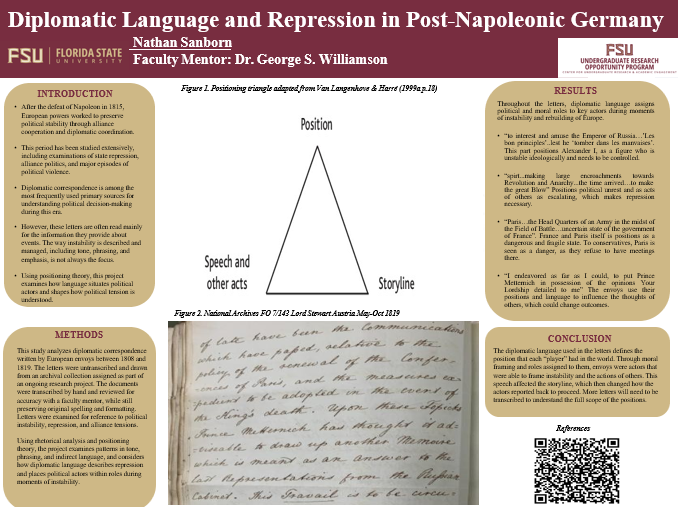
This project looks at how European envoys described political tension after Napoleon. Diplomatic correspondence is often treated as straightforward reporting, but the wording matters. Using positioning theory, I analyze letters written between 1808 and 1819 to see how language places political actors into roles and builds a storyline about instability. The documents were originally untranscribed. I transcribed them by hand and checked them with my faculty mentor while preserving original spelling and formatting. Across the letters, envoys portray certain figures as needing control, describe revolutionary pressures as growing toward a breaking point, and frame Paris and the French government as fragile and dangerous. They also show envoys actively passing along opinions in ways meant to shape what other decision makers think. Reading the letters this way highlights how diplomatic language could make repression appear reasonable and could affect how instability was understood inside the alliance.
Keywords: Political Violence, Repression, Germany, European Diplomacy, 19th-Century Europe