
Research Symposium
26th annual Undergraduate Research Symposium, April 1, 2026
Morgan Brown Poster Session 2: 10:45 am - 11:45 am / Poster #244

BIO
Morgan Brown is originally from Boca Raton, Florida. She is currently majoring in Psychology with a strong interest in internalizing disorders, particularly treatment-resistant depression and suicide ideation. Her academic focus centers on using neurophysiology techniques to explore the complex neural mechanisms that underlie psychiatric disorders & suicidality and how novel treatment paradigms, such as Transcranial Magnetic Stimulation (TMS), can support and enhance psychotherapies.
Over the past year, Morgan has been involved in various projects between two research labs (PI: Dr. Sarah Brown & PI: Dr. Justin Riddle). These projects include investigating the neural basis of cognitive control using frequency-specific TMS, assessing the role of suicide imagery in suicide risk, and evaluating the efficacy of cross-frequency transcranial alternating current stimulation in anhedonic depression. Additionally, she has been working to complete her Honors Thesis with Dr. Brown with the aim of assessing how negative mood states influence inhibitory control using an Emotional Stop-Signal Task. Outside of research, Morgan serves as a UROP Leader where she co-teaches a group of underclassmen the principles of research.
Moving forward, Morgan is looking forward to pursuing a career where she can intertwine her passion for research with clinical care utilizing neuromodulation tools such as TMS. Soon, she will be applying to Clinical Psychology Ph.D. programs with an emphasis on understanding the neurobiology of depression and suicide risk.
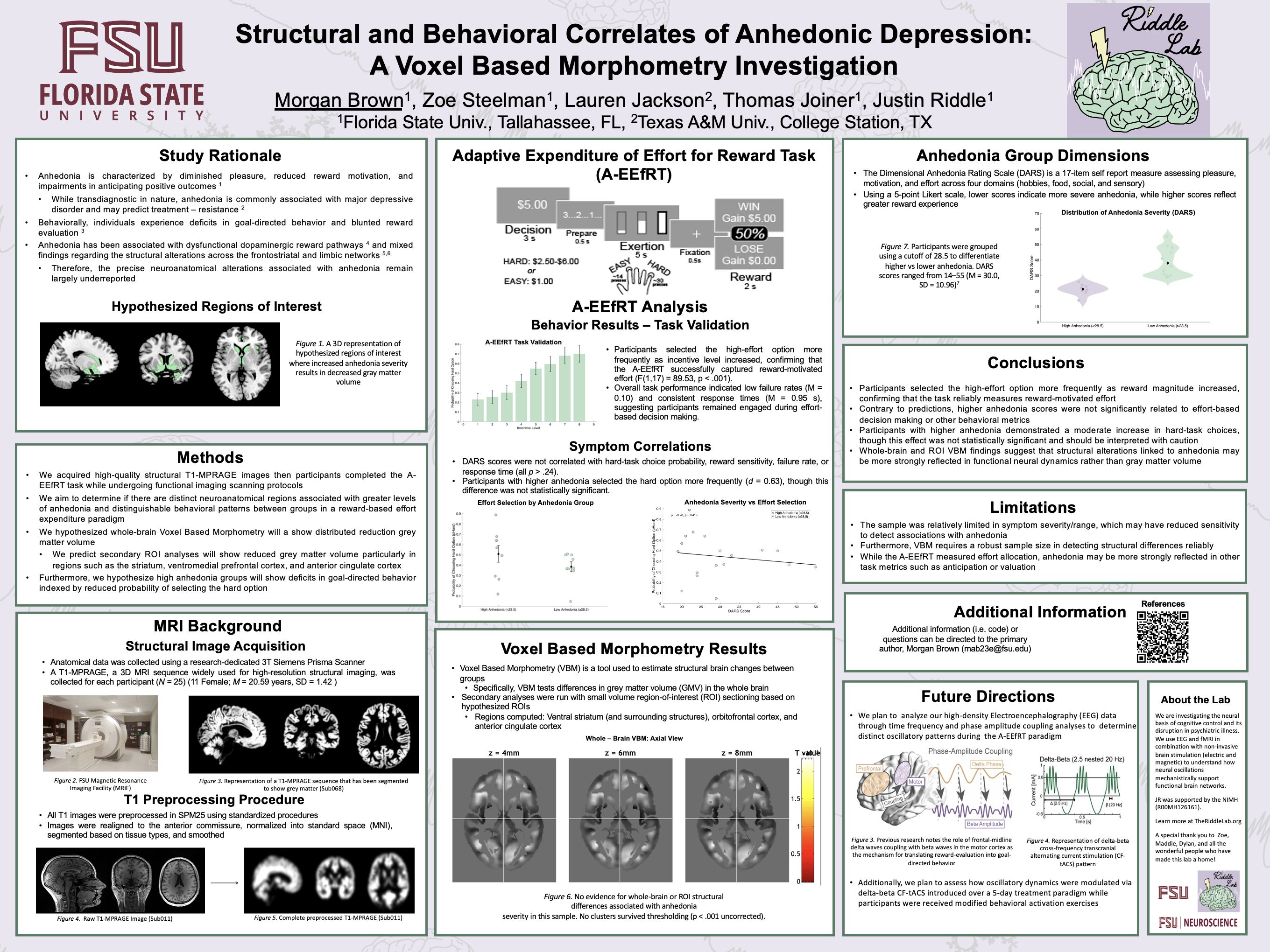
Structural and Behavioral Correlates of Anhedonic Depression: A Voxel Based Morphometry Investigation
Authors: Morgan Brown, Dr. Justin RiddleStudent Major: Psychology
Mentor: Dr. Justin Riddle
Mentor's Department: Department of Psychology, Program in Neuroscience Mentor's College: College of Arts and Sciences Co-Presenters:
Abstract
Anhedonia, while transdiagnostic in nature, represents a core symptom of major depressive disorder and is characterized by diminished pleasure, reduced reward motivation, and impairments in anticipating positive outcomes. Clinically, individuals with elevated anhedonia demonstrate decreased reward-seeking behavior and a bias toward negative expectancy matching. Neurobiologically, anhedonia has been associated with dysfunction in dopaminergic reward circuitry and structural alterations across frontostriatal and limbic networks; however, the precise neuroanatomical mechanisms underlying anhedonic depression are not fully elucidated. The present study utilizes whole-brain & region of interest (ROI) voxel-based morphometry (VBM) to examine grey matter volume differences associated with increased anhedonic depression symptoms, as measured by the Dimensional Anhedonia Rating Scale (DARS). Additionally, we aim to determine if there are distinguishable behavioral patterns between anhedonia groups in a reward-based effort expenditure paradigm. We hypothesize that higher prevalence of anhedonia symptoms will be associated with reduced grey matter volume in key reward-related regions, including the ventral striatum, orbitofrontal cortex, anterior cingulate cortex, and temporal lobe structures. Furthermore, we hypothesize groups higher in anhedonia will display deficits in goal-directed behavior. By identifying structural and behavioral markers of anhedonic depression, this work aims to inform targeted interventions for a population that often demonstrates treatment resistance and worsened clinical prognosis.
Keywords: Anhedonia, depression, reward, MRI