
Research Symposium
26th annual Undergraduate Research Symposium, April 1, 2026
Sarah Montero Poster Session 2: 10:45 am - 11:45 am / Poster #214

BIO
Sarah Montero is a second-year FSU student from South Florida double majoring in Criminology and Psychology. Sarah is grateful for the opportunity to gain experience and develop her research skills in preparation for graduate school, where she intends to earn a Master’s in Public Administration and/or Criminology. She enjoys reading and learning about the ways in which psychological and criminological research informs the implementation and evaluation of current practices, accounting for the costs, benefits, and possible barriers to effective implementation.
Smart Use or Overuse? How Students' AI Patterns Shape Learning
Authors: Sarah Montero, Hongcui DuStudent Major: Criminology and Psychology
Mentor: Hongcui Du
Mentor's Department: Psychology; Florida Center for Reading Research Mentor's College: Arts and Sciences Co-Presenters:
Abstract
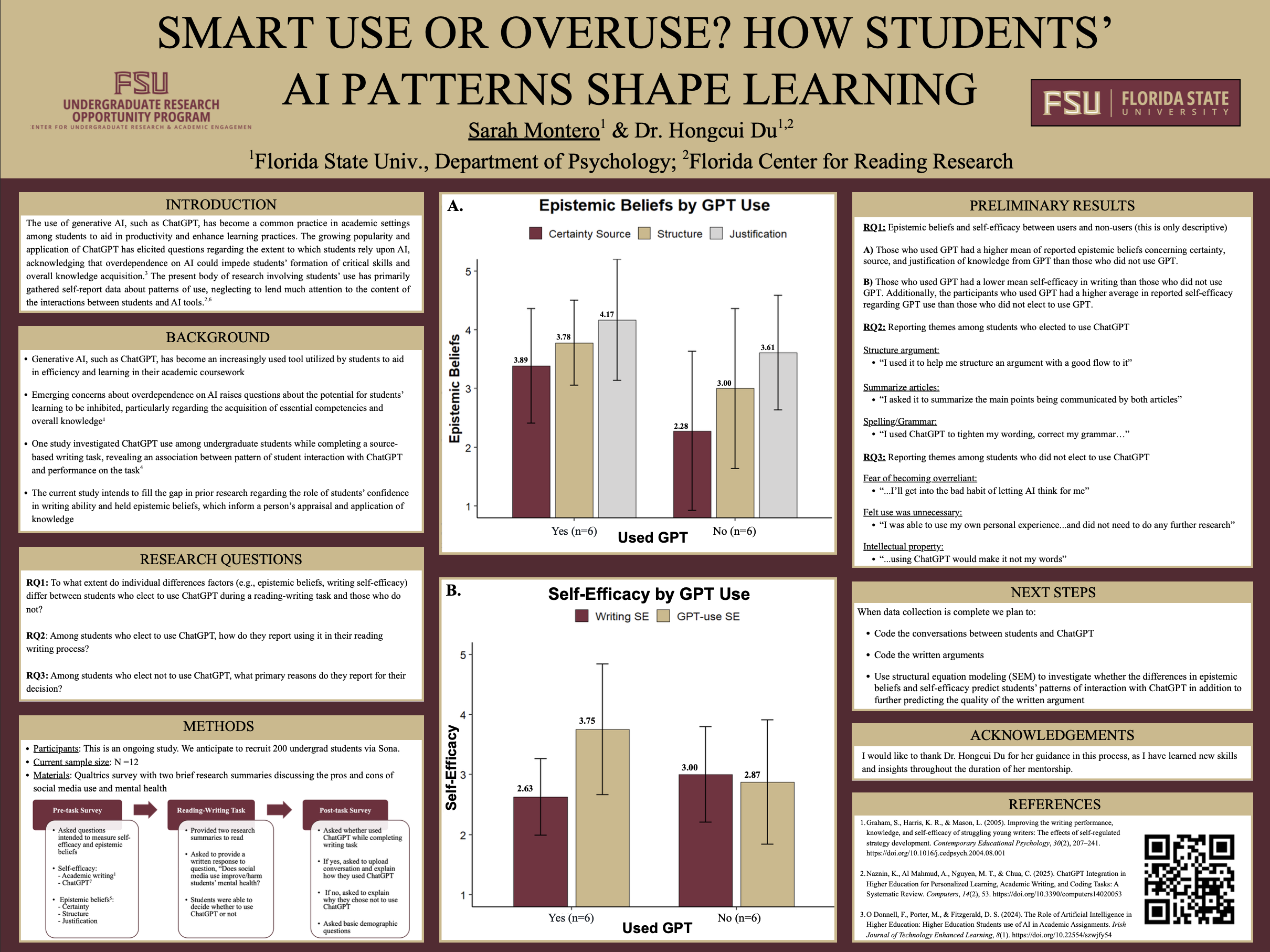
The use of generative AI, such as ChatGPT, has become a common practice in academic settings among students to aid in productivity and enhance learning practices. The growing popularity and application of ChatGPT has elicited questions regarding the extent to which students rely upon AI, acknowledging that overdependence on AI could impede students’ formation of critical skills and overall knowledge acquisition. The present body of research involving students’ use has primarily gathered self-report data about patterns of use, neglecting to lend much attention to the content of the interactions between students and AI tools. The current study seeks to examine the interplay of individual differences, such as confidence in writing ability and epistemic beliefs, in predicting patterns of AI usage and overall performance in academic writing tasks. This ongoing correlational study aims to recruit approximately 200 undergraduate students who will be administered a Qualtrics survey comprising three main components. In addition to asking questions regarding epistemic beliefs, self-efficacy in academic writing and utilizing ChatGPT, and demographic information, students are presented with an academic reading-writing task, of which they have the option to use ChatGPT to complete. Participants are asked to upload their conversations with ChatGPT if they choose to use it in their writing task. We expect the distinctions in observed epistemic beliefs and self-efficacy to forecast the patterns of AI interactions among students and overall performance on the task.
Keywords: AI, ChatGPT, Learning, Reading-Writing Task