
Research Symposium
26th annual Undergraduate Research Symposium, April 1, 2026
Oscar Gurdian Poster Session 3: 1:45 pm - 2:45 pm / Poster #79

BIO
Oscar Gurdian is a student at Florida State University pursuing a Bachelor of Science in Political Science with interests in law, history, and public affairs. As a first-year student with junior-level credit standing, he has been named to the President’s List and is a recipient of the FSU Vires Scholarship of Achievement and the Florida Bright Futures Scholarship.
Gurdian participates in the Undergraduate Research Opportunity Program (UROP) at Florida State University, where he works under the mentorship of Professor George Williamson. His research focuses on domestic terrorism in nineteenth-century Germany, contributing to collaborative historical analysis and presentations for the university’s Undergraduate Research Symposium.
Beyond research, Gurdian serves on the Standards Committee of the Kappa Alpha Pi Pre-Law Fraternity and has pursued professional experience through internships in both government and legal settings. He previously served as a Constituent Services Caseworker in a district office of a member of the U.S. House of Representatives, assisting constituents with federal agencies and case coordination. He later interned at Lydecker LLP, where he conducted legal research, analyzed case materials, and contributed to litigation preparation.
The Continental Consequences of the Assassination of August von Kotzebue
Authors: Oscar Gurdian, George WilliamsonStudent Major: Political Science
Mentor: George Williamson
Mentor's Department: Department of History Mentor's College: College of Arts and Sciences Co-Presenters: Victoria Pivatelli, Charalampos Archavlis
Abstract
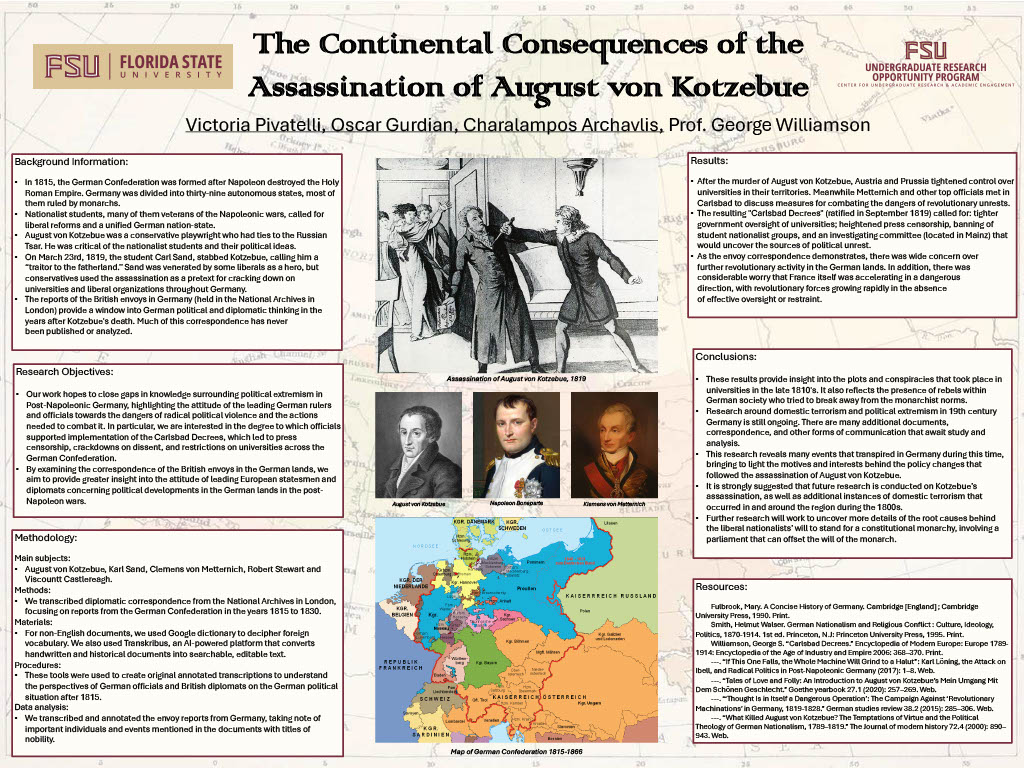
On March 23, 1819, August von Kotzebue, a German playwright famous across Europe for his conservative commentaries on culture, was assassinated by University of Jena student Karl Sand. This assassination reflected the deep rivalry between conservative royalists and liberal nationalists, where the European ruling class feared a rise in revolutionary anti-monarchist thought after Napoleon’s rampage across Europe. Our research focuses on the extent to which this event was used to justify silencing dissent, censoring the press, and restricting academia across Europe. Our team analyzed, transcribed, annotated, and translated archived materials from English and French diplomatic envoys. To transcribe and translate, we adjusted image exposure and brightness and used Google dictionary to decipher French and English text. The main topic discussed was the tense situations in universities where political fraternity groups hostile to monarchies were organizing. Our research suggests that many German students sought a united German state, which they operated clandestinely in universities to oppose the monarchies. Although authorities believed few students adhered to these radical revolutionary ideas, they still proposed extensive restrictions on universities through the Carlsbad Decrees. The study of government responses to political violence is important to the stability of our political systems, as the potential for the exploitation of chaos threatens the permanent regression of civil liberties.
Keywords: German History, Politics, Study of Terrorism