
Research Symposium
26th annual Undergraduate Research Symposium, April 1, 2026
Julia DeBardeleben Poster Session 3: 1:45 pm - 2:45 pm / Poster #195

BIO
Julia DeBardeleben is a fourth-year undergraduate majoring in art history with minors in anthropology and museum studies. She will be defending her Honors in the Major thesis in April, written under the direction of Dr. Erika Loic in the Department of Art History. Julia was awarded the Bess H. Ward Honors Conference Award, and will be presenting her research in May at the International Congress on Medieval Studies in Kalamazoo, Michigan. After she graduates in May, Julia will be pursuing a master’s degree in library science.
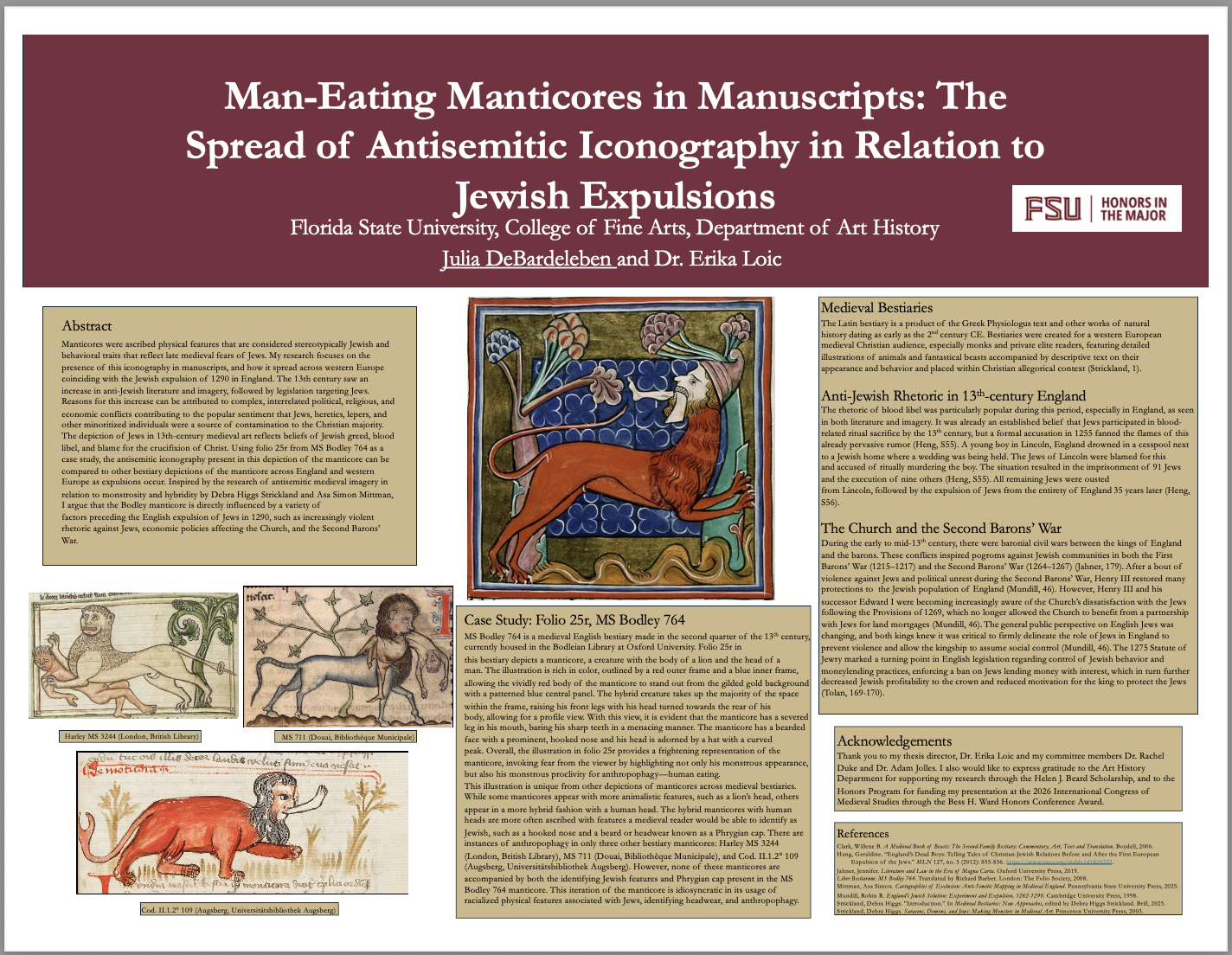
Man-Eating Manticores in Manuscripts: The Spread of Antisemitic Iconography in Relation to Jewish Expulsions
Authors: Julia DeBardeleben, Dr. Erika LoicStudent Major: Art History
Mentor: Dr. Erika Loic
Mentor's Department: Department of Art History Mentor's College: College of Fine Arts Co-Presenters:
Abstract
Manticores were ascribed physical features that are considered stereotypically Jewish and
behavioral traits that reflect late medieval fears of Jews. My research focuses on the
presence of this iconography in manuscripts, and how it spread across western Europe
coinciding with the Jewish expulsion of 1290 in England. The 13th century saw an
increase in anti-Jewish literature and imagery, followed by legislation targeting Jews.
Reasons for this increase can be attributed to complex, interrelated political, religious, and
economic conflicts contributing to the popular sentiment that Jews, heretics, lepers, and
other minoritized individuals were a source of contamination to the Christian majority.
The depiction of Jews in 13th-century medieval art reflects beliefs of Jewish greed, blood
libel, and blame for the crucifixion of Christ. Using folio 25r from MS Bodley 764 as a
case study, the antisemitic iconography present in this depiction of the manticore can be
compared to other bestiary depictions of the manticore across England and western
Europe as expulsions occur. Inspired by the research of antisemitic medieval imagery in
relation to monstrosity and hybridity by Debra Higgs Strickland and Asa Simon Mittman,
I argue that the Bodley manticore is directly influenced by a variety of
factors preceding the English expulsion of Jews in 1290, such as increasingly violent
rhetoric against Jews, economic policies affecting the Church, and the Second Barons’
War.
Keywords: art history, medieval, monsters