
Research Symposium
26th annual Undergraduate Research Symposium, April 1, 2026
Davion Slocum Poster Session 2: 10:45 am - 11:45 am / Poster #246

BIO
Davion is an undergraduate student majoring in Cell and Molecular Neuroscience and is passionate about understanding the biological foundations of human health and disease. He plans to pursue a career in medicine as a physician, as his academic experiences have strengthened his interest in neuroscience, human physiology, and patient care, while also developing his critical thinking and problem-solving skills. As a first-generation college student, Davion is motivated to use education as a way to create opportunities for himself and to give back to his community. He is committed to lifelong learning, service, and making a meaningful impact on others' lives through healthcare. In the future, Davion hopes to combine scientific knowledge with compassionate patient care to improve health outcomes and support individuals and families navigating complex medical challenges.
Cognitive Skills Model for Predicting Alzheimer's Disease
Authors: Davion Slocum, Dr. Dorota Kossowska-KuhnStudent Major: Cell and Molecular Neuroscience
Mentor: Dr. Dorota Kossowska-Kuhn
Mentor's Department: Psychology Mentor's College: Arts and Sciences Co-Presenters:
Abstract
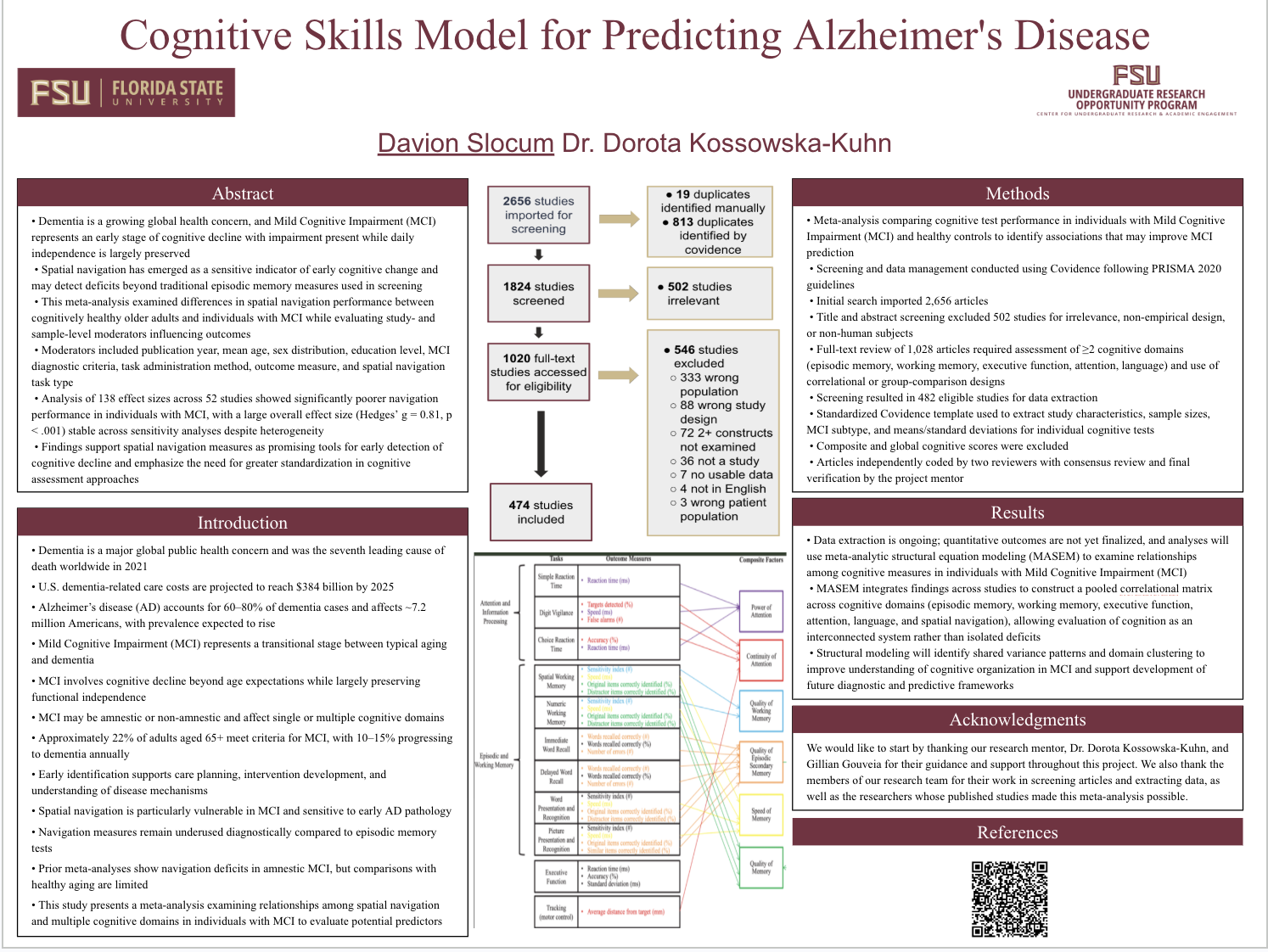
Dementia is a growing global health concern, and Mild Cognitive Impairment (MCI) represents a transitional stage of cognitive decline where measurable deficits occur while daily functional independence is largely preserved. Spatial navigation has emerged as a sensitive cognitive indicator of early decline and may reveal impairments that extend beyond traditional episodic memory measures commonly used in cognitive screening. This meta-analysis examined differences in spatial navigation performance between cognitively healthy older adults and individuals with MCI while evaluating study- and sample-level factors that may influence cognitive outcomes. Moderators included publication year, mean age, sex distribution, education level, MCI diagnostic criteria, task administration method, outcome measure, and spatial navigation task type. Analysis of 138 effect sizes across 52 studies showed significantly poorer navigation performance in individuals with MCI, with a large overall effect size (Hedges’ g = 0.81, p < .001) that remained stable across sensitivity analyses despite heterogeneity. These findings support spatial navigation as an important cognitive component associated with early decline and highlight the need for greater standardization in cognitive assessments used to study Alzheimer’s disease risk.
Keywords: Alzheimer, Dementia, Spatial Navigation, Prediction