
Research Symposium
26th annual Undergraduate Research Symposium, April 1, 2026
Sofia Sierra Poster Session 2: 10:45 am - 11:45 am / Poster #118

BIO
Sofia Sierra is a first-year pre-medical student studying Cell and Molecular Neuroscience and gaining experience in both clinical and research settings. She is a Vires Scholar, a Dean's List student, and a part of the Honors Program. Her current research on Elasmobranchs is through her invested interest, but she is currently working as a lab assistant and studying neurobiology and behavior patterns of Chorus Frogs under the Lemmon Lab. With the support of Dr. Emily Lemmon and Domenica Aguirre, Sofia is able to gain technical lab skills and opportunities to advance her own research. Sofia is working to combine the fields between healthcare, research, and conservation, pursuing an MD/PhD in Biomedical Neuroscience. She loves learning about the brain, sharks, and how to better care for others.
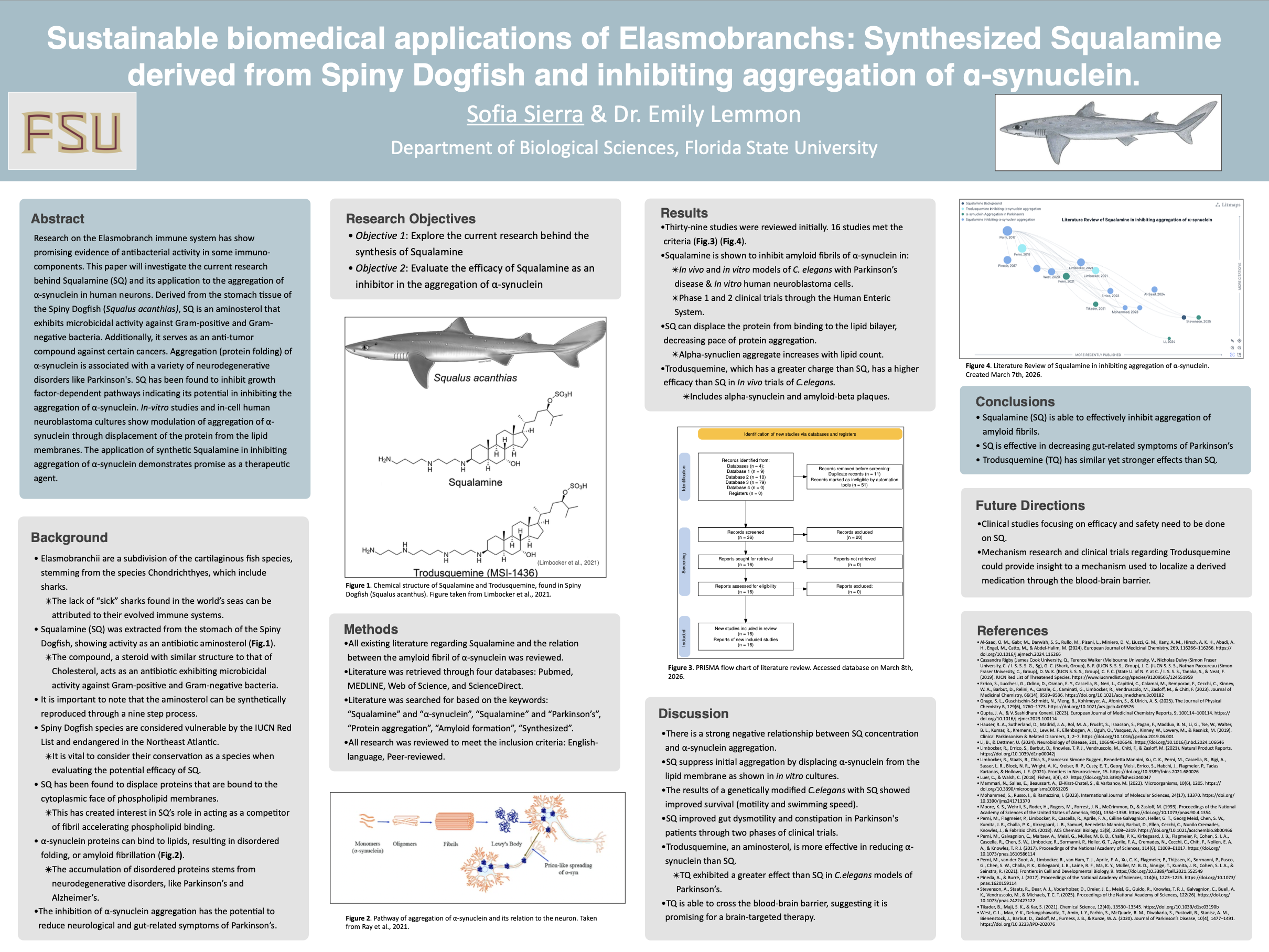
Sustainable biomedical applications of Elasmobranchs: Synthesized Squalamine derived from Spiny Dogfish and inhibiting aggregation of α-synuclein.
Authors: Sofia Sierra, Dr. Emily LemmonStudent Major: Cell and Molecular Neuroscience
Mentor: Dr. Emily Lemmon
Mentor's Department: Biological Sciences Mentor's College: College of Arts and Sciences Co-Presenters:
Abstract
The bioactive compounds present in marine ecosystems have proved effective as major therapeutic treatments for the prevention of bacterial and degenerative illnesses. Elasmobranchs have successfully evolved over 400 million years, partly from a low incidence of disease stemming from an adaptive immune system. Given the rarity of the elasmobranch immune system, previous studies have gathered collections of compounds that contain potential for pharmaceutical therapeutics. Preliminary research on the immuno-components of Elasmobranchs have demonstrated promising antibacterial activity. Still, the biomedical implications are at the developmental stages due to scepticism surrounding long-term effectiveness and sustainability. In an effort to focus on one Elasmobranch-derived antibiotic that can be synthetically replicated, this paper will investigate the current research behind the genesis of Squalamine and its application to the aggregation of α-synuclein in human neurons. Derived from the stomach tissue of the Spiny Dogfish (Squalus acanthias), Squalamine is an aminosterol that exhibits microbicidal activity against Gram-positive and Gram-negative bacteria. Additionally, it serves as an antiangiogenic and antitumor compound against certain cancers. Aggregation of α-synuclein is associated with the pathogenesis of a variety of neurodegenerative disorders like Parkinson's. Squalamine has been found to inhibit growth factor-dependent pathways and displace proteins on the cytoplasmic layer of the plasma membrane, both indicating its potential in inhibiting the aggregation of α-synuclein. In-vitro studies and in-cell human neuroblastoma cultures show modulation of aggregation of α-synuclein through displacement of the protein from the lipid membranes. The application of synthetic Squalamine in inhibiting aggregation of α-synuclein demonstrates promise as a therapeutic agent.
Keywords: Proteins, Parkinson's, Elasmobranch, Biomedical