
Research Symposium
26th annual Undergraduate Research Symposium, April 1, 2026
Laila McCullers Poster Session 1: 9:30 am - 10:30 am / Poster #223

BIO
Laila McCullers is a freshman at Florida State University, majoring in Biological Sciences. Laila is from Fort Myers, Florida. Laila has been apart of UROP this year and has loved every second of it. By helping develop a game for healthy eating habits, it has been a fulfilling project. Laila would like to thank her mentor Chaewon Kim, and her research partner Nicky Ven for always supporting her. Her goal is to go to PA school after graduation. She would like to thank the UROP team for creating this great experience!
NutriQuest: A Serious Game for Improving Eating Habits in Young Adults
Authors: Laila McCullers, Chaewon KimStudent Major: Biological Sciences
Mentor: Chaewon Kim
Mentor's Department: College of Education Mentor's College: College of Education, Health, and Human Sciences Co-Presenters: Nicky Ven
Abstract
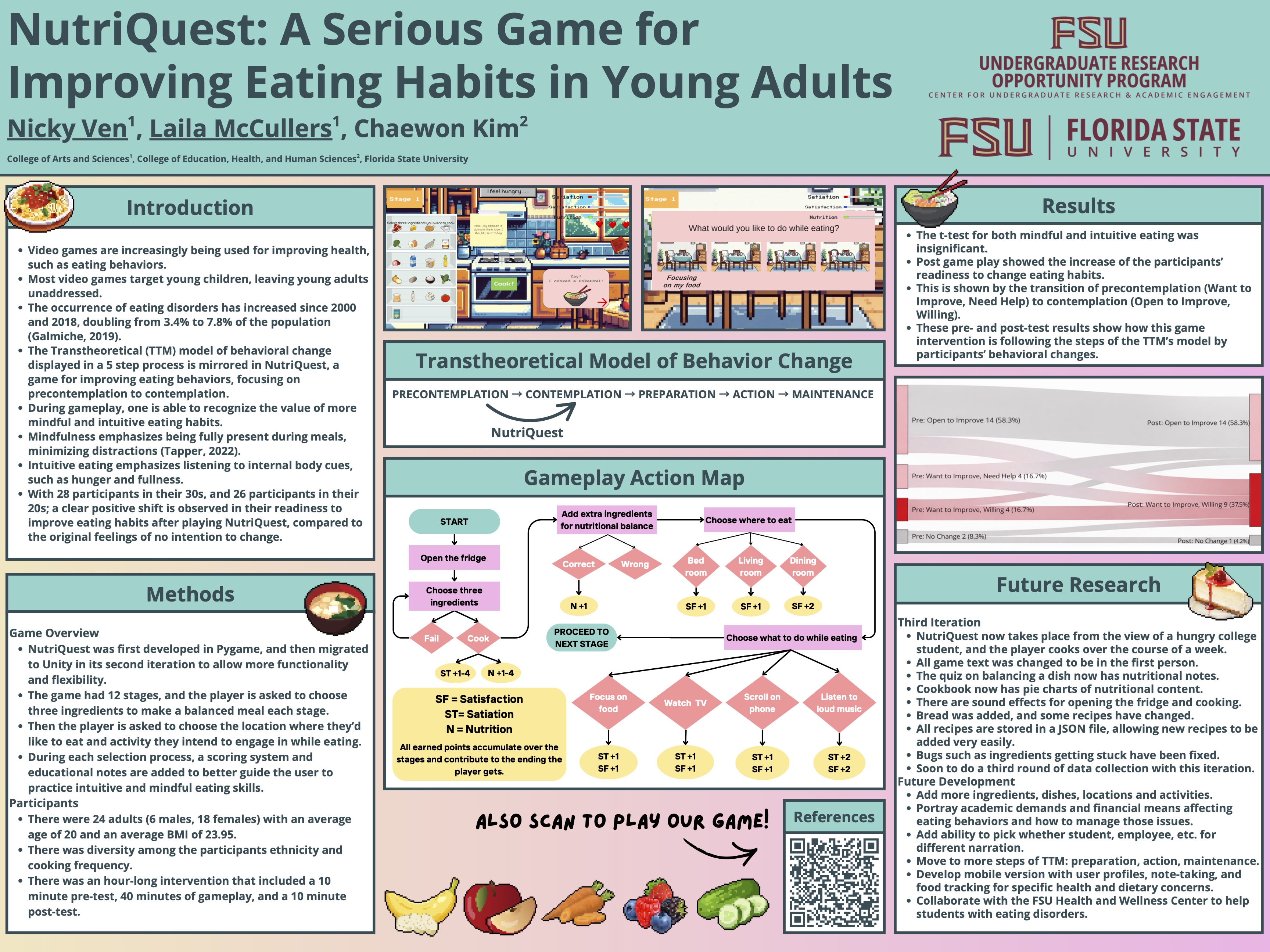
Video games have increasingly been used to improve health-related behaviors, including addiction, weight management, and eating practices. However, many of these interventions have primarily targeted young children, leaving young adults in their 20s and 30s, an age group particularly vulnerable to developing unhealthy eating habits due to stress and fast-paced lifestyles, largely unaddressed. Grounded in the transtheoretical model of behavior change (TTM), this study investigates the potential of NutriQuest, a serious game designed to promote mindful and intuitive eating, in supporting positive eating behavior change among young adults. TTM proposes that individuals progress through five stages of change: precontemplation, contemplation, preparation, action, and maintenance. By encouraging users to reflect on their daily eating patterns and cooking behaviors during gameplay, NutriQuest aims to guide players from precontemplation, where they are not yet considering change, toward contemplation, where they begin to recognize the value of adopting more mindful and intuitive eating habits. We tested the game with 28 participants in their 30s and 26 participants in their 20s. Results indicated a clear positive shift in readiness to improve eating habits, with users moving away from states of needing help or expressing no intention to change, and toward greater willingness and proactive engagement in the improvement process. Notably, no participants regressed to lower-readiness categories, suggesting that the game may effectively support forward momentum in behavior change. Future work will focus on refining the game experience and examining its long-term impact, particularly for individuals with disordered eating tendencies.
Keywords: Healthy Eating habits video game