
Research Symposium
26th annual Undergraduate Research Symposium, April 1, 2026
Lauren Talley Poster Session 3: 1:45 pm - 2:45 pm / Poster #115
BIO
Hello! My name is Lauren Talley, and I am a third-year undergraduate student from Coral Springs, Florida. I am pursing dual B.S. degrees in Psychology & Communication Science and Disorders with a minor certificate in Interdepartmental Developmental Disabilities. I am excited about pursuing a career in health care and plan on attending graduate school to become a Speech-Language Pathologist. I serve as the lead research assistant in the NoLab, Neurobiology of Language and Behavior, where I assist with research examining language processing and neurocognitive disorders. In addition to my research role, I work as a PCA in the Neurology department at Tallahassee Memorial HealthCare, gaining valuable clinical exposure to neurological conditions that affect communication. My academic and professional experiences have fueled my interest in understanding the neural mechanisms underlying language and cognition. I am grateful for the opportunity to present this research and engage with others in the field!
Impairment-Based Versus Dynamic Digital Language Therapy in Two Cases of Logopenic Variant Primary Progressive Aphasia
Authors: Lauren Talley, Sladjana LukicStudent Major: Psychology & Communication Science and Disorders
Mentor: Sladjana Lukic
Mentor's Department: School of Communication Science and Disorders Mentor's College: College of Communication & Information Co-Presenters:
Abstract
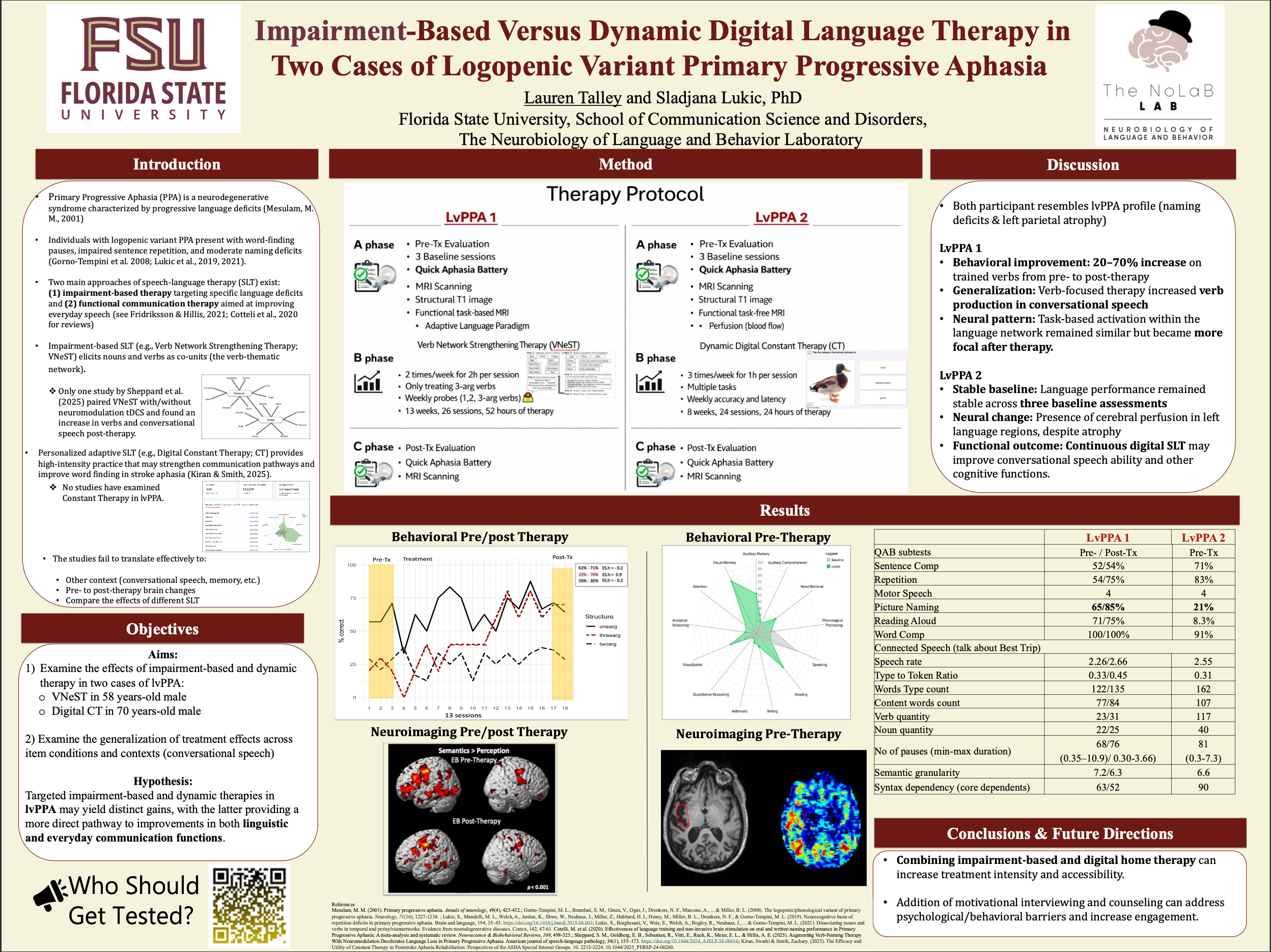
Primary Progressive Aphasia (PPA) is a neurodegenerative disorder marked by progressive language decline. Although impairment-based treatments such as Verb Network Strengthening Treatment (VNeST) have demonstrated gains in PPA, improvements are often limited to trained items, with unclear generalization to broader language abilities or everyday communication. This study reports two cases of logopenic variant PPA (lvPPA), examining behavioral and neural changes following two distinct interventions.
A 58-year-old male completed 13 weeks of VNeST (52 hours), while a 70-year-old participant received 8 weeks of client-centered digital therapy using Constant Therapy (24 hours), targeting functional generalization. Both participants underwent structural and functional neuroimaging pre- and post-treatment. Baseline assessments indicated word-finding and repetition deficits, and structural MRI revealed left temporoparietal atrophy consistent with lvPPA.
The VNeST participant improved verb naming by 47% on trained items (ESh = 0.9), with no gains on untrained items (ESh = −0.2), and demonstrated at least 20% improvement on standardized measures. The Constant Therapy participant showed sustained engagement and task-based language gains across digital exercises, along with improved perceived communicative ability.
Findings highlight differential patterns of treatment response and underscore the need to evaluate generalization and real-world communication outcomes in PPA interventions.
Keywords: Primary Progressive Aphasia, Language, Therapy