
Research Symposium
26th annual Undergraduate Research Symposium, April 1, 2026
Ha Phuong Nguyen Poster Session 1: 9:30 am - 10:30 am / Poster #227

BIO
Phuong Ha Nguyen is a dedicated undergraduate student at Florida State University, currently pursuing a Bachelor of Science in Biomedical Engineering with minors in Biological Sciences and Computer Science. Maintaining a 3.80 GPA, Phuong is currently in her second year of study and expects to graduate in May 2028. She has earned a Gold Medal in the Environmental Science category and a Special Award from the Malaysia Young Scientists Organization at the Youth International Science Fair 2023 in Bali, Indonesia.
Phuong's extensive research background is marked by a commitment to utilizing engineering principles to solve biological challenges. Phuong gained valuable clinical experience as a Laboratory Technician Intern at Vietnam Green Veterinary Joint Stock Company, performing diagnostic tests using PCR and real-time PCR. Phuong is also currently a Course-based Tutor for General Chemistry at the ACE Learning Studio, helping peers master complex problem-solving skills. She holds a leadership role as the Secretary for the FSU Badminton Club. Driven by a desire to bridge the gap between technology and healthcare, Phuong intends to pursue further research opportunities specifically focused on medicine and bioinformatics.
Food is the best medicine: developing starch with controlled digestion
Authors: Ha Phuong Nguyen, Yimin MaoStudent Major: Biomedical Engineering
Mentor: Yimin Mao
Mentor's Department: Chemical and Biomedical Engineering Mentor's College: FAMU-FSU College of Engineering Co-Presenters:
Abstract
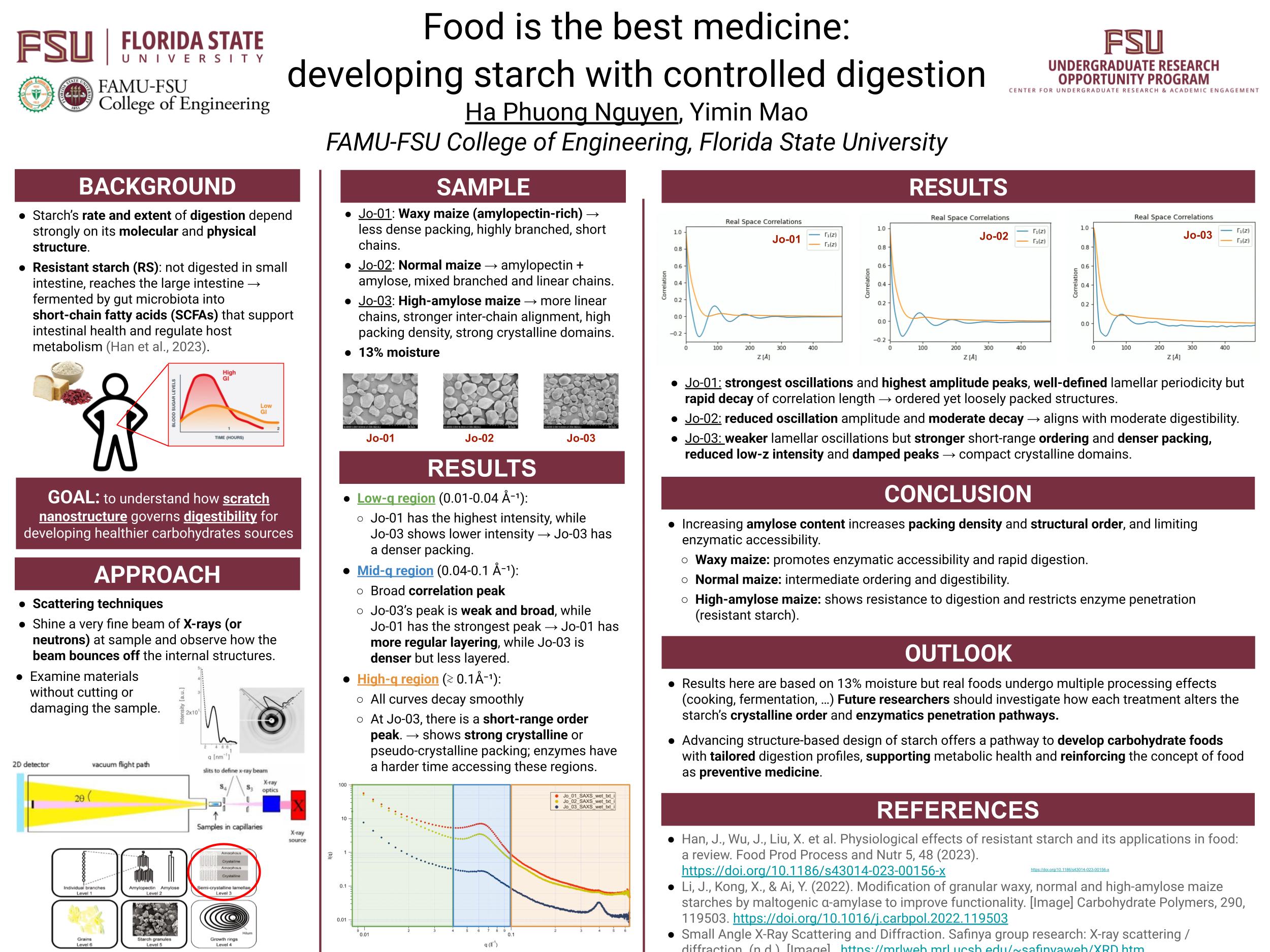
Starch is a major dietary carbohydrate that provides energy through enzymatic digestion, yet its rate and extent of digestion depend strongly on its molecular and physical structure. Certain starches, known as resistant starch (RS), are not digested in the small intestine and instead reach the large intestine. Because it is not rapidly converted into glucose, it leads to lower postprandial blood sugar and insulin responses and is associated with improved insulin sensitivity and lipid metabolism, reducing the risk of metabolic disorders. This study will help understand how starch structure governs digestibility for developing healthier carbohydrate sources. We apply the scattering technique to probe the internal nanostructure of three maize starches with distinct architectures: waxy maize (amylopectin-rich, highly branched), normal maize (mixed amylose/amylopectin), and high-amylose maize (predominantly linear chains). This technique enables non-destructive characterization of amorphous and crystalline domains that are directly linked to enzymatic accessibility. Our results demonstrate that starch digestibility is governed primarily by internal structural organization rather than chemical composition alone. Linear amylose promotes dense crystalline alignment that limits enzyme access, whereas extensive branching prevents tight packing and accelerates digestion. Understanding and controlling these structure-function relationships provides a rational framework for developing starch-based foods with tailored digestion profiles, supporting metabolic health, and reinforcing the concept that food can function as preventive medicine.
Keywords: starch, scattering techniques, amylose content