
Research Symposium
26th annual Undergraduate Research Symposium, April 1, 2026
Sofia Martinez Poster Session 3: 1:45 pm - 2:45 pm / Poster #45

BIO
Sofia Martinez is a second year student at Florida State University pursuing dual Bachelor of Science degrees in Nursing and Public Health on the pre-med track, with minors in Social Welfare and Chemistry. She chose to major in Nursing because it allows her to gain hands on clinical experience and a deeper understanding of patient care while preparing for to become a well-rounded physician.
Through the Undergraduate Research Opportunity Program, she conducts research focused on maternal and infant health under the mentorship of Dr. Bahorski. Her work explores maternal wellbeing during the postpartum period, including factors that influence recovery and support for new mothers. Her research interests are driven by her passion for improving outcomes for mothers and infants and by the fact that many areas of women’s health remain under researched, particularly postpartum recovery and maternal support.
In addition to research, Sofia serves as a Learning Assistant for Microbiology for Health Sciences where she helps support student learning in the classroom. As an aspiring pediatrician, she hopes to work with underserved communities and continue contributing to research that improves care and support for mothers, children, and families.
Breastfeeding and Postnatal Depression
Authors: Sofia Martinez, Dr. Jessica BahorskiStudent Major: Nursing and Public Helth
Mentor: Dr. Jessica Bahorski
Mentor's Department: Nursing Mentor's College: College of Nursing Co-Presenters:
Abstract
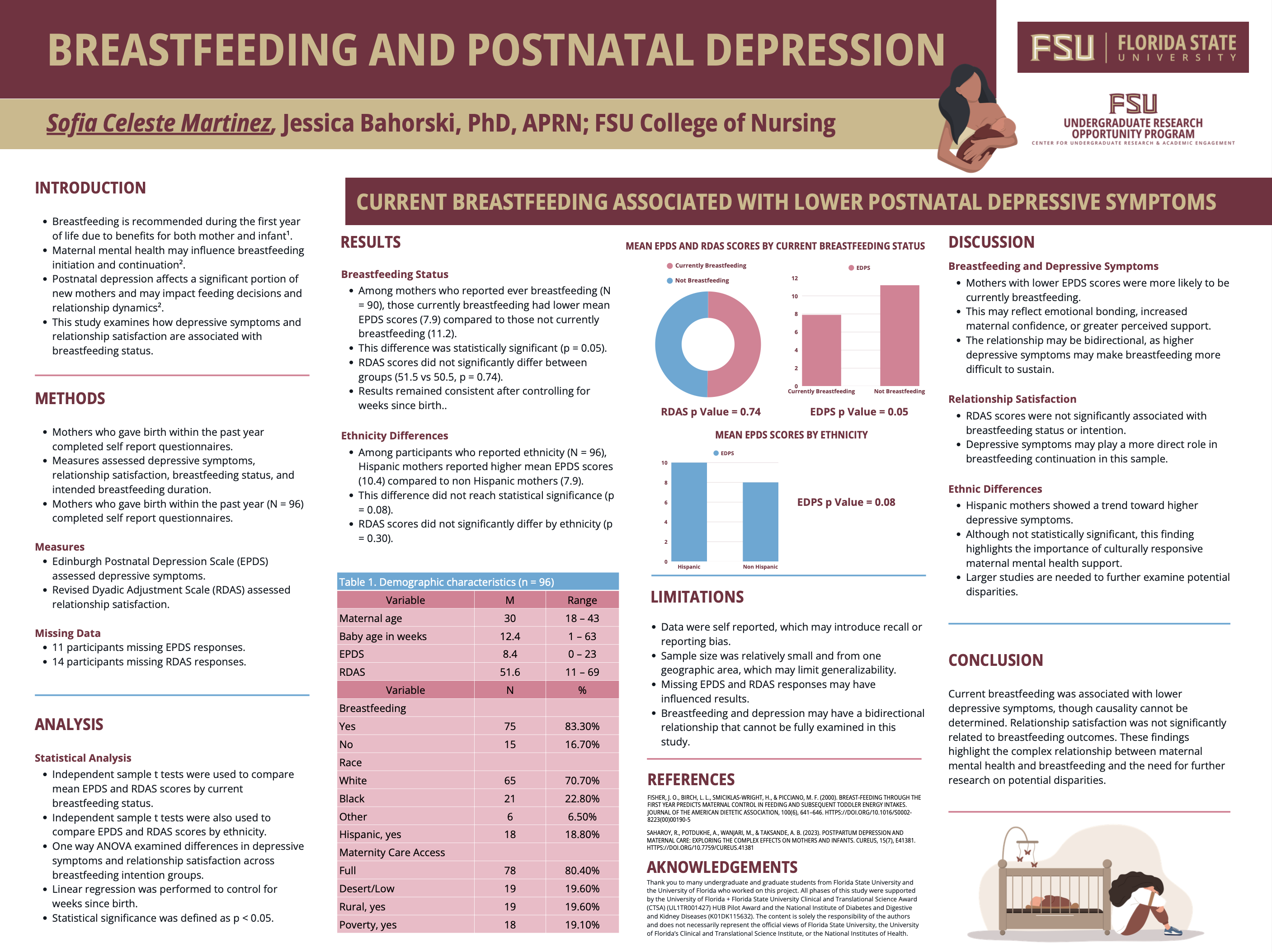
Breastfeeding is recommended for the first year of life. Maternal support and mental health can influence breastfeeding. The goal of this research is to explore how a mother’s relationship and depression correspond to breastfeeding.
Mothers who gave birth within the year completed two validated measures: the Revised Dyadic Adjustment Scale (RDAS), which evaluates relationship satisfaction, cohesion, and agreement with a partner; and the Edinburgh Postnatal Depression Scale (EPDS), which screens for postnatal depressive symptoms. These scores were compared to current breastfeeding status and breastfeeding intention. Statistical tests included t tests and ANOVA, with linear regression used to control for weeks since birth.
For mothers who reported ever breastfeeding (N=90), the moms who were currently breastfeeding had a lower mean EPDS score (7.9) compared to those who were not currently breastfeeding (11.2), this difference was significant (p=0.05). RDAS scores were similar between groups and did not reach statistical significance (51.5 breastfeeding vs. 50.5 not breastfeeding; p=0.74). Results remained consistent when controlling for weeks since birth. Among the mothers who were currently breastfeeding (N=75), breastfeeding intentions (less than 6 months vs. 6–12 months vs. over 12 months) were not related to EPDS scores (p=0.96) nor RDAS scores (p=0.88).
Mothers who were currently breastfeeding reported lower depressive symptoms than those who were not breastfeeding. This may suggest that breastfeeding promotes emotional closeness and confidence, which improves maternal wellbeing. It is also possible that mothers experiencing higher depressive symptoms may find breastfeeding more challenging to sustain, which could reduce the duration of breastfeeding.
Keywords: Postpartum, Maternal, Infant, Women, Depression