
Research Symposium
26th annual Undergraduate Research Symposium, April 1, 2026
Melanie Polanco Poster Session 2: 10:45 am - 11:45 am / Poster #242

BIO
Melanie Polanco is a current Sophomore majoring pursuing a Bachelors of Science in Chemical-Materials Engineering with a minor in STEM Entrepreneurship. She is an Undergraduate Research Opportunity Program (UROP) student. Melanie is conducting research on corrosion mechanisms, their responses to conductive fluids, and their interactions with applied magnetic fields under the mentorship of Dr. Liu in the Department of Materials Science & Engineering. Her research is relevant to prospective nuclear fusion systems. Melanie's research involves design using modelling software such as AutoCAD & Fusion 360, as well as the creation and analysis, and data extraction of COMSOL Multiphysics simulations. She is interested in pursuing a career in advanced materials and energy systems and plans to continue with graduate studies in Materials Engineering.
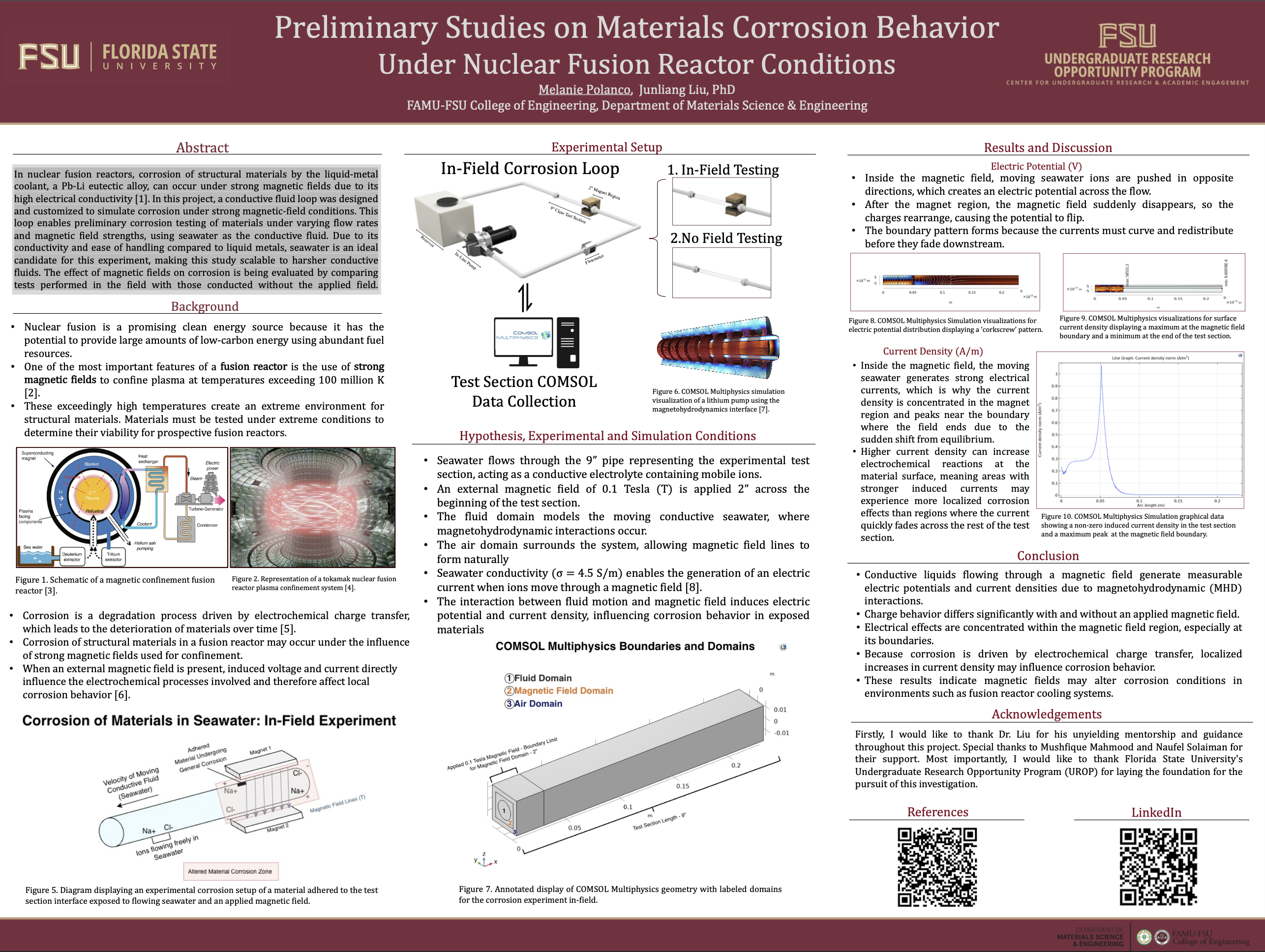
Preliminary Studies on Materials Corrosion Behavior Under Nuclear Fusion Reactor Conditions
Authors: Melanie Polanco, Junliang LiuStudent Major: Chemical-Materials Engineering
Mentor: Junliang Liu
Mentor's Department: Materials Science & Engineering Mentor's College: FAMU-FSU College of Engineering Co-Presenters:
Abstract
In nuclear fusion reactors, corrosion of structural materials by the liquid-metal coolant, a Pb-Li eutectic alloy, can occur under strong magnetic fields due to its high electrical conductivity. In this project, a conductive fluid loop was designed and customized to simulate corrosion under strong magnetic-field conditions. This loop enables preliminary corrosion testing of materials under varying flow rates and magnetic field strengths, using seawater as the conductive fluid. Due to its conductivity and ease of handling compared to liquid metals, seawater is an ideal candidate for this experiment, making this study scalable to harsher conductive fluids. The effect of magnetic fields on corrosion is being evaluated by comparing
tests performed in the field with those conducted without the applied field.
Keywords: Materials, Materials Engineering, Nuclear, Fusion, Energy