
Research Symposium
26th annual Undergraduate Research Symposium, April 1, 2026
Aubrey Donehoo Poster Session 3: 1:45 pm - 2:45 pm / Poster #107

BIO
Aubrey Donehoo is from Naples, FL and a senior majoring in Communication Sciences and Disorders. She will graduate in Fall 2026 and plans to pursue a master's degree in Speech-Language Pathology with the goal of becoming a licensed speech language pathologist (SLP). During her time at Florida State University, she worked under Dr. Richard Morris on his personal research and is now completing her Honors in the Major thesis project under his mentorship. Her research interests are primarily within voice and resonance, with a personal passion for the singing voice. Aubrey is especially interested working alongside vocal musicians and learning how clinical voice sciences can support vocal music performance and vocal health.
Developing a Voice Quality Survey: A Qualitative Review
Authors: Aubrey Donehoo, Dr. Richard MorrisStudent Major: Communication Sciences and Disorders
Mentor: Dr. Richard Morris
Mentor's Department: Communication Sciences and Disorders Mentor's College: College of Communication and Information Co-Presenters:
Abstract
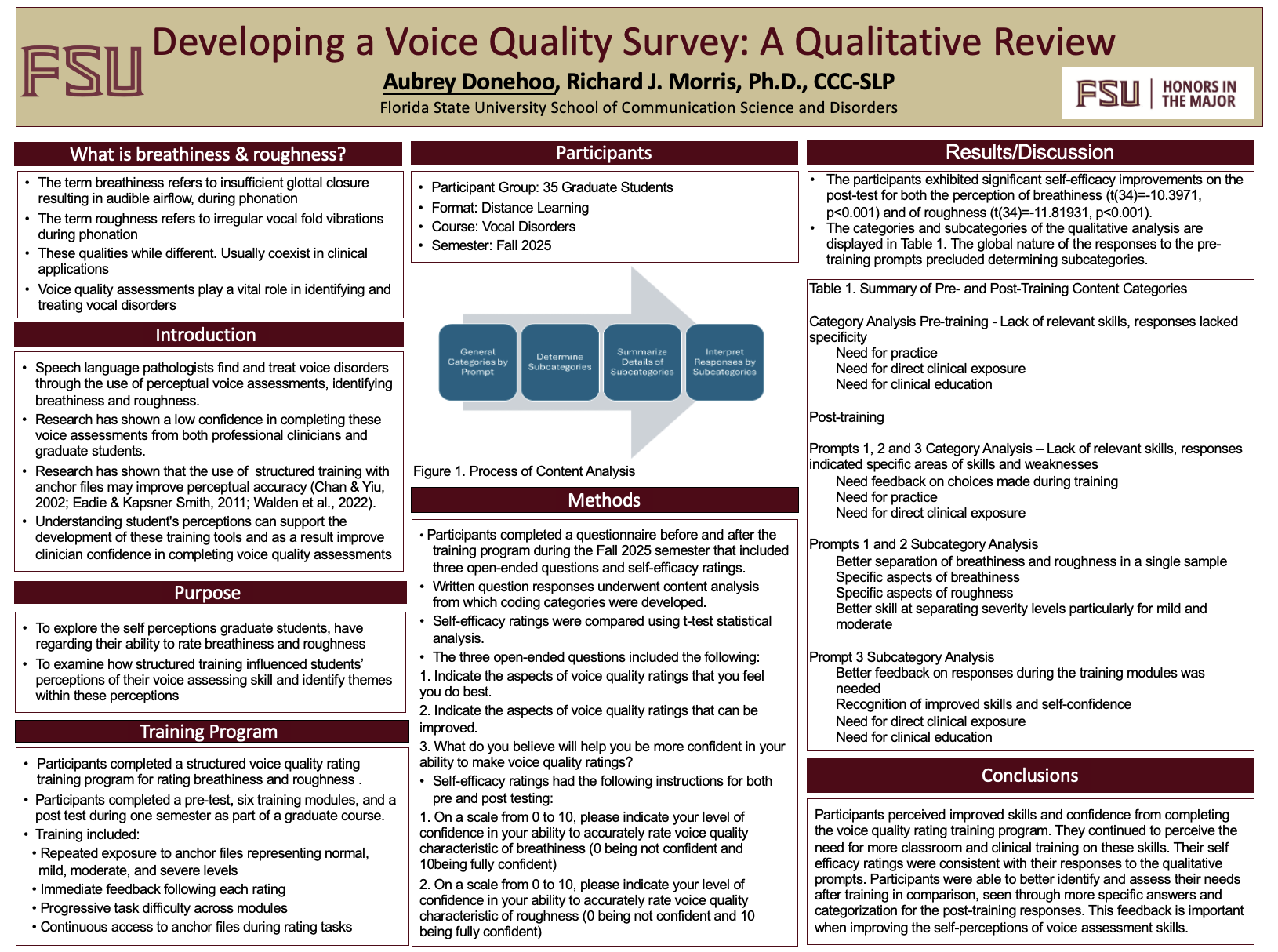
This Honors in the Major project explores how graduate students describe their self efficacy and experiences when learning to rate breathiness and roughness, two core dimensions of voice quality. Students and speech language pathologists often report low confidence and discomfort rating voice quality features. Previous research has demonstrated that structured training, such as repeated exposure to voice samples, the use of anchor samples, and guided reflective practice can improve the rating accuracy and consistency of students. However, less is known about how students feel regarding their own developing skills during this training process.
This qualitative study utilized pre and post training surveys consisting of two self efficacy ratings and three short answer prompts. The prompts ask students to identify aspects of voice quality rating they feel most confident in, areas needing improvement, and factors that would increase their confidence. When completed, the essay responses underwent a content analysis to identify the themes related to confidence, training construction, and clinical skills.
This study’s goal is to better understand how students think and feel about their developing perceptual skills and how these training modules influence their thoughts, with the overarching goal of guiding future instructional approaches in voice assessment. Results show that the use of training modules improve student’s personal confidence in performing voice quality assessments and that there are extensive measures to be taken to increase clinical confidence this area of skill.
Keywords: voice, speech therapy, qualitative, vocal, breathiness, roughness