
Research Symposium
26th annual Undergraduate Research Symposium, April 1, 2026
Peter Fasano Poster Session 3: 1:45 pm - 2:45 pm / Poster #72

BIO
Peter Fasano is a HPMI Carbon Composites Researcher earning a Bachelor of Science in Mechanical Engineering and a Bachelor of Arts in Music with a focus on Jazz, Producing, and Acoustics with minors in Physics and Mathematics. His work at HPMI over two years has focused on making the properties of Carbon Nanotube Yarn composites accessible in two and three dimensions using textile methods through mentorship with Dr. Richard Liang. Advised by Dr. Christian Hubicki, he researched and compared methods of quantifying musical dissonance for means of microtonal pitch correction in the 2025 IDEA Grant program. He also explored microtonality creatively through compositions and Lumatone performance for the 2025 Presidential Showcase. His goal is to return to FSU for graduate school in Materials Science & Engineering pursuing a focus in materials for Nuclear Energy.
Z-Stitching CNT Yarns in Carbon Fiber for Thermal Isotropy
Authors: Peter Fasano, Dr. Richard LiangStudent Major: Mechanical Engineering & B.A. in Music
Mentor: Dr. Richard Liang
Mentor's Department: Industrial & Manufacturing Engineering Mentor's College: Engineering Co-Presenters:
Abstract
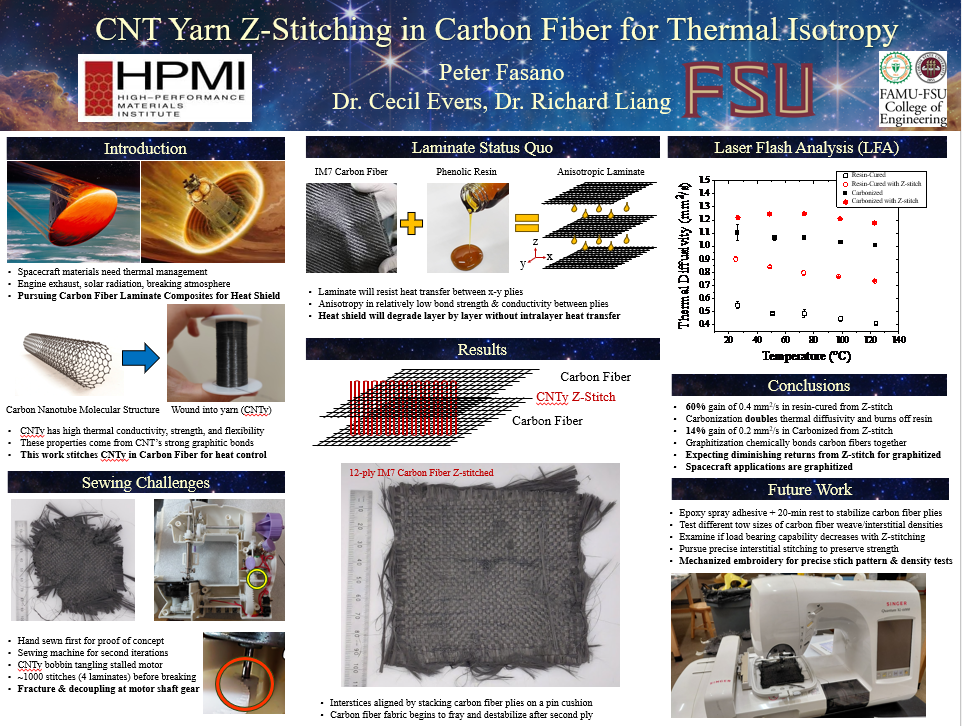
NASA aerospace structures need to withstand the heat from engine exhaust, solar radiation, and breaking atmosphere. The carbon/carbon laminates used in high-temperature applications are limited by their anisotropy. The high load-bearing, thermal, and electrical conductivity of these laminates are active in the x and y directions of each laminate ply, but are limited in between plies in the z direction. This work consisted of Z-stitching Carbon Nanotube yarns (CNTy) through IM7 carbon fiber plies to decrease anisotropy, providing a faster though-thickness route for heat conduction. CNC sewing and mechanized embroidery guarantee consistent CNTy density and interstitial stitching between pre-woven IM7 tows. The IM7 interstices are aligned manually by stacking plies atop a pin cushion. Laser Flash Analysis was used to measure thermal diffusivity. CNTy Z-stitching improved thermal diffusivity by 60% for a phenolic IM7 green-body composite, achieving 0.8mm^2/s. When carbonized, all thermal diffusivity is improved, reducing the impact of CNTy’s to a 14% increase, achieving 1.25mm^2/s. Z-stitched CNTy consistently reduces the carbon/carbon laminate’s thermal anisotropy.
Keywords: Thermal-Isotropy, Carbon-Nanotube-Yarn, Z-stitching, Anisotropy