
Research Symposium
26th annual Undergraduate Research Symposium, April 1, 2026
Samantha Sentell Poster Session 4: 3:00 pm - 4:00 pm / Poster #210

BIO
Sam is a second-year FSU student double-majoring in Biology and Environmental Science with a passion for ecology, evolution, and animal behavior. Her current research focuses on the courtship displays of the tropical lance-tailed manakin. In an effort to continue research after graduation, she hopes to pursue a PhD, ultimately striving for a career in conservation.
Temporal Variation in Lance-Tailed Manakin Practice Displays and Their Effect on Displays for Females
Authors: Samantha Sentell, Daniel GutiérrezStudent Major: Biology and Environmental Science
Mentor: Daniel Gutiérrez
Mentor's Department: Department of Biological Science Mentor's College: College of Arts and Sciences Co-Presenters: Jonluca Cortese and Jay Fire
Abstract
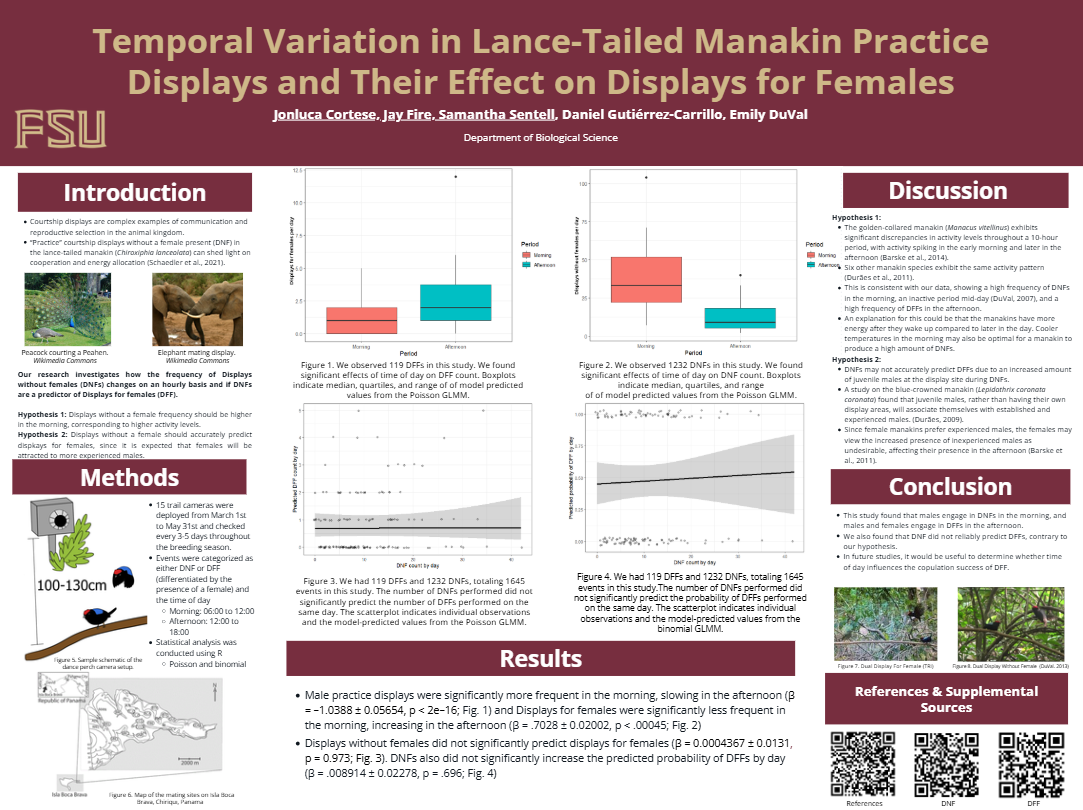
Courtship displays in birds are complex examples of communication and reproductive selection in the animal kingdom. Exploring variation in practice courtship displays in the lance-tailed manakin (Chiroxiphia lanceolata) can shed light on how species cooperate and how they allocate energy throughout the day. Males display in pairs to attract and court females. Even though males form alliances, only the alpha of the pair copulates if the display succeeds. These displays also occur without the presence of females, both in pairs and alone. In this study, we examined whether displays without females present (DNFs) can predict displays for females (DFF) and if time of day influences the frequency of DNFs. After analyzing hours of behavioral recordings during peak breeding season, it was found that there were significantly more displays without females present in the morning (06:00 to 12:00) than there were in the afternoon (12:00 to 18:00). DNFs were not a significant predictor of DFFs. The first set of results are consistent with the idea that manakins experience higher energy levels in the morning, resulting in increased display frequency. It is also possible that female manakins have different periods of activity; males potentially use DNFs as practice displays when females are not active in the morning. The second set of data can be explained by the fact that manakins have limited energy; the males would have to sacrifice extensive amounts of energy for an increased number of DNFs, leaving less energy for DFFs later in the day.
Keywords: Biology, Animal Behavior, Courtship Displays, Manakins