
Research Symposium
26th annual Undergraduate Research Symposium, April 1, 2026
Helen Rahou Poster Session 4: 3:00 pm - 4:00 pm / Poster #112

BIO
Helen is a transfer student from Jacksonville, Florida. She is an undergraduate student at Florida State University, majoring in Psychology with a minor in Social Work. Her goal is to build a career focused on supporting communities in need and improving the systems they rely on. She is passionate about applied research that addresses real-world challenges in service accessibility and communication. After earning her Bachelor of Science, she plans to pursue a Master’s in Clinical Mental Health Counseling, aiming for a career that integrates direct service, advocacy, and research-informed practices to enhance the quality of life for people facing barriers.
Role Ambiguity Among Therapists Working With CWS-Involved Parents: The Impact of Communication Breakdowns
Authors: Helen Rahou, Marisa LucianoStudent Major: Psychology
Mentor: Marisa Luciano
Mentor's Department: Human Development and Family Science (HDFS) Mentor's College: Anne Spencer Daves College of Education, Health, and Human Sciences Co-Presenters:
Abstract
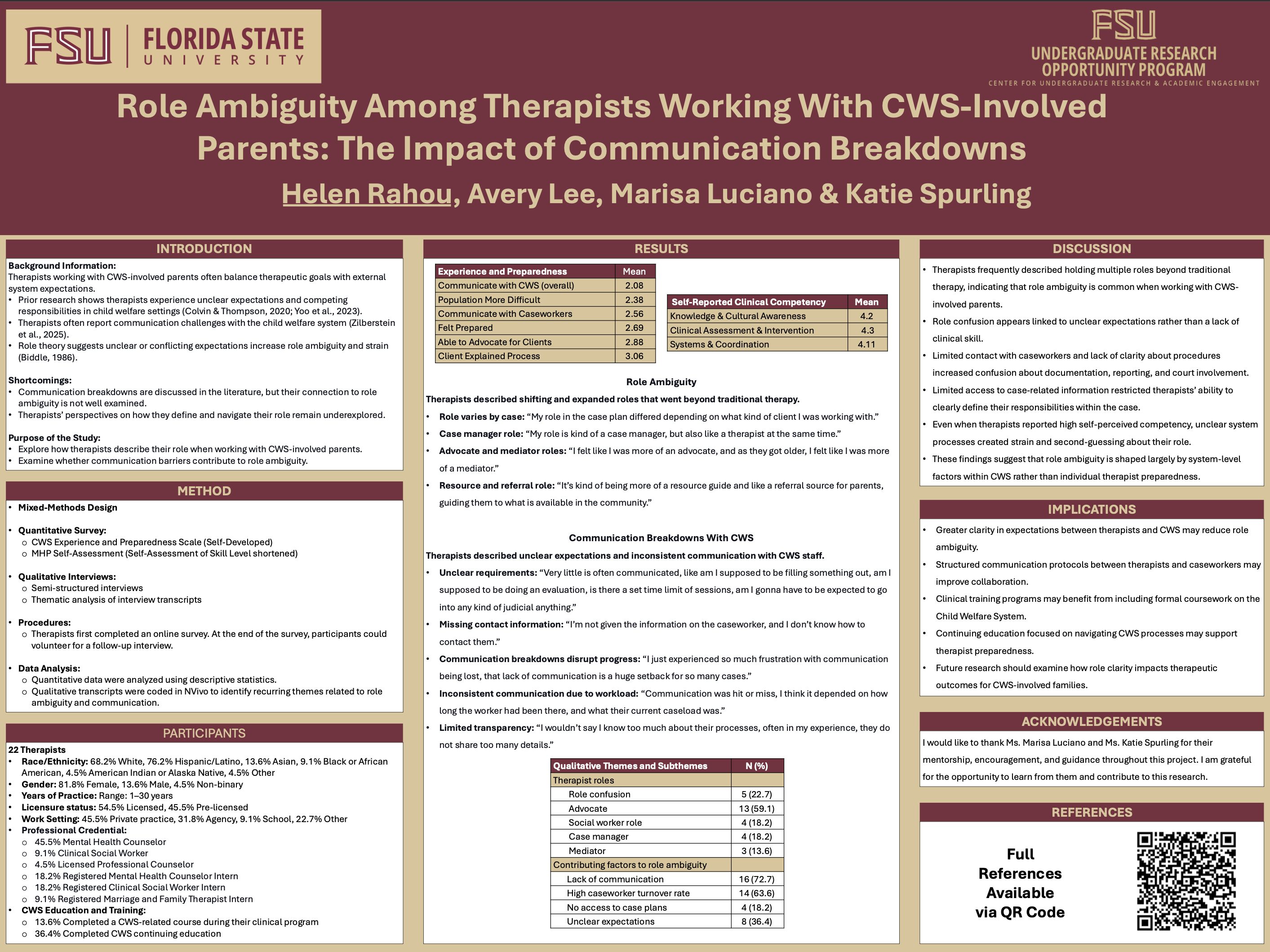
Therapists working with parents involved in the Child Welfare System (CWS) find themselves in complicated systems that include caseworkers, courts, and mandated treatment. This complexity creates uncertainty for many therapists as they navigate their professional roles, especially when they find that CWS's expectations conflict with traditional therapeutic values. This mixed-methods study examined what therapists report their role is when working with parents involved in CWS and potential communication barriers. The data collected was used to look at how therapists perceive their roles, communication with CWS, and comfort working with clients involving CWS. The qualitative data collected from the interviews was analyzed to explore the ways in which therapists understand and provide meaning to their role within child welfare. These two sources of data give both breadth and depth to our understanding of role ambiguity among therapists who work with parents dealing with CWS. Results of the study suggest that many therapists experience role ambiguity when working with parents involved in CWS. Quantitative results show that therapists experience a range of perceptions regarding their role clarity and their ability to communicate effectively with CWS. In addition, the emerging themes from the qualitative data indicate that many therapists are often expected to perform multiple and conflicting roles when working with parents dealing with CWS. Therefore, confusion about what is required of them, uncertainty about how to communicate effectively with CWS, and limited collaboration with CWS result in role strain and role confusion.
Keywords: Psychology. Therapy. Counseling. Social work. HDFS.